


Narrator: ‘Creating Destiny’ is about forming one’s fate rather than being bound by it. The Lesson of Learning to Create Destiny discusses the principle behind fate and the knowledge necessary to change it. By relating his own experiences and trials at changing destiny, Mr. Liao-Fan Yuan taught his son, Tian-Chi, not to be bound by fate, but rather to put forth his best effort in practicing kindness and eradicating wrong-doing.
One should not reject doing a kind act simply because it seems to be a minute goodness or commit a bad deed simply because it appears to be a small wrongdoing. If one practices in a proper manner, it is assured that one’s destiny can be changed. It is often said, "Refraining from all wrongdoing and practicing all forms of kindness brings about the reduction of disasters and the coming of good fortune." This is the principle behind creating one’s destiny…
Liao-Fan: My father passed away when I was young and mother persuaded me to learn medicine instead of becoming a scholar.
Mother: Learning medicine will be a good way to support yourself and to help others. Besides, having a skill, you will never have to worry about making a living and you can even become famous through your medical skills. This was always your father’s wish for you.
Liao-Fan: One day, at the Compassionate Cloud Temple, I met an elderly but distinguished looking man with a long beard. He had such a look of a sage that I immediately paid my respects to him. The old man told me…
Old Man: You are destined to become a government official. You can attain the rank of Erudite First Level Scholar next year, why aren’t you studying for the exam?
Liao-Fan: So I told him of my mother’s instructions to give up scholarly study for learning medicine. Then I asked for his name, birthplace and residence. He replied…
Old Man: My last name is Kong. I came from Yunnan Province. I have inherited the knowledge of Mr. Shao, who developed the art of prediction very well. By calculations, I am supposed to pass it on to you.
Liao-Fan: I led Mr. Kong to my home and told my mother about him. Mother told me to treat him well and said…
Mother: Since Mr. Kong is so good at predicting the future, he must also know our past. Let’s ask him and test his authenticity.
Liao-Fan: Consequently, I found Mr. Kong’s calculations to be very accurate, even in very small cases. After hearing his words of advice, I again thought about studying. I then consulted my cousin Shen-Chen. He recommended…
Cousin: My friend, Mr. Hai-Gu Yu is teaching at the home of Yo-Fu Sheng. It would be very convenient for me to take you there for boarding and studying.
Liao-Fan: This was how I became Mr. Yu’s student. Once again, Mr. Kong made a prediction for me.
Mr. Kong: As a student, you will place fourteenth in the county examination, seventy-first in the regional examination and ninth in the provincial examination.
Liao-Fan: The following year, at the three places of examination, I placed exactly as he had predicted. Then Mr. Kong calculated the predictions for my entire life.
Mr. Kong: You will pass such and such a test in such and such a year, you will become a civil servant in such a year and in such a year you will receive a promotion. Finally, you will be appointed as a magistrate in Szechwan Province. After holding that office for three and a half years, you will resign and return home. At the age of fifty-three, you will die around one o’clock in the morning on August 14th. It is a pity that you will not have a son.
Liao-Fan: I recorded and remembered all that he said. From then on, the outcome of every examination I took turned out exactly as Mr. Kong had predicted. Mr. Kong also predicted that I would be promoted only after receiving a salary in the weight of ninety-one dans and five dous of rice. However, I had received only seventy-one dans of rice when the senior educational official, Mr. Tu, recommended me for a promotion. I secretly began to doubt Mr. Kong’s predictions.
Liao-Fan: Nevertheless, the prediction turned out to be correct after all, because the recommendation was turned down by Mr. Tu’s superior, Mr. Yang. It was not until several years later when Mr. Chiu-Min Ying saw my old exam papers and exclaimed…
Mr. Ying: These five essays are as well written as reports to the Emperor! How can we bury the talents of such a great scholar?
Liao-Fan: Mr. Ying wanted the magistrate to issue an official order for me to become a candidate for ‘imperial student’ under his authority. After undergoing this eventful promotion, my calculations showed that I had received exactly ninety-one dans and five dous of rice. From then on, whether it was promotion, rank or wealth, I deeply believed that all came about in due time and that the length of one’s life is predestined.
I began to view everything in a more detached manner and ceased to seek gain and profit. After being selected as an imperial student, I was to attend the university at Beijing. During my yearlong stay at the capital, my interest in meditation grew and I often sat silently without giving rise to a single thought. I lost interest in books and did not study at all.
Before I was to enter the National University at Nanjing, I paid a visit to the enlightened Zen Master Yun-Gu at Chishia Mountain. We sat face to face in the Zen Hall for three days and nights without ever falling asleep. Master Yun-Gu questioned me saying…
Master Yun-Gu: The reason why ordinary people are unable to attain sagehood is because they have too many wandering and false thoughts running through their minds. In our three-day meditation, I have not observed the slightest wandering thought arise in you. Why is this so?
Liao-Fan: I replied, "Mr. Kong has clearly predicted the entire outcome of my life. I have seen that the time of life, death, promotion and failure are all predestined. There is no use or need for me to think about it or to desire anything. That is why you have not seen me give rise to a single wandering thought." Master Yun-Gu laughed.
Master Yun-Gu: I thought you were someone of remarkable capabilities! Now I realize you are nothing but an average, ordinary person!
Liao-Fan: Feeling confused by what he said, I asked the Master to explain.
Master Yun-Gu: An average person’s mind is forever occupied by wandering and imaginary thoughts, so naturally their life is bound by the chi of yin and yang as well as fate. We cannot deny the fact that fate exists, but only ordinary people are bound by it. Fate cannot bind those who cultivate great kindness.
Narrator: Because their virtues accrued from kind acts are so great that these acts will alter their ‘original’ destiny for the better.
Master Yun-Gu: The merits accrued can actually change their destiny from suffering to happiness, poverty to prosperity and short lives to long lives. Similarly, fate cannot bind those who commit great wrongdoing.
Narrator: When a person’s bad deeds are so great and powerful, they will cancel out the good fortune and prosperity predetermined in his original fate and his or her life can be transformed from good to bad.
Master Yun-Gu: For the past twenty years, you have lived your life according to Mr. Kong’s predictions and did not do a thing to change it. Instead, you became bound by your own fate. If you are not considered an ordinary mortal, then who is?
Liao-Fan: Taken aback, I proceeded to ask Master Yun-Gu, "According to you then, is it true that one can change one’s fate, that one can escape from it?" The Master answered…
Master Yun-Gu: We create our own fate. Good or bad fortune is also determined by ourselves. When I commit bad deeds, disasters are bound to strike. When I cultivate kindness, good fortune will naturally come my way. It says so in all the great ancient books of wisdom. In the Buddhist teachings, it is written that if one wishes for and seeks wealth, position, a son, a daughter or a long life, one can attain them. One only has to cultivate kind deeds in order to escape the control of fate. Since untruthful speech is one of the greatest offenses in Buddhist teachings, we can be assured that these are not lies. Buddhas and Bodhisattvas certainly have no reasons to deceive us.
Liao-Fan: I did not quite understand what he meant by "attaining all that one wished for" and so I asked him. Mencius once said…
Mencius: Whatever is sought for can be attained. The seeking is in oneself.
Liao Fan: This refers to inner qualities such as virtue, kindness and morality. These are all qualities we can work toward. However, when it comes to outside factors such as wealth, fame and prestige, how can we seek to attain them? Don’t these have to be granted by others in order to be achieved? The Master replied…
Master Yun-Gu: Mencius was correct, but you misinterpreted his meaning. Hui-Neng, the Sixth Patriarch of the Zen School has taught that…
Sixth Patriarch Hui-Neng: All the fields of merit are within one’s own heart. If one seeks from within, one can be in touch with all good fortunes and disasters. The outside is merely a reflection of the inside.
Master Yun-Gu: By seeking within ourselves, we cannot only attain the inner qualities of virtue, kindness and morality, but we can also attain wealth, fame and prestige.
Narrator: If wealth, fame and prestige are embodied in one’s fate, then one will attain them even without having to pursue them. If they are not, then one cannot attain them even through plotting and scheming.
Master Yun-Gu: Therefore, if one cannot reflect within one’s own heart but instead blindly seeks fame, fortune and long life from external sources, then this seeking will be in vain. Just as Mencius once said…
Mencius: In seeking, one needs to follow the right path. In attaining, one attains what destiny has entitled one to.
Narrator: Whatever is attained in the end is still part of one’s own fate.
Master Yun-Gu: If one tries to seek these qualities from the outside and even goes to the extent of committing bad deeds for them, then one will not only lose one’s inner qualities of virtue and kindness, but predetermined good fortune as well. Furthermore, wrongdoing committed in one’s greedy mind to obtain more can reduce the good fortune of one’s original fate. From this, we can see that no benefit is derived from blind seeking. What were Mr. Kung’s predictions regarding your entire life?
Liao-Fan: I told him in detail, from the placement positions in the examinations, to my appointment as an official and finally, the date of my death.
Master Yun-Gu: Do you feel you deserve imperial appointments or a son?
Liao-Fan: I reflected upon my previous deeds and attitudes in the past for a long time. Then I answered him saying, "No, I do not feel I deserve an imperial appointment or a son. Those who receive imperial appointments all have the appearance of good fortune and I do not. I do not work towards accumulating virtues to build up my good fortune, either. I am very impatient, intolerant and undisciplined, and speak without any restraint. I also have a strong sense of pride and arrogance. These are all signs of scant good fortune and non-virtue. How is it possible for me to receive an imperial appointment?"
Narrator: Next, we will see why Liao-Fan has no children. Liking cleanliness is a good thing, but it can become a problem if one becomes obsessive about cleanliness. There is an old saying, "Life springs from the dirt of the earth and water too clean often harbors no fish."
Liao-Fan: The first reason why I feel I do not deserve a son is that I am overly attached to cleanliness, resulting in the lack of thoughtfulness for others. The second reason is that…Narrator: …harmony is the cultivator of all life.
Liao-Fan: But I have a quick temper and easily become angry. The third reason is based on the principle that…
Narrator: …loving-kindness is the basis of reproduction and harshness is the root of sterility.
Liao-Fan: I overly guard my own reputation and cannot sacrifice anything for the sake of others. The fourth reason is that I talk too much which wastes a lot of chi, or energy. The fifth reason is that I also delight in drinking alcohol and that depletes my spirit.
Narrator: To remain healthy, one does not sleep during the daytime and stay up through the night.
Liao-Fan: The sixth reason I do not have a son is my habit of staying up nights, not knowing how to conserve my energy. Aside from these, I have many, many, other faults, which are too numerous to mention. Master Yun-Gu then said…
Master Yun-Gu: According to you then, there are many things in life you do not deserve, not only fame and a son!
Narrator: Both good and bad fortune are formed from one’s heart. Wise people know that everything they achieve or fail at in life are only consequences of their own actions and thoughts. Only an ignorant person assumes that all is the work of fate and destiny!
Master Yun-Gu: Those who have millions of dollars in this life must have cultivated the good fortune worthy of that amount in the past. Those who have thousands of dollars must also have good fortune, which is worthy of generating that sum. Those, who die of starvation, in fact were meant to die in that manner. We must understand that their own past thoughts and actions created the fate of these people; the karmic result today is simply the fruit of their deeds. Heaven does nothing more than punish bad beings with the suffering they deserve and reward kind ones with the good fortune they deserve.
Narrator: The following section is Master Yun-Gu’s advice to Liao-Fan, using the views of ordinary people, persuading him to cultivate virtue.
Master Yun-Gu: Bearing children is similar to bearing fruit from seeds. If the seeds are planted well, the fruits will flourish. If the seeds are not planted well, then the fruits will become malnourished. For example, if a person has accumulated enough merits and virtues for a hundred generations, then he or she will have descendants to last a hundred generations.
One who accumulates enough merits and virtues to last ten generations will then have ten generations of descendants to live out that good fortune. The same goes for three generations or two generations. For those who have no descendants at all, it is because they have not accumulated enough good merits and virtues. They may have amassed offenses instead!
Now that you recognize your own shortcomings, you can work to change and reform the misdeeds, which cause you to not have a child or become an imperial official. You would do well to cultivate virtue and tolerance and to treat others with compassion and harmony. Also, care for your health and conserve your energy and spirit.
Live as though everything of the past dissolved yesterday and all of the future begins today. If you can accomplish this, then you are a person born anew. If even our physical body is governed by the law of fate, then how can a mind of virtue and discipline not evoke a response from heaven? As said in the Tai Ja Chapter in The Chinese Book of History…
Narrator: "One may run from the decrees of heaven, but one can never escape the retribution for one’s own wrong deeds." In other words, one can alter the retribution due from past deeds, but if one continues to behave immorally, then there is no chance of avoiding disaster.
Master Yun-Gu: It is also said in the Book of Poems…
Narrator: "People should often reflect upon their own thoughts and actions to see if they accord with the ways of heaven. If one practices in this way, then good fortune will come without being sought. The choice to seek good fortune or to bring about adversity is all up to the individual."
Master Yun-Gu: Mr. Kong had predicted that you would not receive an imperial appointment or have a son. We can think of these as the decrees of heaven, but even that can still be changed. You only need to reform your improper ways, practice kind deeds and work to accumulate merits and virtues. These are your own transactions to create good fortune, no one can take it away. How is it then possible that you will not get to enjoy it?
Narrator: The I Ching, Book of Change, was written to help kind people bring about good fortune and avoid adversity.
Master Yun-Gu: If everything is predestined with no room for change, how can we improve upon our good fortune and avoid adversity? The very first chapter of The I Ching, Book of Change also said…
Narrator: "Families who often perform kind deeds will have an excess of good fortune to pass on to the next generations."
Master Yun-Gu: Do you believe in this?
Liao-Fan: I understood and believed the Master and gratefully paid my respects to him. Then I began to regret all my past wrongdoings, whether large or small, in front of the Buddha image. I wrote down my wish to pass the imperial examinations and vowed to complete three thousand meritorious deeds to show my gratitude towards ancestors, earth and heaven. Upon hearing my vow, Master Yun-Gu showed me a chart and taught me how to keep a daily record of the kind and unkind acts I committed. He told me that bad deeds could neutralize the merits I had accrued from good deeds. The Master also taught me how to recite the Jwun Ti Mantra; a way to train my mind for single-minded concentration. Only with a pure and unscattered mind could what I seek for come true. Master Yun-Gu then said…
Master Yun-Gu: It is said, "Those who are considered experts in the art of writing mantras but do not know the right way to do it will be laughed at by spirits and gods." The secret behind writing mantras is the absence of thought from start to finish. In the process of drawing, one must not give rise to a single wandering thought; even kind thoughts have to be let go of. Only under these circumstances can a mantra be successful. When one asks for or seeks something in terms of changing fate, it is important that one does it when the mind is still. In this way, wishes will be easily fulfilled.
Master Yun-Gu: Mencius stated in his "Principle of Forming Destiny" that…
Mencius: There is no difference between a long life and a short life.
Master Yun-Gu: At first glance, one would find this hard to understand. How can long life and short life be the same? In actuality, when we look within our hearts, we will find no duality, no difference. We will see everything with eyes of equality and live morally regardless of good or bad times. If one can practice accordingly, then one can master the fate of wealth and poverty. Therefore, when we are able to create and form our own destiny, it does not matter whether we are presently rich or poor.
Narrator: Just as a wealthy person would do well to not become careless in thoughts and actions because he or she is rich, a poor person would not resort to committing improper deeds due to poverty. In either case, one needs to meet one’s responsibilities and to be a virtuous person.
Master Yun-Gu: If one can practice morality regardless of conditions, then he or she will surely change a poor life into a prosperous one, and a prosperous life into an even longer lasting prosperity. One should also look upon long life and short life equally. A person who knows he or she is short-lived should not think, "I am going to die anyway, so there’s no point in being virtuous, I should steal and kill for my benefit while I can."
Narrator: Instead, one who already knows he or she has a short life to live can be even more diligent in cultivating kindness, hoping to gain a longer life next time and then perhaps the merits from practicing kindness can even lengthen the present life.
Master Yun-Gu: One who is long-lived should not think, "I have all the time in the world, it does not matter if I do something bad once in while."
Narrator: A long life does not come easily. It is to be cherished and used to cultivate even more kindness and virtue. Otherwise, we may very well use up our long life all too soon.
Master Yun-Gu: One who understands this principle, will be able to change a short life into a long life through virtuous behavior.
The issue of life and death is the most critical issue of one’s life. Therefore, long life and short life is also the most important issue to us. The same applies to wealth and poverty, good or bad reputation. The issue of long life and short life encompasses all of these.
Narrator: That is why Mencius did not need to mention the latter in his principle of creating destiny, since he had already spoken about long and short life.
Liao-Fan: Master Yun-Gu then told me about Mencius’ teaching on cultivating the self.
Master Yun-Gu: One who wishes to cultivate needs to do so daily and to be mindful of his or her conduct every moment, ensuring that no transgressions are made. As for changing one’s destiny, that depends on the accumulation of merits, seeking for a response from the heavens. When cultivating, one needs to be aware of one’s own faults and resolve to correct them just as in curing a sickness.
Perseverance is required and attainment comes when one’s practice matures and ripens. In that case, one’s destiny will most definitely change for the better. We should work toward severing all bad habits and thoughts. It would be quite an accomplishment for the true benefits of these teachings to be felt once one reaches the state of ‘no thought.’
The actions of worldly people usually follow their thoughts. Whatever has to be ‘thought’ is not considered natural. I know that you are still unable to accomplish the state of ‘no thought’, but if you practice reciting the Jwun Ti Mantra continuously, it will help you to overcome scattered thoughts. When you recite, you must not think of reciting, but recite consciously and diligently without any attachment. When the reciting becomes second nature, it will be effective.
Narrator: The essence of this practice can only be understood after one practices it.
Liao-Fan: My name used to be Shuei-Hai, which meant ‘broad learning’, but after receiving these teachings from Master Yun-Gu, I changed it to Liao-Fan, which means ‘transcending the ordinary.’ It signified my understanding of the fact that we create our destiny and that I did not wish to be like worldly people, who allowed destiny to control them.
From then on, I began to be constantly aware of my thoughts and actions. I was very cautious and careful in whatever I thought or did. Soon I felt quite different from before. In the past, I used to be careless and lived my days in distraction and had no self-discipline at all.
Now, I find myself being naturally respectful, careful and conservative in my thoughts, speech and actions. I maintain this attitude even when I am alone, for I know that there are spirits and gods everywhere who can see my every action and thought. Even when I encounter people, who dislike or slander me, I can take their insults with a patient and peaceful mind and not feel compelled to quarrel with them.
The year after I met Master Yun-Gu, I took the preliminary imperial exam in which Mr. Kong had predicted I would come in third place. Amazingly, I came in first! Mr. Kong’s predictions were beginning to lose their accuracy. He had not predicted I would pass the imperial exam at all, but that autumn, I did! None of these were part of my original destiny. Master Yun-Gu had said that…
Master Yun-Gu: Destiny can be changed.
Liao-Fan: And now I believe it more than ever! Although I had corrected many of my faults, I found that I could not wholeheartedly do the things I ought to do. Even if I did do them, it was forced and unnatural. I reflected within and found that I still had many shortcomings.
Narrator: Such as seeing an opportunity to practice kindness and not being eager enough to do it, or harboring doubts when helping others in need.
Liao-Fan: Sometimes I forced myself to act kindly, but my speech was still untamed and offensive. I found I could contain myself when sober, but after a few drinks, I would lose self-discipline and act without restraint. Although I often practiced kind deeds and accumulated merits, my faults and offenses were so numerous, they seemed to outnumber my good deeds. A lot of my time was spent vainly and without value. It took me more than ten years to complete the three thousand meritorious deeds I had vowed to do.
I was not able to dedicate the merits from these three thousand kind deeds at a temple until I returned to my hometown in the south a few years later. Then I made my second wish and that was for a son. I vowed to complete another three thousand good deeds. A few years later, your mother gave birth to you and named you Tian-Chi.
Every time I performed a kind deed, I would record it in a book. Your mother, who could not read or write, would use a goose feather dipped in ink and make a red circle on the calendar for every kind deed she did. Sometimes she gave food to the poor or bought living creatures from the marketplace to free in the wild. She recorded all of these with her circles on the calendar. At times, she could accumulate more than ten red circles in one day!
Everyday we practiced like this and in four years, the three thousand deeds were completed. Again, I made the dedications, this time in our home. On September thirteenth of that same year, I made my third wish and that was to pass the next level of the imperial examination, the Jinshr level. I also vowed to complete ten thousand meritorious deeds. After three years, I attained my wish and passed the Jinshr level. I was also made the mayor of Baodi province. While in that office, I prepared a small book to record my merits and faults, and called it The Book of Disciplining the Mind.
Narrator: The book was called Disciplining the Mind in hopes of helping him avoid selfish and improper thoughts.
Liao-Fan: From that day, I recorded all my good and bad deeds in that book and kept it on my desk. Every evening, I would burn incense and make a report of my deeds to the heavens at the little altar in the garden. Once, your mother was concerned when she saw that I had not accumulated much merit and asked…
Tian-Chi’s Mother: In the past, I was able to help you in your accumulation of kind deeds and we were able to complete the three thousand meritorious deeds. Now, you have made a vow to complete ten thousand kind deeds and there are fewer opportunities to practice them here at the government residence. How long will it be before your vow can be fulfilled?
Liao-Fan: That night, after your mother spoke these words, I dreamed of a heavenly being and told him of my difficulty in completing the ten thousand kind deeds. The heavenly being said to me…
Heavenly being: When you became mayor, you reduced the taxes on the rice fields; that was a great kind deed and that deed itself was worth ten thousand merits. Your vow is already fulfilled!
Liao-Fan: As it turned out, the farmers in Baodi province had to pay a very high tax and when I came to office, I reduced the taxes on the rice fields by nearly half. But still, I felt strange...
Narrator: …how did the heavenly being know about the tax reduction? Liao-Fan still held doubts and wondered how a single deed could be worth ten thousand merits.
Liao-Fan: Coincidentally, the Zen Master Huan-Yu was traveling from the Five-Plateau Mountains and stopped in Baodi. I invited him to the government residence, told him of my dream and asked whether it was believable. Mater Huan-Yu said…
Master Huan-Yu: When doing kind deeds, one must be true and sincere and not seek any rewards or act with falsity. If one does a kind deed with such a true and sincere heart, then one deed can indeed be worth the merits from ten thousand kind deeds. Besides, your act of reducing the taxes in this province benefits more than ten thousand people; you have relieved the suffering of heavy taxes on all these farmers. The good fortune you will gain from this act will surely be great!
Liao-Fan: Upon hearing his words, I was overwhelmed with gratitude and immediately gave all my savings for him to take back to the Five-Plateau Mountains. I asked the Master to use the money for a food offering for ten thousand monks and to dedicate the merits for me.
Mr. Kong had predicted that I would die at the age of fifty-three. However, I survived that year with no illnesses although I did not ask the heavens for a longer life. Now I am sixty-nine and I have lived sixteen more years than what was destined! The Chinese Book of History had said…
Narrator: "The way of the Heavens is not determined and neither is one’s destiny. Destiny is not set, but is only created and determined by oneself."
Liao-Fan: These are all true, and I have come to understand that both good fortune and adversity are results of one’s own doings. These are truly the words of sages and saints! If one were to say that good fortune and adversity are all determined by the heavens, then I would consider that person to be ordinary.
Tian-Chi, my son, I wonder how your life will be? In any case of destiny we should always prepare for the worst; therefore, even in times of prosperity, act as if you were not and when things are going your way, be mindful of adversity. When you are wealthy, be mindful of poverty and when loved and respected by all, remain careful and conservative. When the family is greatly respected and revered, carry yourself humbly. When your learning is broad and deep, always think of it as slight and keep it humbly within.
Narrator: If one can cultivate the mind, then virtue and morality will grow and good fortune will increase on it’s own.
Liao-Fan: When ‘mindful of the past’, we can spread the virtues of our ancestors. When ‘mindful of the present’, we can conceal the faults of our own parents. This is what Mencius called…
Mencius: Parents caring for children and children caring for parents.
Liao Fan: When ‘mindful of the nation’, we can think of how we can repay its kindness to us and when ‘mindful of the family’, we can think of how to bring about good fortune. When ‘mindful of the outside’, think of how to help those in need around us, and when ‘mindful of within’, think of how to prevent wrong thoughts and improper actions from arising.
Narrator: These six contemplations are all positive ways to cultivate good character. If one can practice accordingly, one will surely become a truly honorable person.
Liao-Fan: One needs to be able to detect one’s faults everyday in order to correct them everyday. If one is unable to detect any faults in oneself, then improvement of character is out of the question. There are many intelligent people in the world who refuse to cultivate morality and virtue, and cannot put forth diligent effort in their work. Their failures later in life are owed to a single word - laziness.
Tian-Chi, the teachings of Master Yun-Gu are truly the most worthy, profound, real and proper teachings, and I hope you will study them closely and practice them with all your effort. You must use your time wisely and not let it slip by in vain.
(Article source: http://www.buddhanet.net/l1lesson.htm)
Contents
Introduction
First Lesson
Second Lesson
Third Lesson
Fourth Lesson
--------------------------------------
Technorati: Buddhism Buddha Buddhist Dharma Compassion Wisdom Religion Meditation Zen Philosophy Spirituality Inspiration Liao-Fan’s Four Lessons Insight
Wednesday, January 06, 2010
Liao-Fan’s Four Lessons - First Lesson: Learning to Create Destiny

Liao-Fan’s Four Lessons - Introduction
Liao-Fan Yuan originally wrote Liao-Fan’s Four Lessons in the sixteenth century in China. The book was intended to teach his son, Tian-Chi Yuan, how to recognize the true face of destiny, tell good from bad, correct one’s faults and practice kind deeds. It also provided living proof of the rewards and outcomes of people who practiced kind deeds and cultivated virtue and humility. Relating from his own experience at changing destiny, Mr. Yuan himself was a living embodiment of his teachings.
After reading this wonderful book, one may feel more open and confident towards life, and at the same time, courageously compelled to follow the example of Liao-Fan in changing one’s original destiny. Liao-Fan’s Four Lessons is truly a rare book which is not only precious to an individual’s spiritual needs, but is also capable of transforming unhealthy attitudes in today’s society.
While reading, one may wonder why the Chinese placed so much emphasis on examinations. In the past, studying was held in highest regard while all other occupations were considered ‘low-class.’ The Chinese government selected its officials through a system of meritocracy. Many levels of imperial examinations were given to all who wished to take them. It was very difficult to pass these tests and one had to be very learned and talented in writing essays.
Those who did pass had the chance to advance to high government positions and live a life of wealth and prominence. People who could not pass the examinations were not recognized, regardless of how smart or capable they were otherwise. This was why many youths of that time turned to studying for the exams in hopes of a prosperous future.
Since the original work of Liao-Fan was written in classical Chinese, it tended to be hard to read and understand. In the early 1900s, Mr. Zhi-Hai Huang added a detailed commentary to the book using contemporary Chinese. His edition of Liao-Fan’s Four Lessons became very popular and benefited many people of his time. However, as time went on, even Mr. Huang’s edition became too difficult for today’s readers, so the influence of this beneficial book was greatly reduced.
In view of this sad situation, The Foundation of Liao-Fan’s Four Lessons, which is dedicated to the reorganization, editing and reprinting of the book, initially sponsored the editing of The Brief Explanation of Liao-Fan’s Four Lessons. As a result they released an updated version of Liao-Fan’s Four Lessons as an audio book. The following edition is a further re-editing of the Foundation’s initial work. We hope that everyone will learn the spirit of Liao-Fan in changing one’s destiny and creating a brighter future for oneself, society, the nation and all the people of this world.
Contents
Introduction
First Lesson
Second Lesson
Third Lesson
Fourth Lesson
~End of Post~
--------------------------------------
Technorati: Buddhism Buddha Buddhist Dharma Compassion Wisdom Religion Meditation Zen Philosophy Spirituality Inspiration Peace Insight
心包太虚,量周沙界
 介尔之心,居于方寸,何能包许远佛土
介尔之心,昧者谓小达人大观,真妄无二,盖此妄心,全性而起,性既无边,心亦无际性如大海,心如浮沤。全海为沤,沤还匝海。盖真如不变随缘,随缘不变。既曰随缘不变,岂可以真妄而局大小哉。(出自《净土生无生论》)
阿弥陀佛是法界藏身,就是法身充满虚空宇宙,又说六方有恒河沙诸佛那么多,弥陀法身已经塞满整个虚空法界,那么六方恒河沙数诸佛,坐在何处?岂非无容身之处吗?
法身(梵语dharma—kaya,巴利语dhamma—kaya),指佛所说之正法,佛所得之无漏法,及佛之自性真如如来藏。这位仁者问得相当好,也蛮有趣的,我们应该明白,法身是无形无相的,非青、黄、赤、白、黑、蓝、靛、紫等颜色所能形容的,非大小长宽圆所能比拟的,弥陀法身固然充塞虚空,六方诸佛亦是法界藏身,充塞虚空,照理而说,应该拥挤得非常火爆才对,反而为什么不会互相挤压叫苦呢?或者挤得满身大汗呢?这位仁者啊!这就是诸佛甚深境界,不愧是真功夫!我们不应该以凡夫之情见,臆断诸佛空性世界,若以凡情测量佛境界,始终堕入我见我执,我见我执是入佛知见的大障碍,凡夫若能空我见,空我执,即能逐渐入佛见,所以,在学佛的历程,应转凡夫知见入佛知见,这是转凡入圣的根本关键所在。
梵网经云:“转一切见入佛见,佛见入一切见。”
法身与法身是相互无碍的,空(梵语sunya)与空亦无碍。譬如:一盏日光灯的光明照于暗室,暗室当下光亮起来,第二盏日光灯又打开,此日光灯之光明又照明在前日光灯之光明处,前日光灯之光明与后一盏日光灯之光明绝对不会相互排挤,你推我推的、你挤我挤的,当下光明与光明互不侵犯,互不排斥,反而相互包容。相互无碍、相互安住,二盏日光灯是如此,十盏、百盏、千盏、无量盏日光灯皆如是,日光灯这种美德实在值得赞叹,值得嘉许!诸佛法身与法身之间相互无碍,相互包容之美德,亦复如是。
又如众流百川流入大海,大海不嫌一切川流,川流之水与大海之水不相排斥,反而相互包容,相互无碍,打成一片,大海之雅量,能纵容百川众流,而不增不减,始终是大海一片,容多容少自在!诸佛法身充塞虚空,未曾增多,亦未曾减少;又如虚空,挖一个洞,未曾减少一空间,虚空添塞一个空间,亦未曾增加一个空间,虚空终不增不减,虚空与虚空不相互阻碍,而能相互包容;无量诸佛之法身充满虚空,亦复如是!
法身是解脱甚深之境,与般若性空正等相应,非凡情所能揣测得知,已超乎时度空间,非语言文字所能描述,言语道断,心行处灭,一落入知见即成障道。
法身之德,大之无外,小之无内,大能容小,小能容大,大不碍小,小不碍大,大小亦不可得,纵横三千大千世界,自在无碍,分身无量百千万亿化身于一刹那,如是穷劫欲赞叹法身之德,终无是处。(如本法师著《佛学问答》).
(文章原址:http://www.dizang.org/wd/fx/023.htm)
~End of Post~
--------------------------------------
Technorati: Buddhism Buddha Buddhist Dharma Compassion Wisdom Religion Meditation Zen Philosophy Spirituality Inspiration 心包太虚,量周沙界 Insight
Monday, November 16, 2009
Take Charge of Your Practice
Years ago, Dzigar Kongtrul Rinpoche realized that if he didn’t take charge of his schedule, it would take charge of him. His advice? Organize your schedule, let go of distractions, and make a clear aspiration to practice.
Nowadays, even older people in their seventies feel they have a lot of time to fool around. I don’t know where this comes from. Maybe it’s because in modern cultures people stay healthier, active, and mobile longer due to a better diet, more vitamins, and the latest medicines. Elderly people also have more things to distract themselves with: packaged holiday cruises, workshops, and different kinds of physical activities. You hear people say, “The forties are the new thirties, and the fifties are the new forties…” People put a lot of effort into staying and looking young. This kind of thinking changes our concept of aging and how we relate to growing old.
When I first came to the West, most of my students were quite young, except for a dedicated group of women who were forty and older. They started a dharma study group, which they affectionately called the old ladies’ group. I asked one of my older students in her seventies if she attended the old ladies’ group, and she got offended. People are a little eternalistic in this way.
In more traditional cultures, seventy is considered old, and people have no problem saying so. These cultures recognize old age as a time to prepare for death. People who in their youth engaged in naughty, unwholesome behavior often start to soften and go in the direction of practice as they get older. Instead of being diligently naughty, they diligently dedicate their remaining years to saying mantras and doing prostrations and prayers. I see this happen all the time, even in myself.
In Tibet, as people age their children will say, “Mom, you’re getting old, go do some mantras and circumambulations!” This has a dual function: the children know this will get their parents out of their hair, but it is also a cultural push—a push to prepare for death. People expect this; it helps them get ready.
It’s good to look at life pragmatically, rather than as how we might want it to be. Taking care of our bodies is intelligent enough; we certainly don’t want to get old and infirm prematurely. We don’t want to lose our sense of curiosity and interest in life, our spark. But the focus on prolonging life rather than accepting death is futile. Youth goes by in a flash, and then we enter adulthood and old age. That’s about it. Patrul Rinpoche suggests we look at our life cycle as the length of a day: infancy at dawn, childhood and adolescence in the morning hours, adulthood at noon, and old age with the setting of the sun. If you want to prepare the mind for death, putting time into perspective is a realistic thing to do.
Organizing Your Time
I’m not a planner by nature, but some years back I realized that if I didn’t take charge of my schedule, it would take charge of me. So now I fill my schedule with as much dharma practice and activity as I can. I fill the pages of my calendar—one year in advance—with my mind’s intention, then I follow and meet it. I know how many hours of practice I want to do each day, and I organize my time to complete that. I figure, this is my life, and if I don’t take charge no one else will. I find myself thinking a lot about time, how much I have, and what I want to do with it.
Practically speaking, there are only twenty-four hours in a day. How do we want to spend them? Some of that time we need to sleep. But how much sleep do we actually need? More than seven or eight hours usually doesn’t support us, unless of course we are a teenager. Most of us have jobs. We may work nine hours a day—that seems standard. This still leaves us with seven or eight hours of spare time. Then there are family obligations, and we need to tend to those with care. With our remaining hours, how can we fit practice time into our lives?
I am a night person, so I practice late at night. Some people prefer to start before dawn. These are quiet hours—guaranteed practice periods—because everyone else is asleep, or maybe practicing too. Sometimes at night I get sleepy, but when I stay with it for a bit, I find a whole new reserve of energy that sustains me throughout my session. Anything that brings our actions together with our intentions energizes us and brings deep meaning to our lives. I used to have trouble sleeping, but now that I have a regular practice schedule, I have a restful unbroken sleep.
Making a Clear Decision
If we have an aspiration to practice, we should make a clear decision to do so. It won’t help to have a “split mind.” In Tibetan there is a term: yi nyi te tsom. Yi nyi means that we have two minds, or in other words, conflicting interests. Te tsom means that we have doubts concerning which way we want to go. We may want to practice, yet somehow we fail to bring our aspirations together with our actions.
I see a lot of people wanting to practice yet not finding the time. It affects their self-esteem. We need to ask ourselves what prevents us from meeting our aspirations in life. Are we using our life well, or are we simply working to maintain it? How are we using our time? Are we considering what’s at stake? Are we tending to our desire for a meaningful life, or are we simply avoiding it? If so, why?
How we spend our time depends on how we organize our time, and how we organize our time depends on how we envision our lives. Once we have sorted out these questions and have made a clear decision to make room in our lives for practice, we have to exert ourselves rather than let the mind become too loose and unorganized, and just wait for something to happen.
Beware of Distraction
Distractions come in all sorts of disguises. Sometimes we feel we need to manage everyone else’s problems. If we have this tendency, there will always be someone who wants to pull us in, in some way. They want to consult, but they don’t necessarily want to hear what we have to say. They just want to vent. They feel stressed, and then we get stressed and no one profits in the end. Or, if in our work we are too meticulous and fixate on perfecting everything, we may never get anything done and run out of time for practice. We may also feel that we are the only ones who know how to do anything, so we end up doing everything. Some people can never say no. These kinds of distractions don’t even include the constant need for entertainment and fun, and all the foreign, high-maintenance elements we invite into our lives, such as puppies, personal-entertainment systems, and fancy computers.
Even in retreat, people can find all kinds of ways to occupy themselves and avoid practice, like spending hours each day pondering over their shopping lists. In India they say, “All you need are two chapattis a day.” I don’t think this means we need to subsist on two pieces of Indian bread a day, become a sadhu [an ascetic who renounces his body and all worldly things], or rough it. I think this is a metaphor for doing without. How much do we actually need? How often do we get distracted by what we want and figuring out how we can get it? Can we free ourselves from this kind of distraction through simply doing without? Whatever our tendency, it won’t do much good to blame anyone else for our distractions. Kunchyen Longchenpa said, “Distractions are limitless; only when you quit them will they leave.”
A Relaxed and Open Mind
If we don’t have a focus, we meander around like a restless tiger, not finding any pleasure in anything. We find ourselves laying on the bed, then turning on the TV and flipping through the channels, eating when we’re not hungry, then picking up the phone. What are we trying to do? We are trying to connect with the phenomenal world. But how can we when we are not connected inwardly?
The times we don’t feel connected inwardly are the best times to practice. When our minds are restless, this might sound about as appealing as dental work. We are tormented and distracted by our thoughts, emotions, and fears. We come up with all kinds of physical sensations too. We have a pain in our neck, then it moves to our back, then our foot. All of a sudden we hear a ringing in our ears, or our eyes start to itch. It’s a little suspicious, don’t you think?
We need to give ourselves time to allow the nervous and restless energy to settle in our bodies. When the body rests, the mind rests. When the mind rests, the emotions rest, and we feel a profound sense of contentment and relaxation, or shenjong. When the mind relaxes in a state of shenjong, it is available to us, to serve us or at least help us understand what’s up. The space of shenjong means less vulnerability, so our thoughts and emotions cannot simply shove us around and rough us up as they usually do. All our fatigue falls away. The heart clears. The body lightens and feels as weightless as feather.
It Takes Might and Clarity
We need a little strength to resist the habit of grasping at distractions, even if we are halfway in. We don’t want to be like a freshwater salmon that swims all the way upstream, and just when it is halfway into a bear’s mouth, rather than trying to wiggle out, thinks, “Oh well, I’m halfway in anyway.” Wiggling out of distraction takes some might and clarity.
I’ve heard people say, “I’m too lazy and love my ego too much to dedicate my time to practice.” That kind of laziness and lack of intention will never support realization. The Buddha said that if flies, grubs, and bacteria had a capacity to aspire for enlightenment, they would attain it. That would be embarrassing, wouldn’t it? A grub attaining enlightenment before we did. In the sutra it says, “All things are circumstantial.” The circumstances we need are created by the might and clarity of our intention and how we carry it out in our lives.
It’s not as if we have no diligence. The alarm rings, it’s 4 a.m. The temperature has dropped into the single digits. We don’t want to get out of bed, but it’s Monday and there will be consequences. We get up. We scrape the snow off the windshield, heat up the car, and head to work for nine hours, maybe more. To do this every morning takes a little vision, a little might and clarity. Surely if we can do this, we can find a little time to practice.
A Modern-Day Mango Grove
If we can put time into perspective, organize our schedules, wiggle out of distraction with might and clarity, and think about what makes life meaningful, we will surely find time to practice, to relax the mind. Ordinarily, relaxing means taking our minds off our daily routine, laying on the couch, and watching a movie or going to sleep. Usually relaxing means distracting ourselves from the stresses of daily life. But we have spent half our lives sleeping without ever feeling rested. This is because we haven’t focused on relaxing the mind itself.
What could be more relaxing than letting go of preferences and worries? What better way is there to reduce our self-clinging than by contemplating bodhichitta? What can liberate our hopes and fears other than letting them arise and disassemble themselves naturally in the space of an open mind? Meditation leaves plenty of room for everything: all of our hopes, fears, and anxieties as well as our joys and aspirations. There is no need to control our thoughts, because when we practice we have committed ourselves to letting them be—not judging them as good or bad, spiritual or not spiritual, helpful or harmful. Is there any other activity that can accommodate the mind and its various arisings in this way?
The only thing we need to practice is a quiet place to sit: a room, a park bench, or our own bed. The sutras describe a peaceful mango grove as an ideal place to practice. The Buddha and his disciples practiced meditation in such a place. If you think about it, in the midst of our busy lives, any quiet place to sit can be our modern-day mango grove.DZIGAR KONGTRUL RINPOCHE is a lama in the Nyingma tradition of Tibetan Buddhism. Born in Northern India, he was recognized as a reincarnation of the Rimé master Jamgon Kongtrul Lodro Thaye and raised in a monastic environment. In 1989 he moved to the United States with his family, where he founded his own teaching organization, Mangala Shri Bhuti. He is the author of Light Comes Through and It’s Up to You.
(Article Source: http://www.thebuddhadharma.com
--------------------------------------
Technorati: Buddhism Buddha Buddhist Dharma Dzigar Kongtrul Rinpoche Wisdom Religion Meditation Zen Philosophy Spirituality Inspiration Take Charge of Your Practice Insight

Saturday, October 24, 2009
The Buddha as a Businessman
~End of Post~
--------------------------------------
Technorati: Buddhism Buddha Buddhist Dharma Compassion Wisdom Religion Meditation Zen Philosophy Spirituality Inspiration Peace Insight
Friday, October 23, 2009
Vipassana in India Prison
--------------------------------------
Technorati: Buddhism Buddha Buddhist Dharma Compassion Wisdom Religion Meditation Zen Philosophy Spirituality Inspiration Peace Insight
King Asoka - The Movie
~End of Post~
--------------------------------------
Technorati: Buddhism Buddha Buddhist Dharma Compassion Wisdom Religion King Asoka Zen Philosophy Spirituality Inspiration Peace Insight
Thursday, October 22, 2009
Buddhist Economics by E. F. Schumacher

Buddhist countries have often stated that they wish to remain faithful to their heritage. So Burma: “The New Burma sees no conflict between religious values and economic progress. Spiritual health and material well-being are not enemies: they are natural allies.” 1 Or: “We can blend successfully the religious and spiritual values of our heritage with the benefits of modern technology.” 2 Or: “We Burmans have a sacred duty to conform both our dreams and our acts to our faith. This we shall ever do.” 3
All the same, such countries invariably assume that they can model their economic development plans in accordance with modern economics, and they call upon modern economists from so-called advanced countries to advise them, to formulate the policies to be pursued, and to construct the grand design for development, the Five-Year Plan or whatever it may be called. No one seems to think that a Buddhist way of life would call for Buddhist economics, just as the modern materialist way of life has brought forth modern economics.
Economists themselves, like most specialists, normally suffer from a kind of metaphysical blindness, assuming that theirs is a science of absolute and invariable truths, without any presuppositions. Some go as far as to claim that economic laws are as free from "metaphysics" or "values" as the law of gravitation. We need not, however, get involved in arguments of methodology. Instead, let us take some fundamentals and see what they look like when viewed by a modern economist and a Buddhist economist.
There is universal agreement that a fundamental source of wealth is human labour. Now, the modern economist has been brought up to consider "labour" or work as little more than a necessary evil. From the point of view of the employer, it is in any case simply an item of cost, to be reduced to a minimum if it can not be eliminated altogether, say, by automation. From the point of view of the workman, it is a "disutility"; to work is to make a sacrifice of one’s leisure and comfort, and wages are a kind of compensation for the sacrifice. Hence the ideal from the point of view of the employer is to have output without employees, and the ideal from the point of view of the employee is to have income without employment.
The consequences of these attitudes both in theory and in practice are, of course, extremely far-reaching. If the ideal with regard to work is to get rid of it, every method that "reduces the work load" is a good thing. The most potent method, short of automation, is the so-called "division of labour" and the classical example is the pin factory eulogised in Adam Smith’s Wealth of Nations. 4 Here it is not a matter of ordinary specialisation, which mankind has practiced from time immemorial, but of dividing up every complete process of production into minute parts, so that the final product can be produced at great speed without anyone having had to contribute more than a totally insignificant and, in most cases, unskilled movement of his limbs.
The Buddhist point of view takes the function of work to be at least threefold: to give man a chance to utilise and develop his faculties; to enable him to overcome his ego-centredness by joining with other people in a common task; and to bring forth the goods and services needed for a becoming existence. Again, the consequences that flow from this view are endless. To organise work in such a manner that it becomes meaningless, boring, stultifying, or nerve-racking for the worker would be little short of criminal; it would indicate a greater concern with goods than with people, an evil lack of compassion and a soul-destroying degree of attachment to the most primitive side of this worldly existence. Equally, to strive for leisure as an alternative to work would be considered a complete misunderstanding of one of the basic truths of human existence, namely that work and leisure are complementary parts of the same living process and cannot be separated without destroying the joy of work and the bliss of leisure.
From the Buddhist point of view, there are therefore two types of mechanisation which must be clearly distinguished: one that enhances a man’s skill and power and one that turns the work of man over to a mechanical slave, leaving man in a position of having to serve the slave. How to tell the one from the other? “The craftsman himself,” says Ananda Coomaraswamy, a man equally competent to talk about the modern West as the ancient East, “can always, if allowed to, draw the delicate distinction between the machine and the tool. The carpet loom is a tool, a contrivance for holding warp threads at a stretch for the pile to be woven round them by the craftsmen’s fingers; but the power loom is a machine, and its significance as a destroyer of culture lies in the fact that it does the essentially human part of the work.” 5 It is clear, therefore, that Buddhist economics must be very different from the economics of modern materialism, since the Buddhist sees the essence of civilisation not in a multiplication of wants but in the purification of human character. Character, at the same time, is formed primarily by a man’s work. And work, properly conducted in conditions of human dignity and freedom, blesses those who do it and equally their products. The Indian philosopher and economist J. C. Kumarappa sums the matter up as follows:
If the nature of the work is properly appreciated and applied, it will stand in the same relation to the higher faculties as food is to the physical body. It nourishes and enlivens the higher man and urges him to produce the best he is capable of. It directs his free will along the proper course and disciplines the animal in him into progressive channels. It furnishes an excellent background for man to display his scale of values and develop his personality. 6
If a man has no chance of obtaining work he is in a desperate position, not simply because he lacks an income but because he lacks this nourishing and enlivening factor of disciplined work which nothing can replace. A modern economist may engage in highly sophisticated calculations on whether full employment "pays" or whether it might be more "economic" to run an economy at less than full employment so as to insure a greater mobility of labour, a better stability of wages, and so forth. His fundamental criterion of success is simply the total quantity of goods produced during a given period of time. “If the marginal urgency of goods is low,” says Professor Galbraith in The Affluent Society, “then so is the urgency of employing the last man or the last million men in the labour force.” 7And again: “If . . . we can afford some unemployment in the interest of stability—a proposition, incidentally, of impeccably conservative antecedents—then we can afford to give those who are unemployed the goods that enable them to sustain their accustomed standard of living.”
From a Buddhist point of view, this is standing the truth on its head by considering goods as more important than people and consumption as more important than creative activity. It means shifting the emphasis from the worker to the product of work, that is, from the human to the subhuman, a surrender to the forces of evil. The very start of Buddhist economic planning would be a planning for full employment, and the primary purpose of this would in fact be employment for everyone who needs an "outside" job: it would not be the maximisation of employment nor the maximisation of production. Women, on the whole, do not need an "outside" job, and the large-scale employment of women in offices or factories would be considered a sign of serious economic failure. In particular, to let mothers of young children work in factories while the children run wild would be as uneconomic in the eyes of a Buddhist economist as the employment of a skilled worker as a soldier in the eyes of a modern economist.
While the materialist is mainly interested in goods, the Buddhist is mainly interested in liberation. But Buddhism is "The Middle Way" and therefore in no way antagonistic to physical well-being. It is not wealth that stands in the way of liberation but the attachment to wealth; not the enjoyment of pleasurable things but the craving for them. The keynote of Buddhist economics, therefore, is simplicity and non-violence. From an economist’s point of view, the marvel of the Buddhist way of life is the utter rationality of its pattern—amazingly small means leading to extraordinarily satisfactory results.
For the modern economist this is very difficult to understand. He is used to measuring the "standard of living" by the amount of annual consumption, assuming all the time that a man who consumes more is "better off" than a man who consumes less. A Buddhist economist would consider this approach excessively irrational: since consumption is merely a means to human well-being, the aim should be to obtain the maximum of well-being with the minimum of consumption. Thus, if the purpose of clothing is a certain amount of temperature comfort and an attractive appearance, the task is to attain this purpose with the smallest possible effort, that is, with the smallest annual destruction of cloth and with the help of designs that involve the smallest possible input of toil. The less toil there is, the more time and strength is left for artistic creativity. It would be highly uneconomic, for instance, to go in for complicated tailoring, like the modern West, when a much more beautiful effect can be achieved by the skillful draping of uncut material. It would be the height of folly to make material so that it should wear out quickly and the height of barbarity to make anything ugly, shabby, or mean. What has just been said about clothing applies equally to all other human requirements. The ownership and the consumption of goods is a means to an end, and Buddhist economics is the systematic study of how to attain given ends with the minimum means.
Modern economics, on the other hand, considers consumption to be the sole end and purpose of all economic activity, taking the factors of production—and, labour, and capital—as the means. The former, in short, tries to maximise human satisfactions by the optimal pattern of consumption, while the latter tries to maximise consumption by the optimal pattern of productive effort. It is easy to see that the effort needed to sustain a way of life which seeks to attain the optimal pattern of consumption is likely to be much smaller than the effort needed to sustain a drive for maximum consumption. We need not be surprised, therefore, that the pressure and strain of living is very much less in say, Burma, than it is in the United States, in spite of the fact that the amount of labour-saving machinery used in the former country is only a minute fraction of the amount used in the latter.
Simplicity and non-violence are obviously closely related. The optimal pattern of consumption, producing a high degree of human satisfaction by means of a relatively low rate of consumption, allows people to live without great pressure and strain and to fulfill the primary injunction of Buddhist teaching: “Cease to do evil; try to do good.” As physical resources are everywhere limited, people satisfying their needs by means of a modest use of resources are obviously less likely to be at each other’s throats than people depending upon a high rate of use. Equally, people who live in highly self-sufficient local communities are less likely to get involved in large-scale violence than people whose existence depends on world-wide systems of trade.
From the point of view of Buddhist economics, therefore, production from local resources for local needs is the most rational way of economic life, while dependence on imports from afar and the consequent need to produce for export to unknown and distant peoples is highly uneconomic and justifiable only in exceptional cases and on a small scale. Just as the modern economist would admit that a high rate of consumption of transport services between a man’s home and his place of work signifies a misfortune and not a high standard of life, so the Buddhist would hold that to satisfy human wants from faraway sources rather than from sources nearby signifies failure rather than success. The former tends to take statistics showing an increase in the number of ton/miles per head of the population carried by a country’s transport system as proof of economic progress, while to the latter—the Buddhist economist—the same statistics would indicate a highly undesirable deterioration in the pattern of consumption.
Another striking difference between modern economics and Buddhist economics arises over the use of natural resources. Bertrand de Jouvenel, the eminent French political philosopher, has characterised "Western man" in words which may be taken as a fair description of the modern economist:
He tends to count nothing as an expenditure, other than human effort; he does not seem to mind how much mineral matter he wastes and, far worse, how much living matter he destroys. He does not seem to realize at all that human life is a dependent part of an ecosystem of many different forms of life. As the world is ruled from towns where men are cut off from any form of life other than human, the feeling of belonging to an ecosystem is not revived. This results in a harsh and improvident treatment of things upon which we ultimately depend, such as water and trees. 8
The teaching of the Buddha, on the other hand, enjoins a reverent and non-violent attitude not only to all sentient beings but also, with great emphasis, to trees. Every follower of the Buddha ought to plant a tree every few years and look after it until it is safely established, and the Buddhist economist can demonstrate without difficulty that the universal observation of this rule would result in a high rate of genuine economic development independent of any foreign aid. Much of the economic decay of southeast Asia (as of many other parts of the world) is undoubtedly due to a heedless and shameful neglect of trees.
Modern economics does not distinguish between renewable and non-renewable materials, as its very method is to equalise and quantify everything by means of a money price. Thus, taking various alternative fuels, like coal, oil, wood, or water-power: the only difference between them recognised by modern economics is relative cost per equivalent unit. The cheapest is automatically the one to be preferred, as to do otherwise would be irrational and "uneconomic." From a Buddhist point of view, of course, this will not do; the essential difference between non-renewable fuels like coal and oil on the one hand and renewable fuels like wood and water-power on the other cannot be simply overlooked. Non-renewable goods must be used only if they are indispensable, and then only with the greatest care and the most meticulous concern for conservation. To use them heedlessly or extravagantly is an act of violence, and while complete non-violence may not be attainable on this earth, there is nonetheless an ineluctable duty on man to aim at the ideal of non-violence in all he does.
Just as a modern European economist would not consider it a great achievement if all European art treasures were sold to America at attractive prices, so the Buddhist economist would insist that a population basing its economic life on non-renewable fuels is living parasitically, on capital instead of income. Such a way of life could have no permanence and could therefore be justified only as a purely temporary expedient. As the world’s resources of non-renewable fuels—coal, oil, and natural gas—are exceedingly unevenly distributed over the globe and undoubtedly limited in quantity, it is clear that their exploitation at an ever-increasing rate is an act of violence against nature which must almost inevitably lead to violence between men.
This fact alone might give food for thought even to those people in Buddhist countries who care nothing for the religious and spiritual values of their heritage and ardently desire to embrace the materialism of modern economics at the fastest possible speed. Before they dismiss Buddhist economics as nothing better than a nostalgic dream, they might wish to consider whether the path of economic development outlined by modern economics is likely to lead them to places where they really want to be. Towards the end of his courageous book The Challenge of Man’s Future, Professor Harrison Brown of the California Institute of Technology gives the following appraisal:
Thus we see that, just as industrial society is fundamentally unstable and subject to reversion to agrarian existence, so within it the conditions which offer individual freedom are unstable in their ability to avoid the conditions which impose rigid organisation and totalitarian control. Indeed, when we examine all the foreseeable difficulties which threaten the survival of industrial civilisation, it is difficult to see how the achievement of stability and the maintenance of individual liberty can be made compatible. 9
Even if this were dismissed as a long-term view there is the immediate question of whether "modernisation," as currently practised without regard to religious and spiritual values, is actually producing agreeable results. As far as the masses are concerned, the results appear to be disastrous—a collapse of the rural economy, a rising tide of unemployment in town and country, and the growth of a city proletariat without nourishment for either body or soul.
It is in the light of both immediate experience and long term prospects that the study of Buddhist economics could be recommended even to those who believe that economic growth is more important than any spiritual or religious values. For it is not a question of choosing between "modern growth" and "traditional stagnation." It is a question of finding the right path of development, the Middle Way between materialist heedlessness and traditionalist immobility, in short, of finding "Right Livelihood."
Endnotes
The essay "Buddhist Economics" was first published in Asia: A Handbook, edited by Guy Wint, published by Anthony Blond Ltd., London, 1966. In 1973 it was collected with other essays by Ernest Friedrich Schumacher in Small Is Beautiful: Economics as if People Mattered. The book has been translated into 27 different languages and in 1995 was named by the London Times Literary Supplement as one of the hundred most influential books written after World War II.
In December of 2001, Mrs. Vreni Schumacher and Hartley and Marks Publishers kindly extended permission to include "Buddhist Economics" in the pamphlet, An Economics of Peace, available from the E. F. Schumacher Society, 140 Jug End Road, Great Barrington, MA 01230 USA, (413) 528-1737, www.smallisbeautiful.org.
Source of article: Schumacher Society
--------------------------------------
Technorati: Buddhism Buddha Buddhist Dharma Compassion Wisdom Religion Buddhist Economics Zen Philosophy Spirituality Inspiration Peace Insight
Buddhist Economics by Phrabhavanaviriyakhun (Phadet Dattajeevo)
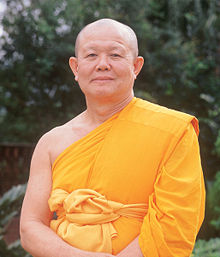
Buddhists often tend to disregard economics completely, because the monastic way of life idealized by Buddhism is economically very minimalist. Such neglect of comment concerning economic values is not warranted, however, because the Buddhist scriptures are in fact rich with advice from the Buddha regarding sound economic values -- and they are applicable to monastic and lay lifestyles alike.
The availability of teachings, is not, however, the only reason Buddhists should take an interest in economics. Of all the reasons for compiling a treatise in Buddhist economics, the most pressing reason Buddhists have to sit up and take notice of economic issues is because if we don't, abuse of economic principles will continue to escalate conflict in the world. The whole history of our planet from ancient times until now has been punctuated by wars -- whether they be world wars or more localized ones -- and as Buddhists see it, the outbreak of war can usually be traced back to financial strife, or else problems of the abuse of economic knowledge. However, once war breaks out, the nature of the problem is often distorted to make it look as if it is a problem of religious or ethnic conflict.
In the West we are accustomed to feeling a sense of relief when we hear that the economy is booming -- however, we sometimes fail to realize what those economic figures actually reflect in terms of quality of life. Ironically, all it takes for a country to be considered economically strong is for its economic figures to look good. If every household in a certain country or society were wealthy, of course that country or society would have good economic figures to show for itself. In Thailand, however, the majority of the population are economically poor. It is only a small minority of population who are wealthy -- thus, how can Thailand possibly be considered economically strong? If you want to have an accurate picture of the economy of any country, you have to take a long hard look at the wealth of the majority -- not just at the collective figures. It is the economic status of the majority which most accurately reflects the true economic state of that country or society.
Economic values in Buddhism are concerned with quality of life. But in Buddhism we define quality of life not only in terms of material comfort, but also in terms of mental wellbeing and ultimately liberation of the mind from negative latent tendencies. Thus, value is put on sometimes quite abstract qualities. As in the words of the Buddhist nun, Kuhn Yay Ratana Upasika Chandra Khonnokyoong who founded Wat Phra Dhammakaya in Thailand:
"with a well-trained group of people in front of me ready to work for good in society, I fell that I am already a multimillionnaire -- because even if I were to have ten million, I could still not guarantee being able to train up such a group."
Contrary to popular opinion, the Buddha never prohibited wealth -- but he did prohibit poverty. Happiness appropriate to a householder (A.ii.69) includes ownership [atthisukha], enjoyment [bhogasukha], freedom from debt [ananasukha] and blamelessness [anavajjasukha]. Buddhism praises contentment [santu.t.thi] and limited desires [appicchata] but not poverty. What is important as a Buddhist, however, in the economic process, whether one is earning, saving or using money, is that one should never compromise one's principles. Once wealthy, as a Buddhist one should use one's wealth in a way that supports a wholesome aim in life -- not to fritter away money away aimlessly or in a way that leads to further proliferation of defilements of greed, hatred or delusion in the mind. It is not to say that riches cannot buy happiness -- but riches used aimlessly may create more damage than good. Riches, if they are to bring happiness, must be applied to support the emergence of higher spiritual values -- especially virtues and virtuous people -- which according Buddhist economics have more value than anyone can put a price on.
Originally this book was intended to deal solely with Buddhist Economics, however after the warlike events of 11 September 2001, the present author would like to extend the scope of this book to show how the build-up of economic tensions can be blamed for these sort of incidents.
1
The Economic Hidden Agenda behind every war
"When one nation's army turns its guns on another, far from starting a war, they are the products of a war started long ago through economic exploitation."
The abuse of economic knowledge has beset our interactions with the economy all the way from earning, to saving and expenditure -- every step of the economic process being vulnerable to those who respect no ethical guidelines. In spite of this, western economics seems to turn a blind eye to ethical issues surrounding the economic process. Ethical issues are often intentionally overlooked under the pretext of being 'objective' -- but alas, this leaves the door open to all sorts of economic exploitation -- and even though opponants might never be threatened with knives or guns, the positioning that goes on behind the scenes of the world economy is no less cruel than out-and-out aggression. Economic exploitation in the present day has proliferated to the point that entire populations of countries are forced into compromises that leaves them strait-jacketed with regard to the appropriation of their own finances. This is the reality of economic 'colonization' in many countries of the world even at this very moment -- and Thailand is just one of many countries that seems to have become an economic plaything to more dominant superpowers.
In response to obvious injustice, it is hard to deny that understanding of economics attuned to ethical values must start by addressing two issues:
* the scrupulousness of how wealth is accrued
* the scrupulousness of those who accrue it
The seriousness of economic exploitation, of course depends on how far people are prepared to go to achieve their economic ends. Are they to kill each other or does their conscience cause them to stop short of this merely at indirect (political or diplomatic) pressure? In brief, it can be said that when resources are acquired, hoarded or used unscrupulously, it soon leads to conflict and chaos throughout the world. Insignificant incidences of exploitation gradually exacerbate the burden of bitterness which eventually stops short at nothing less than armed conflict.
The Economics of Exploitation
Having recognized the implications of economic exploitation (even without knowing who is taking advantage of whom) we can start to appreciate that the web of economic exploitation has become so complex that it is difficult to know a beginning or an end of it. When one nation's army turns its guns on another, far from starting a war, they are the products of a war started long ago through economic exploitation. In the absence of any ethical guidelines, when any means seems justified by economic ends, it is no surprise that the conflicts continue to escalate -- violence has indeed proliferated to a point where it is difficult to see how we personally can do anything to ameliorate the situation, without remedies of a similarly large scale.
Condoning unethical economic practices is to kindle the flames of war on our planet. Wars like the Crusades, lasted for longer than a century -- and upon first sight they might seem to have been nothing more than a religious war between Christians and Moslems, however, if examined in more depth, they turn out to have been the result of badly organized economic policy admixed with incompatability of beliefs. If you look beneath the surface of any other religious war which has broken out in history, you will always find a hidden agenda of economic advantage behind the conflict. It is only with the admixture of other elements that turns the conflict into a war. If it wasn't for economic difficulties, in spite of differences of belief, why should different groups want to interrupt 'business as usual'? However, any day economic progress becomes obstructed and a political tinder box doesn't emerge spontaneously, it is not usually long before ethnic and religious differences will provide the necessary spark. To the uninitiated, of course it looks like a war motivated by ethnic or religious conflict . . .
Even the battle for Ayutthaya had economic roots
Even the most famous invasion of Thailand in 1564 when the (then) capital of Ayutthaya was sacked by the Burmese is popularly believed to have been a fight over 'royal white elephants'. The first invasion took place in the reign of King Maha Chakrap'at. At that time the region of Ayutthaya, extended as far south as Rangsit and the present site of Wat Phra Dhammakaya. The populace were renowned for elephant husbandry -- especially elephants for use in royal service -- and several of these included the legendary 'white elephants'. According to eye-witness accounts, even as recently as fifty years ago, there was still a large shallow pond in front of Wat Phra Dhammakaya, which previously was used as a watering hole for the elephants of the vicinity. At that time, although the whole area was densely forested, the presence of herds of elephants made the area of strategic importance, because as well as being the royal 'chargers', trained elephants were the most indefatiguable 'machines of war' (equivalent to the modern-day tanks).
The news of the abundance of elephants reached the ears of King Bayinnaung of Burma, who sent an emissary to ask for a pair of 'white elephants' for himself in 1563.
BOX 1: THE LEGENDARY ROYAL WHITE ELEPHANTS
In Southeast Asia, white elephants are held in very high regard because they are believed to be the bodhisatva (a future Buddha in the making) --however, because of residual bad karma from previous lives, instead of taking human birth, the bodhisatva takes birth in one of the most elevated forms of animal life, indicated by the rare 'whiteness' of an elephant. The people of old had the belief that any country possessing such an elephant would prosper, as the charm of the the beast would call the rain to fall according to season.
Of course Thailand would never agree to part with any white elephants -- and that was known full well in advance by King Bayinnaung. He knew that when the refusal came, he would have an excuse to go to war with Thailand. When a battle ensued in 1564, it turned out that it was the Thais who lost on their home ground as a result of their lack of strategy and unity. That is the popular history of the outbreak of war. However, in reality it would be crazy for any king to risk the life and limb of large numbers of his subjects just out of the whim of acquiring an elephant. There ought to be more substantial reasons for the war breaking out in those times.
Much later the present author came across the description of a historical document found in about 1987 by Professors Prasert na Nakorn and Sukit Nimmanmain. It was a letter describing how the Lanna Kingdom had used to trade with Burma in silver, gold, herbs (especially alloe, cinnamon and spices), lac and honey. According to the document Lanna changed its policy on trade and started trading with Ayutthaya instead of Burma. Originally Burma had no interest in the spice trade, but when Europe started trading in spices through India, it saw its chance to dominate the market. Burma had become a wealthy middle man for spices traded between Lanna and the Europeans in India.
Ayutthaya, however, was also a spice trading centre -- but its prices were lower than those of Burma. It was no real difficulty for the trading ships from Europe to round the peninsular at Singapore to trade with Thailand instead of Burma. Within a relatively short period of time, all the Lanna traders decided to supply Ayutthaya instead of Burma. In addition, to take their merchandise to Ayutthaya was easier than taking it to Burma because it was all downstream. Thus Ayutthaya could be a cheaper middleman than Burma and this was the real reason for the conflict that grew up between Burma and Thailand. This is why King Bayinnaung (and King Tabinshwehti before him) wanted to sack Ayutthaya -- and the white elephant was only an excuse -- but he got lucky in the ensuing war and conquered Siam. Thus the reason for the first invasion of Ayutthaya was for economic reasons.
The second fall of Ayutthaya in 1569 was partly revenge for the rebel Sett'at'irat's subsequent counterattack against Burma in 1566 but analysed more deeply, Burma could only sack Ayutthaya a second time because the Thais were competing amongst themselves for economic power and at that time, towards the end of the Ayutthaya dynasty, vice had become very widespread in the old capital. Even the king was up to his neck in 'roads to ruin'. Wherever there is economic prosperity to excess, as we shall discover later in this book, there will be an upsurge various sorts of vice and addiction.
In conclusion, we can say that Buddhist economics and western economics diverge whenever economic advantage is used as a reason to justify conflict. In Buddhism economics, economic advantage is not seen as adequate means to justify ignoble ends.
Having identified the real roots of world conflict, it is no longer useful to look for who to blame. To look for scapegoats is really only an admission of our own inadequecies or laziness to recognize our own part in the problem. It would be more appropriate that we start to study the ethical issues surrounding economics as outlined in the remainder of this book while doing our personal best to be most scrupulous in all respects.
Scrupulous macroeconomics on the level of national policy has to be built on the foundation of scrupulous on the individual (microeconomic) level. Economics on both levels are dealt with in the remainder of this book.
2
The Distinguishing features of Buddhist Economics
"Don't eat just because you feel like it
-- eat when you feel hungry . . ."
There are many points of similarity and difference between Western Economics and Buddhist Economics. What the two have in common is in their recognition of three stages in the economic process. However, in the detail of each of the three stages, we find significant divergence:
* acquisition of wealth: While Western Economics recognizes acquisition as important, it gives virtually no guidelines for the ethical limits of scrupulous acquisition -- especially concerning livelihood. Anything that doesn't break the Law is seen as fair play. Unfortunately, the Law is a very rough and ready indicator of ethical behaviour. In the olden days where morality was a part of common sense, the Law might have been seen to offer sufficient guidelines, however, in the present day, that can no longer be said to be true. When the way people acquire their wealth is no more ethical than the way animals hunt their prey, that is the point where humans become prepared to kill each other for their wealth -- even if people still have sufficient conscience not to kill each other overtly for wealth, it doesn't mean they won't attempt to do so covertly by economic exploitation -- where direct killing means setting about each other with weapons and indirect killing means pressurizing, cheating and exploiting others by various means.
* conservation of wealth: Having acquired wealth surplus to one's needs, the remainder needs to be stored or shared. Animals will tend to hoard as much as they can without any consideration of ethical fairness. If you watch any African wildlife documentary you will see how in the dry season the big cats don't have to go out hunting, but sculk by the watering hole, dominating that scarce resource, so that they can prey on anything that comes to drink there. The big cat will get both water to drink and easy meat just by staying close to the watering hole. This is the way animals hoard their requisites -- without any consideration of ethicality. How do people measure up to these animal ways? As we all know, some acquire wealth scrupulously -- while others disregard ethicality completely or partially. Hoarding wealth in a way that disregards ethicality includes limiting the supply of resources to the point that others risk death because of the lack of these things in the marketplace. In the present day, this often happens -- for example when oil-producing countries limit the supply of their produce to force the prices up -- to the degree that their potential customers must suffer. In such a case Buddhists would no longer agree with Western economics that such hoarding is ethically justified and would favour the sale of such products at a moderate price. It is frightening to consider what would happen if the food producing countries were to start hoarding their products -- there would be dire consequences for the rest of the world.
* employment of weath for benefit or to satisfy desires: When spending, Buddhist economics again diverges from Western Economics, because it advocates spending one's resources:
o in moderation: 'Moderation' is the keyword when it comes to the beneficial deployment of wealth. Moderation in spending depends largely on a person's ability to distinguish between need and want. Necessary wealth can be broken down into the Four Requisites of clothing, food, shelter and medicine. Buddhists define 'need' as clothing enough to protect oneself from heat and cold, food to stave off hunger, shelter to protect us from the elements and medical care to treat us when we are ill (as mentioned in the verses of the Buddhist monk's recollection [M.i.10, Nd.496]). If one is clear in one's mind what constitutes a 'need', one will see consumption for what it really is -- that is, merely a means to an end. If we confuse 'wants' with 'needs', however, as encouraged by modern marketing forces, we will err into regarding consumption as an end in itself. However because people have the tendency never to know enough of a good thing, 'need' has given way to 'want'. When people want anything they can get their hands on, their ethical considerations tend to be forgotten. The Buddha would see moderation as an antidote for consumption to excess and would say that moderation in fact contributes to economic wellbeing. Most people are most interested in how high their income is. However, more important still is how much you are left with at the end of the month. In the olden days, they used to say "Don't just eat because you feel like it -- eat when you are hungry . . ." -- because we can feel like eating twenty-four hours a day! If there was nothing more to moderation than appetite, then we would need to be no more intelligent than a cow which chews cud at one end and drops cowpats from the other. It is not the income which counts but how much is left after the expenses. The secret of having something left is to expend only in case of need (not want). However, because people know no moderation in their consumption, resources become scarce and there is not much remaining difference between how such people make their living and how scavenging birds fight over their carrion. However, moderate consumption is hardly something supported by Western economics.
o only in order to give the greatest possible amount of true happiness for all: Consider how much the world could be improved if all the money squandered worldwide on gambling, drugs and prostitution were redirected into feeding the hungry, giving basic education or instilling virtue in the hearts of our planet's citizens? Even if not all the money were to be redirected -- maybe just 5-10%, our world would be a much more attractive place to live in! Unfortunately, because such a large amount of money has been sunk into businesses involved with vice, our whole world has become inundated with the contingent social problems -- and consequently, the opportunity to encourage virtue in society diminishes with every passing year.
BOX 2: Diighajaa.nu Sutta
Origin of Principles for Buddhist Economic Practice
Principles of Buddhist Economic practice are derived from a scriptural source called the Diighajaanu Sutta (A.iv.281ff.) -- and are repeated in the Ujjaya Sutta (A.iv.285-9). The former Sutta was given in response to the questions of a householder called Diighajaa.nu who was not short on wealth but failed to apply what he had to achieve any satisfaction in his life. Diighajaa.nu was a man who inhabited Kakkarapatta in Ko.liya -- and the people of that town referred to themselves as Byagghapajjans. He asked Buddha two questions:
* How to find happiness in the present lifetime
* How to find happiness in the next lifetime.
His questions are particularly pertinent to the subject of this book because Diighajaa.nu requested principles of practice applicable to economics for the household life (rather than the monastic one). The answers the Buddha gave were formulated as the 'four principles of finding happiness in the present lifetime' [di.t.t.hadhammikattha-sa.mvattanika dhamma] (enlarged upon in Chapter 3) and the 'four principles of finding happiness in the lifetime to come' [samparaayikattha sa.mvattanika dhamma] (enlarged upon in Chapter 4).
3
Buddhist Micro-economics for the here-and-now
"It's not what you earn that counts -- but how much you have left over at the end of the month . . ."
The Buddha gave a total of four principles of economic practice for finding happiness in the present lifetime [di.t.t.hadhammikattha-sa.mvattanika dhamma] (A.iv.281):
1. Diligent acquisition [u.t.thaanasampadaa]: Diligent acquisition means skilfulness in the acquisition of wealth. Diligent acquisition refers to the habits of a person who works hard for their living -- in contrast to those who are too lazy to make the effort. It also refers to the patience needed for people to work together as a team and the wisdom to recognize the work left undone -- being able to perform, organize and administer the work as required. The most important feature of this first stage of the economic process can be summarized as acquiring wealth in an ethical way. As Buddhists we would say that taking advantage of others economically, in whatever form, is unethical acquisition of wealth. Particular forms of livelihood which the Buddha advised us to avoid in this respect are the five sorts of Unwholesome Livelihood [micchaa va.nijjaa] (A.iii.207) mentioned below:
1. trading in weapons: The weapon trade is a major source of income for every superpower of the world. It is only normal that those who supply weapons will be on the receiving end of hatred from the victims of the destruction caused by the weapons they have sold. Selling weapons is the starting point of a long chain of negative karmic consequences. Weapons have had a part in every violent catastrophe occurring worldwide over the years -- and it is not our place here to say who is right or wrong -- but no-one can deny the magnitude of the death toll coming from armed conflict. Not selling weapons means refraining from any sort of trade in instruments for destroying life, whether it be guns, knives or even hunting equipment like traps or bait. Anything used for killing people or animals are considered weapons for the purposes of Unwholesome Livelihood. Even without physically harming a person, maltreatment can cause resentment which lasts across lifetimes -- thus, it is up to all of us to check our own aggression without waiting for prodding from others . . .
2. trading in people: Trading in people is also making profit out of the suffering of others. It formerly meant trading in slaves, but nowadays has come to include child labour, wage-slaves and prostitution;
3. selling live animals to the slaughterhouse: Selling live animals to the slaughterhouse is taking a profit from the suffering of animals in a way that leads inevitably to their death;
4. trading in alcohol or intoxicants: Trading in alcohol and intoxicants including non-medicinal drugs such as marijuana;
5. trading in poison: Trading in poison means selling poison such as insecticide or rat-poison. The Buddha advised us not to sell such agents because otherwise their retribution will find its way back to us. Even though when we sell the poison it has not yet caused any harm, but as soon as it is used it has the same potency as already mentioned for weapons. If only we were to follow the Buddha's advice more widely we wouldn't have to waste our time in the present day for so much campaigning for biologically grown vegetables.
It is not to say that there are no more than these five ways of unwholesomely earning a living -- but these are the main ones. Thus if you would like to know where to start looking for ways to reduce the amount of conflict in the world, the present author's advice would be to start by minimizing your involvement with Unwholesome Livelihood. The Buddha taught that any person who lapses into Unwholesome Livelihood will eventually attract a heavy burden of negative karma for themselves. Other ways of making money which involve economic exploitation in various ways can also be included as unwholesome livelihood, such as criminal activities, or for example:
* Making one's living out of interest: The present author's still remembers when he was a child, his mother always maintained, "In our household and our family we have never liked living off the interest earned from the money we lend to others." She explained, "It is making a living out of the suffering of people who are incompetent in managing their own finances. If they were really competent in their financial management, they wouldn't have to come borrowing money from the likes of us! Those who are financially careless would rather borrow at a high interest rate than go without -- which would indicate that they don't have much idea about the effective way to earn, save and use their finances. If you get too involved with these sort of people, it will just lead you to unnecessary frustration. If you really want to help such people, then just give the money to them without strings attached. It is not worthwhile to extend the mutual agony of having to be paid back for the interest on a loan."
2. Careful conservation [aarakkhasampadaa]: Careful conservation means skilfulness in the saving of wealth. Having earned wealth by the sweat of one's brow in a scrupulous way, a person should take good care of their wealth, not allowing it to be eroded away by unjust taxation, theft, natural disaster or unintended inheritants. As for unwholesome conservation of wealth -- this refers to excessive hoarding or stockpiling as mentioned above. Furthermore, when saving up one's wealth -- one should not allow doing so to bring us into conflict with those around us. Good reasons to put money on the side, according to Buddhist principles (A.iii.45) are in case of emergency such as repairing the consequences of fire, flood, excess taxation, theft or exhortion by malevolent relatives! You have to consider carefully, however what form you ought to save your money in. Of course the best way to conserve your wealth is as transcendental wealth or merit (see self-sacrifice of Chapter 4) -- because in such a form it is beyond the touch of interest rates and it will appreciate with the passing of the years -- thus saving in the form of transcendental wealth is really the most skilful way of conserving one's wealth.
3. Having virtuous friends [kalyaa.namittata]: Having virtuous friends means surrounding yourself with a network of virtuous friends in all areas of your life. The sort of friends one should cultivate are those endowed with faith [saddha], self-discipline [siila], self-sacrifice [caaga] and wisdom [pa~n~naa]. Apart from facilitating our cultivation of wisdom, it will also strengthen the network of good friends of which we are a part. Such networking is particularly relevant to teamwork because when one earns one's living, one does not usually do so alone -- whether it be working in the same office as one's colleagues or cooperating in an international network. The most important attribute of teamwork is that the team members must have a similarly high level of scrupulousness in their work dealings and a similarly high level of faith in spiritual teachings. Furthermore, everyone in the team should have a similarly high level of self-sacrifice, dedicated to the collective good -- thereby avoiding the dangers of networking with those who are overcome by their own selfishness. The Buddha taught that worldly wealth is exhausted in a moment -- but the value of training other people to be virtuous never knows an end. The importance of this virtue is emphasized over and over again by the Buddha -- who especially in the context of economics, taught that simply acquiring, storing and using wealth is not good enough. We have to build up a network of good people to work with too, before we get round to using our wealth -- the way we use our wealth should be in cooperation with such good friends, if we really want happiness and prosperity in life.The Buddha emphasized that when one is earning one's living, one should try to avoid associating with those who break the Precepts -- no matter whether they be young or old. If not only the Precepts, but also their faith in Buddhism is lacking, then that is all the more reason to avoid associating with them. It is as if we are selective about channelling our resources -- devoting our resources to encourage the proliferation of virtuous people in our society. Those who encourage virtue in their co-workers at the same time they earn their living will never have to complain at a later date of being 'stabbed in the back' by their colleagues. You have no-one else but yourself to blame if your employees are left incompetent, unable to work as a team or unable to delegate -- you cannot just expect competent people to rain down on you from the sky! You have to build on your employees competency by training them yourself. At the same time you need to continue to train yourself -- seeing what virtues you can pick up from those more experienced than yourself -- in this way, you will soon produce a network of good co-workers for yourself.
4. Living within your means [samajiivitaa]: Living within your means means skilfulness in spending. Those who realize the ease with which wealth can come and go, should lead their life in a way that is appropriate to their means -- not being extravagent but at the same time, not too spendthrift either! When we talk of generosity [daana] in this context we mean giving those things which are surplus to our needs. Some people might doubt as to how much they really need or might be unable to distinguish between 'need' and 'want' and hence the Buddha gave guidance about how householders should budget their earnings so that their generosity is neither reluctant nor a burden on the family expenditure. The Buddha taught (Aadiya Sutta A.iii.45 [36/93]) that the family budget should be divided into five. He did not say that each part should be 20% of your earnings, but he taught that you should budget for each of these sorts of expenditure. As for the "working capital" which you have built up for yourself, the Buddha taught in the Si"ngalovaada Sutta (D.iii.180ff.) that you should apply one-quarter of your earnings for your immediate needs, one-half should be reinvested in your business and the remaining quarter should be saved in case of emergency. It is up to each individual to decide how much of their income to use as "working capital" and how much to use for generosity. If you budget in this way, you will be able to practise generosity, giving neither too much nor too little. The fivefold division of one's funds mentioned above should be as follows:
1. one part to support the immediate needs of yourself, your parents, your children, spouse, servants
2. one part to extend generosity towards your friends
3. one part to be saved in case of emergency (as already mentioned above)
4. one part which should be used for five sorts of dedication
1. for one's extended family
2. for hospitality
3. for dedicating merit for the departed
4. for taxes
5. for dedicating merit to the things that you believe in according to your local custom (e.g.ascetics, animals, physical forces and elements, lower deities or higher deities depending on your culture)
5. one part to extend support to well-practising monks and ascetics
In the old days they used to compare an extravagent person with a low income to the owner of a fig-tree who shakes the tree so that all the figs fall off, but who picks up only a few of them to eat. At the other extreme, a person with a good income who is not generous with their wealth will die in hardship out of keeping with their social status. Steering the middle way between stinginess and extravagence in a way appropriate to your level of income is said to be living within your means. Aside of the main five forms of Unwholesome Livelihood (mentioned above) which cause deterioration of wealth, there are another four sorts of behaviour, known as the 'Four Roads to Ruin' which if we can avoid them, will also help to protect our hard-earned income:
1. womanizing;
2. drinking alcohol;
3. gambling;
4. associating with bad company
In conclusion, for anyone to remain scrupulous after wholesomely acquiring and saving their wealth, it is necessary to build up a network of good people [kalyaa.namitta] around themselves first, before they come to spending their hard-earned wealth. Habitually associating with good friends will cause one to expend with reflection as to true benefit, and thereby use one's wealth solely for things which help in cultivating faith, keeping one's precepts purely, practising self-sacrifice and cultivating wisdom in keeping with the guidance of the Buddha for happiness in lives to come (see next chapter).
Thus, throughout one's life one should earn one's living carefully according to the four principles of happiness in the present lifetime -- never compromising one's Buddhist scrupulousness -- and the same goes for saving one's wealth. At the same time one needs to develop those around one as a protective fence or network of good friends. Surrounded by virtuous people, the tendency for our mind to be tempted by unethical compromises will be significantly reduced -- and the interactions we have with our fellow workers will be for mutual encouragement of further good deeds.
Metaphor of the reservoir
The four economic principles for happiness in the present lifetime can be compared to four channels of water which supply a pool. The Four Roads to Ruin can be compared to four outlets from the pool. If we close the inlets and open the outlets, in the absence of rain, the pool will soon become completely dry. There will certainly be no increase in the water level. On the contrary, if one opens all four of the inlets by conducting oneself in keeping with the Buddhist economic principles, while closing the outlets by avoiding all four roads to ruin, before long the pool will be full or even overflowing. Thus, whether we are speaking economically on a personal level or on national level, it is vital to seal up the four possible outlets from our economic prosperity -- by not womanizing, drinking alcohol or gambling -- and by associating with good friends. These are the basics of Buddhist microeconomics for the present lifetime -- economics that you won't find described anywhere else in the world. If you heed the Buddha's words on economics and put them in to practice you will have prosperity in your future, never falling upon hard times.
For rest of the article, please refer to this link.
Download the article:
Word format
PDF format
--------------------------------------
Technorati: Buddhism Buddha Buddhist Dharma Compassion Wisdom Religion Buddhist Economics Zen Philosophy Spirituality Inspiration Peace Insight
