


In the language of India: pratityasamutpada hridaya karika
In the language of Tibet: rten cing 'brel par 'byung ba'i snying po'i tsig le'ur byas pa
Homage to Manjushri, the Youthful!
1. These different links, twelve in number,
Which Buddha taught as dependent origination,
Can be summarized in three categories:
Mental afflictions, karma and suffering.
2. The first, eighth and ninth are afflictions,
The second and tenth are karma,
The remaining seven are suffering.
Thus the twelve links are grouped in three.
3. From the three the two originate,
And from the two the seven come,
From seven the three come once again—
Thus the wheel of existence turns and turns.
4. All beings consist of causes and effects,
In which there is no ‘sentient being’ at all.
From phenomena which are exclusively empty,
There arise only empty phenomena.
All things are devoid of any “I” or mine.
5. Like a recitation, a candle, a mirror, a seal,
A magnifying glass, a seed, sourness, or a sound,
So also with the continuation of the aggregates—
The wise should know they are not transferred.
6. Then, as for extremely subtle entities,
Those who regard them with nihilism,
Lacking precise and thorough knowledge,
Will not see the actuality of conditioned arising.
7. In this, there is not a thing to be removed,
Nor the slightest thing to be added.
It is looking perfectly into reality itself,
And when reality is seen, complete liberation.
This concludes the Verses on the Heart of Dependent Origination composed by the teacher Arya Nagarjuna.
Article source: www.lotsawahouse.org
~End of Post~
--------------------------------------
Technorati: Buddhism Buddha Buddhist Dharma Compassion Wisdom Religion Meditation Zen Philosophy Spirituality Inspiration Nagarjuna Insight
Tuesday, July 27, 2010
Heart of Dependent Origination

Saturday, March 21, 2009
Hymn to the Buddha, The world Transcendent

~ Nagarjuna
Sanskrit title: Lokatistava
Tibetan title: 'jig rten las 'das par bstod pa
Homage to Manjushri!
1
I bow to you, the world transcendent,
You who’re versed in the gnosis of absence.
For the benefit of the world
You’ve suffered long with great compassion.
2
That apart from the mere aggregates
No sentient being exists, you uphold.
Yet, great sage, you continue to remain
Perfectly immersed in the welfare of beings.
3
Wise one, you’ve declared to the intelligent ones
That aggregates too are comparable
To an illusion, a mirage,
A city of Gandharva and a dream.
4
Those which originate from a cause,
Without that [cause], they do no exist;
So why would you not uphold
That clearly they’re just like reflections!
5
The [four great] elements are not perceptible to the eye,
So how can entities be perceptible to the eye?
Clearly rejecting the apprehension of matter itself,
You speak of matter in this manner.
6
Since without the felt there is no feeling;
Feeling itself is devoid of self;
So you uphold that what is felt too
Is devoid of intrinsic existence.
7
If a word and its referent are not different,
[The word] fire would burn one’s mouth;
If they’re different there’ll be no comprehension.
This you, the speaker of truth, have stated.
8
An agent is autonomous and his action too;
This you’ve expressed conventionally.
You uphold that they’re established
Only in terms of mutual dependence.
9
There exists no agent, no subject too;
No merit [exists], they arise through dependence.
“Though dependently arisen they’re unborn”;
So you’ve proclaimed, O master of words.
10
Without being known it’s not an object of knowledge;
Without that there is no consciousness as well.
Therefore the knower and the known
Possess no intrinsic reality, you’ve said.
11
If the characteritic is different from the characterized,
The characterized would exist without the characteristic;
You’ve clearly stated [also] that neither exists
If they’re [conceived of as] non-different.
12
Devoid of characteristic and the characterized,
And free from utterances of words,
With your eyes of [perfect] gnosis,
You bring tranquility to the beings.
13
An existent thing does not arise;
Nor does a non-existent as well, nor does both;
Neither from itself nor from another,
Nor from both; how can there be arising?
14
It’s logical for an existent to endure;
Not so for [such a thing] to disintegrate.
Since it’s logical for a nonexistent not to endure,
It cannot come to disintegrate.
15
First of all it’s illogical for an effect to emerge
From a cause that is itself destructed;
[It] does not [arise] from an undestructed [too]
You accept a dream-like arising.
16
The emergence of effects from a cause
Through destruction or non-destruction,
This origination is like the occurrence of an illusion;
You taught that everything is likewise as well.
17
Therefore you fully understood
This world to have emerged from ideation,
And even when emerging, you’ve declared,
“There is no arising and no disintegration.”
18
In permanence there is no samsara;
In impermanence too there is no samsara.
You, supreme among those who’ve realized suchness,
You’ve declared samsara to be like a dream.
19
Dialectians assert that suffering is created by itself;
Created by another, by both self and another,
Or that they have no cause [at all].
You’ve stated it to be dependent origination.
20
That which originates through dependence,
This you maintain to be empty;
That no independent entity exists,
You, the peerless, [proclaimed] in a lion’s roar.
21
Since you teach the ambrosia of emptiness
To help abandon all conceptualizations,
He who clings to this [i.e. emptiness].
This you’ve strongly condemned.
22
Since they’re inert, dependent, empty,
Like an illusion, and arisen out of conditions,
You’ve made it familiar [to the world]
That all phenomena lack reality.
23. There is nothing that you’ve brought forth;
There is nothing that you have negated;
You’ve comprehended that suchness,
As it was before, so it is afterwards.
24. Without entering the meditation
As shown by the Noble Ones
Can consciousness ever become signless?
25
Without entering signlessness
There is no liberation, you’ve declared;
So you presented this [signlessness]
In its entirety in the Great Vehicle [sutras].
26
By praising you, a vessel worthy of praise,
Whatever merits I may have obtained,
Through this may all beings without exception
Become free from the bondage to signs.
This concludes Hymn to [the Buddha,] the World Transcendent composed by master Noble Nagarjuna. English translation. Geshe Thupten Jinpa, 2007.
--------------------------------------
Technorati: Buddhism Buddha Buddhist Dharma Compassion Wisdom Religion Meditation Zen Philosophy Spirituality Inspiration Peace Insight
Monday, February 18, 2008
Bodhisambharaka
(The Accumulations for Enlightenment)
Arya Nagarjuna
Translated by Christian Lindtner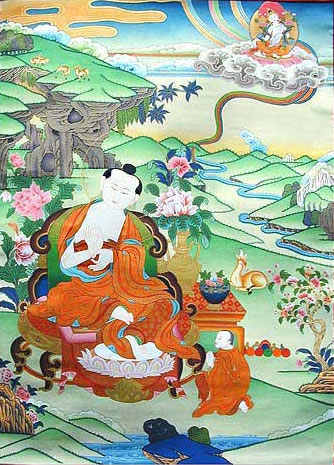
1. Now, in the presence of the Buddhas, I fold my hands and bow my head. I intend to explain according to tradition a Buddha's accumulations for enlightenment.
2. How is it possible to explain without omission the accumulations for enlightenment? [For] the Buddhas are the only ones who individually obtain infinite enlightenment!
3. The body of a Buddha has infinite qualities. The [two] accumulations for enlightenment constitute the basis. Therefore the accumulations for enlightenment have no final limit either.
4. I can only explain a small part of these [two accumulations]. I praise the Buddhas and the Bodhisattvas. All the Bodhisattvas and the rest I revere successively to the Buddhas.
5. Since [Prajnaparamita] is the mother of Bodhisattvas it is also the mother of Buddhas. Prajnaparamita is the foremost collection for enlightenment.
6. Prajnaparamita is the mother of Bodhisattvas, skill in means is their father, and compassion is their daughter.
7. Generosity, morality, patience, energy, dhyana and the [other paramitas] beyond these five are all due to prajna—Prajnaparamita comprises them all.
8. Great compassion penetrates into the marrow of the bone. It is the support of all living beings. Like [the love of a] father for his only son, the tenderness [of a Buddha] is all- pervasive.
9. If one thinks of the Buddha's virtues and listens to [accounts of] the miracles of the Buddha, [this creates] love, joy, a feeling [of happiness], and purity. This is called great joy.
10. A Bodhisattva must not desert or abandon living beings. He should always care for them to the best of his ability.
11. From the very beginning [of the path], in accord with the strength available, a Bodhisattva ought to be skilled in ways of converting people so that they may enter the Mahay ana.
12. One may convert beings [as numerous as] the grains of sand in the Ganges so that they obtain sainthood, but to convert one [single person] to Mahayana— that creates greater merit!
13. Some are instructed according to the Sravakayana and the Pratyekabuddhayana. Because of their limited powers they are not suitable for conversion [to the Mahayana].
14. Those who are not fit for conversion to the Sravakayana, the Pratyekabuddhayana, or the Mahayana must be assigned meritorious tasks.
15. If people are [utterly] unfit to receive conversion [conducive to] heaven and liberation, then [a Bodhisattva] must attract them through advantages in this world, in accordance with the power available.
16. Toward people who cannot possibly be induced to conversion a Bodhisattva should generate great compassion. He must never discard them!
17. Attracting with gifts, teaching the Dharma, listening to the teaching of the Dharma, and also practicing acts of benefit to others — these are skillful means for attracting [others].
18. While benefitting living beings without tiring and without carelessness, [a Bodhisattva] expresses his aspiration for enlightenment: To benefit others is to benefit oneself!
19. By entering the profound foundation of dharmas, exempt and separate from conceptual constructs, entirely without effort, all matters are spontaneously abandoned.
20. Profit, reputation, honors, and pleasure are four things one should not be attached to. Nor should one become embroiled in their opposites. This is called [worldly] renunciation.
21. As long as he has not obtained the Irreversible [Stage], a Bodhisattva should perform these actions for the sake of enlightenment as zealously as if his headdress were on fire.
22. All the Bodhisattvas who seek enlightenment display energy without rest, for they shoulder a heavy burden.
23. If he has not yet produced great compassion and patience, although he may have attained the Irreversible [Stage], a Bodhisattva can become like a mortal by being careless.
24. If he enters the Sravaka and Pratyekabuddha levels, he becomes a mortal, because the roots of the knowledge of deliverance of the Bodhisattvas are cut off.
25. Even if he fell into hell a Bodhisattva would not be afraid, but the level of the Sravakas and Pratyekabuddhas horrifies him.
26. While falling into hell creates no absolute barrier to enlightenment, it is an absolute barrier to fall into the lands of the Sravakas and Pratyekabuddhas.
27. It is said that people who love life are afraid to have their head cut off. In just the same way, the lands of the Sravakas and Pratyekabuddhas ought to evoke similar fear.
28. [To accept all reality as non- arising means seeing everything as] unborn, undestroyed, neither unborn nor undestroyed, neither both nor neither, neither empty nor non- empty.
29. When one does not swerve from the Middle View with regard to any phenomenon whatsoever, there is acceptance [of] non-arising, because all ideas are eliminated.
30. As soon as you have obtained this conviction, at that very moment you receive the prediction [that you will become a Buddha]. You certainly will become a Buddha once you have attained the Irreversible [Stage].
31. Until a Bodhisattva attains the stage of Presence, he should strengthen his samadhi and ought not to become careless.
32. The [sixth stage], the Stage of Presence of a [future] Buddha, is steadfast concentration. This is the father of a Bodhisattva [and] great compassion is his mother.
33. Prajnaparamita is his mother and [skill in] means is his father. The term 'parents of the Bodhisattva' is employed because the latter generates and the former sustains.
34. A small quantity of merit cannot bring about enlightenment. One brings it about by collecting a quantity of merit the size of a hundred Sumerus.
35. Though [a Bodhisattva's] merit be slight, it must be skillful. He must produce a support for all living beings, [thinking:]
36. "All the actions I perform shall always be for the benefit of living beings!" Who can measure the merit of an intention such as this?
37. Not to cherish one's own family or one's body, life, or riches, not to covet pleasures and power or the world of Brahma and the other gods;
38. Not to covet nirvana, but to act to benefit living beings — just this is to care for living beings. Who can measure such merit?
39. To save and protect a world lacking support and protection from suffering and pain — who can measure the merit of forming such intentions?
40. To possess the Prajnaparamita for one or several months, as when briefly milking a cow — who can measure the merit?
41. To recite to oneself and to teach others the profound scriptures praised by the Buddha, and to explain the various meanings: This is called a mass of merit.
42. By causing innumerable beings to turn their minds to enlightenment the store of merit will wax ever greater, so that one will obtain the Immovable Stage.
43. To follow [the Buddha], to turn the victorious Dharmacakra turned by the Buddha, and to calm and quench bad impulse: This is a Bodhisattva's store of merit.
44. Bearing the great suffering of hell (and a little extra suffering as well), so as to benefit and bring pleasure to living beings — this will place enlightenment close at hand.
45. Initiating action not for oneself but only to benefit and please living beings, motivated by compassion — this will place enlightenment close at hand.
46. Wisdom without conceptualization, zeal without sloth, unstinting generosity — this places enlightenment close at hand.
47. Being independent, by thoughts not obsessed, having perfect morality, complete and unstained, accepting [that things] are unborn — this places enlightenment close at hand.
48. In front of the fully enlightened Buddhas who are present in the ten regions, I entirely confess my sins.
49. If the Buddhas who have attained enlightenment in the universe of the ten directions are reluctant to expound their teaching, I entreat them to turn the Dharmacakra!
50. If the fully enlightened Buddhas present in the universe of the ten directions desire to give up life [in samsara], I bow my head and request them to remain.
51. The merit of generosity and good morals, of [good] thoughts and actions produced by living beings by means of body, speech, and mind —
52. We all rejoice in [such] merit, accumulated by holy men and common people of the past, present, and future.
53. If only I could gather all the merit I have and pass it on to living beings so that they might obtain full enlightenment!
54. In this way I repent, exhort [the Buddha to preach], request [the Buddha to remain], and dedicate [my merit] to enlightenment. One must know: [Thus will I be] like the Buddhas.
55. Express remorse for unwholesome acts, request the Buddhas [to abide in samsara], rejoice in merit, and transfer it to enlightenment, as the Jinas have stated.
56. Do so every third hour, day and night, joining palms, with the right kneecap touching the ground and the upper garment arranged on one shoulder.
57. If the merit [thus] created in one hour had outward form, [realms amounting to] many thousands [of times the] number of grains of sand in the Ganges still could not contain it.
58. Once [a Bodhisattva] has first produced the thought [of enlightenment: bodhicitta], he ought to show respect and kindness towards all the minor Bodhisattvas as if they were his teacher or parents.
59. Even if a Bodhisattva has committed a wrong he should not talk about it, much less tell an untruth. Speak only the truth.
60. If a man expresses the vow to become a Buddha, wish that he not fall back, show [him the merit of the Buddha], fire his zeal,
and awaken joy.
61. If he has not yet unravelled the very profound Sutras, he must not say that they are not the Buddha's words. If he makes such statements, he will reap great suffering in return.
62. If all wrongs, including the five anantarya, were to be added together and compared with these two wrongs, they would not amount to a fraction [of them].
63. Develop carefully the three doors to liberation: sunyata, the markless, and the wishless.
64. Since dharmas lack own- being, they are empty (sunya). Being empty, how can they have marks? All marks being extinguished, how can the wise wish [for anything]?
65. While [the Bodhisattva] is cultivating and contemplating these [three and] traversing the path to nirvana, he must not think that the Buddhakaya does not exist. Do not relax your efforts on this score!
66. As for nirvana, he will not realize it at once, but must produce this thought: We must ripen the Prajnaparamita.
67. A master archer releases his arrows so that each of them is aimed one at the other; each supporting the one before it, they do not fall. The great Bodhisattva is like that.
68. Carefully he aims the arrow of the mind at the door to liberation called 'empty'. The arrows of [skill in means] act together to support it, so that [his prajna] is not allowed to fall into nirvana.
69. Let us not desert living beings! In order to benefit living beings, first generate this attitude and then come to possess the practice of the doors to liberation.
70. There are living beings whose attachments persist a long time, and who cultivate misconceptions and [wrong] notions. All this is due to delusion.
71. Those who are addicted to [wrong] notions [and] misconceptions can abandon them by proclaiming the Dharma. First one focuses the mind on reality, and then one comes to possess the practice of the doors to liberation.
72. Bodhisattvas benefit living beings, yet they see no living beings! A difficult point indeed; an exquisite point! One cannot grasp it.
73. Even if a Bodhisattva is predestined, he must practice the doors to liberation. Since the original vow is not yet fulfilled, [the Bodhisattva] does not realize nirvana.
74. If he has not yet attained his predestination, being [only] concerned with skillful means, the original vow is not yet fulfilled. So again he does not realize nirvana.
75. [A Bodhisattva has] extreme distaste for samsara but still turns toward samsara. He has faith and joy in nirvana, yet turns his back on nirvana.
76. Fear the klesas but do not be exhausted by the klesas; accumulate good karma in order to suppress the suppressing klesas.
77. A Bodhisattva has a passionate nature; he does not yet have a nirvana nature. [So only when] the klesas are not yet burned away [can he] produce the seed of enlightenment.
78. A Bodhisattva predicts [the destiny of] other beings. This prediction has as necessary condition a Tathagata's merit and skill, enabling them to reach the farther shore.
79. A [Bodhisattva should] propagate and establish all the sastras, techniques, sciences, and arts for the use and benefit of all humanity.
80. According to the stages of transmigration and caste in the world of potential converts, a Bodhisattva proceeds there as he wishes; by virtue of his vows he accepts rebirth.
81. When faced with various evil matters and people's flattery or deception, put on strong armor. Do not be disgusted [by samsara] and do not be afraid [of seeking enlightenment].
82. Bodhisattvas with a completely pure mind do not flatter or deceive. They reveal all [their] sins and evils, but conceal and store [their] good deeds [without boasting].
83. Pure [in] the karma of body and speech and also [in] the karma of mind, [a Bodhisattva] cultivates all the moral rules, allowing no shortcoming or diminution.
84. [A Bodhisattva must] peacefully dwell in mindfulness. He selects an object and contemplates in solitude, employing mindfulness to safeguard himself, [so that his] mind becomes a mind without attachment.
85. If discursive thoughts arise, he must determine whether they are wholesome or unwholesome, abandoning the unwholesome and increasing the wholesome.
86. If his mind is disturbed by objects, he should concentrate his mindfulness, lead his mind back to the object, and (if it wavers) cause it to remain still.
87. Do not relax or fall into clinging, but cultivate strenuousness. If a Bodhisattva cannot uphold his samadhi, he must constantly strive [to do so].
88. [Those who are about to] ascend the Sravakayana or the Pratyekabuddhayana, merely acting for [their, or its] own benefit, must not abandon firm energy —
89. Then what of the great Bodhisattva! As his own savior and the savior of others, should he not put forth ten thousand million times the zeal?
90. For half an hour one may practice various [meditations] and for another follow different procedures, but this is not the way to practice samadhi! Let the mind be fixed on one object!
91. There should be no affection for the body and no regret for one's life. Even if one wants to protect this body, still in the end it will prove subject to decay and misery by nature.
92. Be altogether unattached to gain, honors, and fame. Act vigorously to fulfill the vow [to liberate oneself and others], as if your head [or] clothes were on fire.
93. Determined to produce the highest good, a Bodhisattva cannot wait till tomorrow. Tomorrow is far away. How can one preserve a transient existence?
94. [A Bodhisattva must] peacefully dwell in mindfulness [with utter equanimity]. If he [had] to eat the flesh of his favorite son, he would eat without being either attracted or repelled.
95. The purpose of renouncing worldly life, and how to determine whether what we have done or left undone must be done or not — this is explained in the Dasadharmakasutra.
96. See that compound things are impermanent, and that there is no I or mine. Aware of all the deeds of Mara, abandon them!
97. Produce zeal and cultivate the [five] powers, the [five] strengths, the [seven] branches of enlightenment, the [four] bases of miraculous power, the [four] restraints, the [eightfold] path, and the four applications of mindfulness.
98. A mind can be a place for the continuous birth of good things, happiness, and merit, but it can also be a root of evil. Reflect on this carefully!
99. Regarding positive dharmas, watch daily how they increase and how they diminish.
100. If one sees others gain in profit, support, respect, and fame, one's mind should not react with even the slightest bit of envy or jealousy.
101. Live without desiring the objects [of the senses], as if dull-witted, blind, dumb, and deaf. At the right moment the lion's roar frightens the tirthika deer.
102. In welcoming and taking leave, honor those to be respected. In all matters of Dharma, be kind and helpful.
103. By saving and liberating those who suffer annihilation, one prospers and is not destroyed. [By] cultivating the sciences and crafts well, one trains oneself and instructs others.
104. Regarding particularly good dharmas, keep to them strenuously. Practice the four foundations of propitiation and make donations of clothing, drink, and food.
105. Do not rebuff those who beg for alms. Reconcile all your kindred. Do not turn against your followers. Make donations of dwellings and property.
106. Give parents, relatives, and friends their due; accord them the treatment due the supreme Lord.
107. Speak kindly even to a slave and care for him. Show him great respect, make medicine available, and heal all diseases.
108. [Those whose] head is [adorned with an usnisa due to] the good karma of prior actions, [whose] voice is fine, smooth, beautiful, and wonderful, [whose] voice [i. e., brahmasvara, is due to] good karma and the right way of mind, will [never] fail to be respected, in the future as in the past.
109. Do not harm the followers of others. Look at living beings with a compassionate eye and without a jealous spirit, as if they were relatives and friends.
110. One must always do as one has promised. Acting according to one's words wins the confidence of others.
111. Support the Dharma and be wary of the idle. Make precious nets of gold and cast them over the caityas.
112. If one wants to seek out a fair maid, one should give her ornaments. But in addition to giving her jewels, one must also discourse [to her] on the qualities of the Buddha.
113. Cast statues of the Buddha sitting upright on exquisite lotus blossoms. Practice the six dharmas [with] joy and pleasure.
114. Those who are honorable are not to be dishonored. Do not criticize the Dharma spoken by the Buddha or by those who discourse on the Dharma, even to [save your] life.
115. Distribute gold and jewels to the teachers and to the caityas of the teachers. If you [find that you] forget what you learn, concentrate so as not to be confused.
116. When one has not yet fully thought out one's actions, one must neither panic nor just imitate [the actions] of others. Do not believe in the gods, nagas, or yaksas of the tirthikas.
117. One's mind should be like a vajra, capable of penetrating all dharmas, or like a mountain, unperturbed in all situations.
118. Enjoy expressions transcending the world. Take no pleasure in transactions of the world. Keep all the virtues in yourself and help others to keep them too.
119. Develop the five spheres of liberation, contemplate the ten notions of impurity, and reflect upon the eight thoughts of a great Being.
120. Clearly develop the five superknowledges: the eye of the gods/ the hearing of the gods, the ability to perform miraculous transformations, the ability to read the minds of others, and remembrance of past lives.
121. The four bases of power form the root: will, mind, energy, and deliberation. The four infinite foundations are love, compassion, joy, and equanimity.
122. Look upon the four elements as a poisonous snake, the six bases as an empty village, the five skandhas as a murderer.
123. Revere the Dharma and the teachers of the Dharma, and put aside any animosity toward the Dharma. The teacher must not clench his hand; those who listen must not be annoyed.
124. Preach the Dharma to others without rudeness and without expectations, with only a compassionate heart and a devoted and respectful mind.
125. Be insatiable for learning and commit to memory what you have learned. Do not be deceitful toward respected holy personages, but give pleasure to the teacher.
126. [When] investigating other teachings, do not let your heart cherish reverence. Do not study or recite worldly texts on account of the difficulty of the [Buddhist] treatises.
127. Do not, on account of anger, slander any of the Bodhisattvas. When one has not yet grasped and learned the Dharma one must not cause calumny.
128. Abandon pride and abide by the four noble principles. Do not despise others; do not be self- important either.
129. Whether an offense is real or fictitious, do not inform others of it. Take no notice of the faults of others; just be aware of your own faults.
130. The Buddha and the Buddhadharma should not be objects of speculation or doubt. Although the Dharma is very difficult to believe in, one must have faith in it.
131. Even if [a Bodhisattva] dies by stating the truth, or is deprived of [his exalted status as] cakravartin king or Indra, he must state the truth and nothing else.
132. [Even if you are] hit, insulted, threatened, flogged, or tied up by someone, bear him no resentment. Future and present [evils] are all due to one's own bad karma.
133. Respect, love, and support your parents greatly; serve your instructor and revere the teacher.
134. It is an error for the Bodhisattva to discourse on the very profound Dharma [i. e., the Mahayana] to those who believe in the Sravakayana and the Pratyekabuddhayana.
135. If people believe in the profound Mahayana and one still advocates the Sravakayana and Pratyekabuddhayana, this also is an error for the Bodhisattva.
136. Many people come [to the monastery] out of interest in the Dharma. If they are careless, one should not offer them discourses, but should care for evildoers and establish non-believers in the Mahayana.
137. [A Bodhisattva] must abandon these four errors. The virtues of a purified man should be recited and learned, practiced and cultivated.
138. [The four Bodhisattvamargas are] equanimity, balanced discourse [on the Dharma], being well- established in impartiality, and being the same toward all living beings.
139. [The four kinds of Bodhisattvas] act for the Dharma, not for profit; for merit, not for reputation. [They] wish to save living beings from suffering, wanting no pleasure for themselves.
140. [If a Bodhisattva] sincerely seeks to have his actions mature, he must make the [three] meritorious practices arise. He must also mature living beings and reject his own affairs.
141. [The Bodhisattva] should approach four kinds of good friends: the teacher, the Buddha, those who offer encouragement to ascetics, and monks.
142. Those who rely on worldly knowledge, who especially crave worldly goods, who believe in the Pratyekabuddhayana, or inj fiie Sravakayana;
143. Seek instead what are known as the four great treasuries:
144. The superworldly Buddha, study of the [six] paramitas, a mind that looks upon the teacher without impediments, [and] being happy to dwell in empty places.
145. Like earth, water, fire, wind, and space, entirely and everywhere, [Bodhisattvas] benefit living beings equally.
146. Consider the very meaning of the Buddha's words and unremittingly produce the dharanis. Do not hinder in any way those who are studying the Dharma.
147. Those who are to be disciplined in the nine bases of quarreling [must] put aside the [twenty] minor matters without exception. The eight kinds of sloth must also be extinguished.
148. Harbor no improper affection, [for] unreasonable desire is not in accord with one's [true] wishes. Those who are disunited should be united, without asking whether they are friends.
149. A sage does not base his actions on sunyata by apprehending sunyata. If one [absolutely] must apprehend sunyata, this error amounts to the fault of belief in a personal substance.
150. Sweep the dust, smear [cow dung], make decorations, and perform worship of the caityas with many kinds of drum music and offerings such as incense, dressing the hair in a knot, and so forth.
151. Make various lamp- wheels, worship the caityas, and donate parasols, leather sandals, riding horses, carriages, chariots, and so forth.
152. [A Bodhisattva] should take special delight in the Dharma and enjoy an intellectual belief in the Buddha's attainments. He should gladly supply and serve the Sangha and take pleasure in listening to the Holy Dharma.
153. Unborn in the past, not remaining in the present, and not arrived in the future — look upon all dharmas thus.
154. Be gracious to living beings without seeking a reward from them. Bear [their] troubles alone, without grasping after pleasure for yourself.
155. Even if one is worthy of [rebirth in heaven as] the result of great merit, one's heart should not be uplifted or elated. Even if one is in great need like a hungry ghost, one should be neither downcast nor sad.
156. Those who are fully disciplined must be paid full respect. Those who are not yet disciplined should enter the discipline, and must not be objects of contempt.
157. Those whose good conduct is perfect should be respected. If [they] violate good conduct, they should return to its practice. Those whose wisdom is perfect [should be] approached as friends. Those who are dull should be established in wisdom.
158. The suffering of samsara is manifold: birth, old age, death, and bad rebirth. But do not fear such perils! Conquer Maraand bad understanding.
159. Gather all the virtues in all the Buddha fields. Make lofty vows, so that all may attain them.
160. Never appropriate dharmas, but always give them up. To do this is to accept the burden, taking on responsibility for the sake of all living beings.
161. One who correctly examines all dharmas sees that there is no I and no mine. Still he does not abandon great compassion and great kindness.
162. One must surpass all worship in order to worship the Buddha Bhagavat. Of what nature is this worship? It is known as Dharma worship.
163. If one grasps the Bodhisattvapitaka and obtains the various dharanis while penetrating the profound foundation of [all] dharmas, that is Dharma worship.
164. Hold to the main thing, without preferring this or that articulation. Enter the profound path of the Dharma with joy, not showing heedlessness.
165. When ascetics and householders have collected these accumulations for great aeons numerous as the sands of the Ganges, they shall attain perfect enlightenment!
Our good fortune is solely due to this translation of this wonderful text by Chris Lindtner
--------------------------------------
Technorati: Buddhism Buddha Buddhist Dharma Compassion Wisdom Religion Meditation Zen Arya Nagarjuna Spirituality Prajnaparamita Bodhisambharaka Insight
Bodhicittavivarana
Arya Nagarjuna
Translated by Christian Lindtner
1. Bowing to the glorious Vajrasattvas embodying the mind of enlightenment, I shall expound the development of the bodhicitta that abolishes [the three kinds of] existence [in samsara].
2. The Buddhas maintain that bodhicitta is not enveloped in notions conscious of a self, skandhas, and so forth, [but] is always marked by being empty [of any such notions].
3. [Those] with minds [only] tinged by compassion must develop [bodhicitta] with particular effort. This bodhicitta is constantly developed by the compassionate Buddhas.
4. When the self imagined by the tirthikas is analyzed logically, it obtains no place within the [five] skandhas.
5. If it were [identical with] the skandhas [the self] would not be permanent, but the self has no such nature. And between things permanent and impermanent a container- content relationship is not [possible].
6. When there is no so-called self how can the so-called creator be permanent? [Only] if there were a subject might one begin investigating its attributes in the world.
7. Since a permanent [creator] cannot create things, whether gradually or all at once, there are no permanent things, whether external or internal.
8. Why [would] an efficacious [creator] be dependent? He would of course produce things all at once. A [creator] who depends on something else is neither eternal nor efficacious.
9. If [he] were an entity he [would] not be permanent, for things are perpetually instantaneous (since [you] do not deny that impermanent things have a creator).
10. This [empirical] world, free from a self and the rest, is vanquished by the [Sravakas'] understanding of the skandhas, elements, sense- fields, and subject and object.
11. Thus the benevolent [Buddhas] have spoken to the Sravakas of the five skandhas: form, feeling, apprehension, karma formations and consciousness.
12- 13. But to the Bodhisattvas [the Buddha], the best among those who walk on two legs, has always taught this doctrine about the skandhas: "Form is like a mass of foam, feeling is like bubbles, apprehension is like a mirage, karma- formations are like the plantain, and consciousness is like an illusion."
14. The form skandha is declared to have the four great elements as its nature. The remaining [four skandhas] are inseparably established as immaterial.
15. Among these eye, form, and so forth are classified as [the eighteen] elements. Again, as subject- object these are to be known as the [twelve] sense- fields.
16. Form is not the atom, nor is it the [organ] of sense. It is absolutely not the active sense [of consciousness]. [Thus] an instigator and a creator are not suited to producing [form].
17. The form atom does not produce sense consciousness, [because] it passes beyond the senses. If [empirical forms are supposed to] be created by an assemblage [of atoms], this accumulation is unacceptable.
18. If you analyze by spatial division, even the atom is seen to possess parts. That which is analyzed into parts — how can it logically be an atom?
19. Concerning one single external object divergent judgments may prevail. Precisely that form which is pleasant [to one person] may appear differently to others.
20. Regarding the same female body, an ascetic, a lover and a wild dog entertain three different notions: "A corpse!" "A mistress!" "A tasty morsel!"
21. Things are efficacious due to being like objects. Is it not like an offense while dreaming [i. e., nocturnal emission]? Once awakened from the dream the net result is the same.
22. As to the appearance of consciousness under the form of subject and object, [one must realize] that there exists no external object apart from consciousness.
23. In no way at all is there an external thing in the mode of an entity. This particular appearance of consciousness appears under the aspect of form.
24. The deluded see illusions, mirages, cities of gandharvas, and so forth. Form manifests in the same way.
25. The purpose of the [Buddha's] teachings about the skandhas, elements, and so forth is [merely] to dispel the belief in a self. By establishing [themselves] in pure consciousness the greatly blessed [Bodhisattvas] abandon that as well.
26. According to Vijhanavada, this manifold [world] is established to be mere consciousness. What the nature of this consciousness might be we shall analyze now.
27. The Muni's teaching that "The entire [world] is mere mind" is intended to remove the fears of the simple- minded. It is not a [teaching] concerning reality.
28. [The three natures] — the imagined, the dependent, and the absolute — have only one nature of their own: sunyata. They are the imaginations of mind.
29. To [Bodhisattvas] who rejoice in the Mahayana the Buddhas present in brief the selflessness and equality of [all] phenomena [and the teaching] that mind is originally unborn.
30. The Yogacarins give predominance to mind in itself. [They] claim that mind purified by a transformation in position [becomes] the object of its own specific [knowledge].
31. [But mind] that is past does not exist, [while] that which is future is nowhere discovered. [And] how can the present [mind] shift from place [to] place?
32. [The alayavijnana] does not appear the way it is. As it appears — it is not like that. Consciousness essentially lacks substance; it has no other basis [than insubstantiality].
33. When a lodestone is brought near, iron turns swiftly around; [though] it possesses no mind, [it] appears to possess mind. In just the same way,
34. The alayavijnana appears to be real though it is not. When it moves to and fro it [seems to] retain the [three] existences.
35. Just as the ocean and trees move though they have no mind, the alayavijnana is active [only] in dependence on a body.
36. Considering that without a body there is no consciousness, you must also state what kind of specific knowledge of itself this [consciousness] possesses!
37. By saying that a specific knowledge of itself [exists] one says it is an entity. But one also says that it is not possible to say, "This is it!"
38. To convince themselves as well as others, those who are intelligent [should] always proceed without error!
39. The knowable is known by a knower. Without the knowable no knowing [is possible]. So why not accept that subject and object do not exist [as such]?
40. Mind is but a name. It is nothing apart from [its] name. Consciousness must be regarded as but a name. The name too has no own-being.
41. The Jinas have never found mind to exist, either internally, externally, or else between the two. Therefore mind has an illusory nature.
42. Mind has no fixed forms such as various colors and shapes, subject and object, or male, female, and neuter.
43. In brief: Buddhas do not see [what cannot] be seen. How could they see what has lack of own-being as its own-being?
44. A 'thing' is a construct. Sunyata is absence of constructs. Where constructs have appeared, how can there be sunyata?
45. The Tathagatas do not regard mind under the form of knowable and knower. Where knower and knowable prevail there isno enlightenment.
46. Space, bodhicitta, and enlightenment are without marks; without generation. They have no structure; they are beyond the path of words. Their 'mark' is non-duality.
47. The magnanimous Buddhas who reside in the heart of enlightenment and all the compassionate [Bodhisattvas] always know sunyata to be like space.
48. Therefore [Bodhisattvas] perpetually develop this sunyata, which is the basis of all phenomena; calm, illusory, baseless; the destroyer of existence.
49. Sunyata expresses non-origination, voidness, and lack of self. Those who practice it should not practice what is cultivated by the inferior.
50. Notions about positive and negative have the mark of disintegration. The Buddhas have spoken [of them in terms of] sunyata, [but] the others do not accept sunyata.
51. The abode of a mind that has no support has the mark of [empty] space. These [Bodhisattvas] maintain that development of sunyata is development of space.
52. All the dogmatists have been terrified by the lion's roar of sunyata. Wherever they may reside, sunyata lies in wait!
53. Whoever regards consciousness as momentary cannot accept it as permanent. If mind is impermanent, how does this contradict sunyata?
54. In brief: When the Buddhas accept mind as impermanent, why should they not accept mind as empty?
55. From the very beginning mind has no own-being. If things could be proved through own-being, [we would] not declare them to be without substance.
56. This statement results in abandoning mind as having substantial foundation. It is not the nature of things to transcend [their] own own-being!
57. As sweetness is the nature of sugar and hotness that of fire, so [we] maintain the nature of all things to be sunyata.
58. When one declares sunyata to be the nature [of all phenomena] one in no sense asserts that anything is destroyed or that something is eternal.
59. The activity of dependent co-origination with its twelve spokes starting with ignorance and ending with decay [we] maintain to be like a dream and an illusion.
60. This wheel with twelve spokes rolls along the road of life. Apart from this, no sentient being that partakes of the fruit of its deeds can be found.
61. Depending on a mirror the outline of a face appears: It has not moved into it but also does not exist without it.
62. Just so, the wise must always be convinced that the skandhas appear in a new existence [due to] recomposition, but do not migrate [as identical or different].
63. To sum up: Empty things are born from empty things. The Jina has taught that agent and deed, result and enjoyer are [all only] conventional.
64. Just as the totality [of their causes and conditions] create the sound of a drum or a sprout, [so we] maintain that external dependent co-origination is like a dream and an illusion.
65. It is not at all inconsistent that phenomena are born from causes. Since a cause is empty of cause, [we] understand it to be unoriginated.
66. That phenomena [are said] not to arise indicates that they are empty. Briefly, 'all phenomena' denotes the five skandhas.
67. When truth is [accepted] as has been explained, convention is not disrupted. The true is not an object separate from the conventional.
68. Convention is explained as sunyata; convention is simply sunyata. For [these two] do not occur without one another, just as created and impermanent [invariably concur].
69. Convention is born from karma [due to the various] klesas, and karma is created by mind. Mind is accumulated by the vasanas. Happiness consists in being free from the vasanas.
70. A happy mind is tranquil. A tranquil mind is not confused. To be unperplexed is to understand the truth. By understanding truth one obtains liberation.
71. It is also defined as reality, real limit, signless, ultimate meaning, the highest bodhicitta, and sunyata.
72. Those who do not know sunyata will have no share in liberation. Such deluded beings wander [among] the six destinies, imprisoned within existence.
73. When ascetics (yogacarin) have thus developed this sunyata, their minds will without doubt become devoted to the welfare of others, [as they think]:
74. "I should be grateful to those beings who in the past bestowed benefits upon me by being my parents or friends.
75. "As I have brought suffering to beings living in the prison of existence, who are scorched by the fire of the klesas, it is fitting that I [now] afford them happiness."
76. The sweet and bitter fruit [that beings in] the world [obtain] in the form of a good or bad rebirth is the outcome of whether they hurt or benefit living beings.
77-78. If Buddhas attain the unsurpassed stage by [giving] living beings support, what is so strange if [those] not guided by the slightest concern for others receive none of the pleasures of gods and men that support the guardians of the world, Brahma, Indra, and Rudra?
79. The different kinds of suffering that beings experience in the hell realms, as beasts, and as ghosts result from causing beings pain.
80. The inevitable and unceasing suffering of hunger, thirst, mutual slaughter, and torments result from causing pain.
81. Know that beings are subject to two kinds of maturation: [that of] Buddhas [and] Bodhisattvas and that of good and bad rebirth.
82. Support [living beings] with your whole nature and protect them like your own body. Indifference toward beings must be avoided like poison!
83. Though the Sravakas obtain a lesser enlightenment thanks to indifference/ the bodhi of the Perfect Buddhas is obtained by not abandoning living beings.
84. How can those who consider how the fruit of helpful and harmful deeds ripens persist in their selfishness for even a single moment?
85. The sons of the Buddha are active in developing enlightenment, which has steadfast compassion as its root, grows from the sprout of bodhicitta, and has the benefit of others as its sole fruit.
86. Those who are strengthened by meditational development find the suffering of others frightening. [In order to support others] they forsake even the pleasures of dhyana; they even enter the Avici hell!
87. They are wonderful; they are admirable; they are most extraordinarily excellent! Nothing is more amazing than those who sacrifice their person and riches!
88. Those who understand the sunyata of phenomena [but also] believe in [the law of] karma and its results are more wonderful than wonderful, more astonishing than astonishing!
89. Wishing to protect living beings, they take rebirth in the mud of existence. Unsullied by its events, they are like a lotus [rooted] in the mire.
90. Though sons of the Buddha such as Samantabhadra have consumed the fuel of the klesas through the cognitive fire of sunyata, the waters of compassion still flow within them!
91-92. Having come under the guiding power of compassion they display the descent [from Tusita], birth, merriments, renunciation, ascetic practices, great enlightenment, victory over the hosts of Mara, turning of the Dharmacakra, the request of all the gods, and [the entry into] nirvana.
93. Having emanated such forms as Brahma, Indra, Visnu, and Rudra, they present through their compassionate natures a performance suitable to beings in need of guidance.
94. Two [kinds] of knowledge arise [from] the Mahayana to give comfort and ease to those who journey in sorrow along life's path— so it is said. But [this] is not the ultimate meaning.
95. As long as they have not been admonished by the Buddhas, Sravakas [who are] in a bodily state of cognition remain in a swoon, intoxicated by samadhi.
96. But once admonished, they devote themselves to living beings in varied ways. Accumulating stores of merit and knowledge, they obtain the enlightenment of Buddhas.
97. As the potentiality of both [accumulations], the vasanas are said to be the seed [of enlightenment]. That seed, [which is] the accumulation of things, produces the sprout of life.
98. The teachings of the protectors of the world accord with the [varying] resolve of living beings. The Buddhas employ a wealth of skillful means, which take many worldly forms.
99. [Teachings may differ] in being either profound or vast; at times they are both. Though they sometimes may differ, they are invariably characterized by sunyata and non-duality.
100. Whatever the dharams, stages, and paramitas of the Buddhas, the omniscient [Tathagatas] have stated that they form a part of bodhicitta.
101. Those who thus always benefit living beings through body, words, and mind advocate the claims of sunyata, not the contentions of annihilation.
102. The magnanimous [Bodhisattvas] do not abide in nirvana or samsara. Therefore the Buddhas have spoken of this as "the non-abiding nirvana"
103. The unique elixir of compassion functions as merit, [but] the elixir of sunyata functions as the highest. Those who drink it for the sake of themselves and others are sons of the Buddha.
104. Salute these Bodhisattvas with your entire being! Always worthy of honor in the three worlds, guides of the world, they strive to represent the lineage of the Buddhas.
105. [In] Mahayana this bodhicitta is said to be the very best. So produce bodhicitta through firm and balanced efforts.
106. [In this] existence there is no other means for the realizationof one's own and others' benefit. The Buddhas have until now seen no means apart from bodhicitta.
107. Simply by generating bodhicitta a mass of merit is collected. If it took form, it would more than fill the expanse of space!
108. If a person developed bodhicitta only for a moment, not even the Jinas could calculate the mass of his merit!
109. The one finest jewel is a precious mind free of klesas. Robbers like the klesas or Mara cannot steal or damage it.
110. Just as the high aspirations of Buddhas and Bodhisattvas in samsara are unswerving, those who set their course on bodhicitta must make [firm their] resolve.
111. No matter how amazing [all this seems], you must make efforts as explained. Thereafter you yourself will understand the course of Samantabhadra!
112. Through the incomparable merit I have now collected by praising the excellent bodhicitta praised by the excellent Jinas, may living beings submerged in the waves of life's ocean gain a foothold on the path followed by the leader of those who walk on two legs.
Our good fortune is solely due to this translation of this wonderful text by Chris Lindtner
--------------------------------------
Technorati: Buddhism Buddha Buddhist Dharma Compassion Wisdom Religion Meditation Zen Arya Nagarjuna Spirituality Inspiration Bodhicittavivarana Insight

