

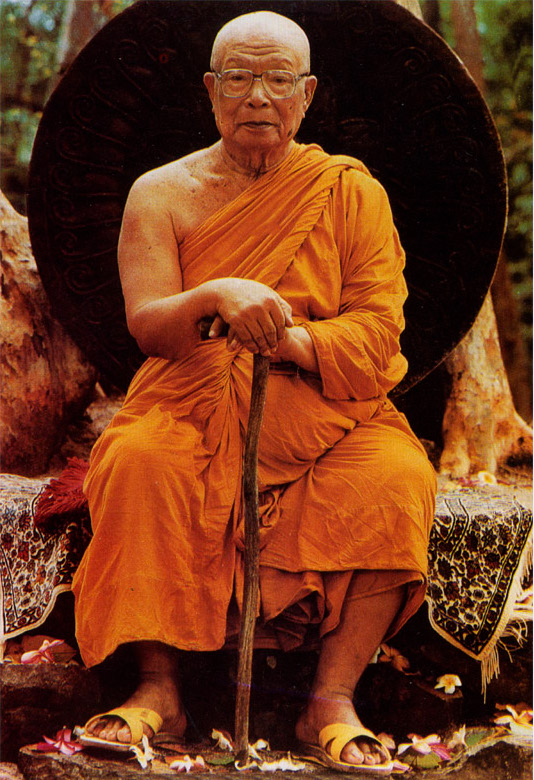
 By Buddhadasa Bhikkhu
Today, I'll speak about "Forest Wat Wild Monks." A topic like this is easy to remember and understand. It's straight-forward and clear. Since you only have a month left as monks, I think you ought to live as "forest wat wild monks," correctly and completely, for at least a little while. Later, it will probably be beneficial, that is, it might make you fit and adequate after you have disrobed. Even ordinary householders should know something about "forest wat wild monks."
These words may sound ugly, but the Buddha and the Arahants (Worthy Ones, Perfected Ones) lived in this way. Please realize that originally all of the wats, monasteries, and ashrams were outside the cities and villages. None were within the city walls. They were forest wats implicitly and in truth. To say "wild monks" is a bit hard on the ears, because the word "wild" can have bad connotations. Here, however, "wild" means the opposite of cities. Town wats and city monks are the opposite of "forest wats and wild monks." Take the meaning of "wild monk" merely to be the opposite of "city monk."
Consider Suan Mokkh a bit. We've intended for it to be a forest wat from the very start. Things I had studied led me to know more about how the Buddha lived. Understanding how he lived, I wanted to have a lifestyle like his. So I thought of supporting the forest style of living. Then, we went even further using the words "to promote vipassana-dhura." We used the phrase that was common then. They called the practice in solitary and quiet places, such as in forests, "vipassana-dhura." 2 We intended to promote vipassana-dhura, or the meditation-duty, to revive it, so we thought of having a place in the forest.
Now, although the village is encroaching, we can probably maintain the condition of a forest wat. To do so, the monks must have a discipline or system of living which is most intimate with nature. This means being comrades with nature, to sit and talk, to sit and watch, to sit and listen, together with nature. The meaning of "wild monk" is to live naturally.
In the past, the elders and old teachers called the monks who live in the forest "nature monks," while the monks in the towns and cities, especially Bangkok, were called "science monks." This is a rural way of speaking, we need not judge whether it is right or wrong: "science monks" and "nature monks." Here, we are nature monks, living in harmony with nature, close to nature, studying nature, until realizing nibbana, which is the pinnacle of nature. Please understand the words "forest wat" and "wild monks" like this.
Please take only the essential meaning of these words. If we take the essence of "forest wat," it means "the most simply way of living" and "wild monks" means "to live most simply." You can blend the two together, they mean the same thing.
So, would all of you please live in the most simple way. So far, you're not yet living most simply, although you may be close. Try to readjust things yourself, through the end of the Rains. From now on, make your living even more easy. The more simple, the more natural it is. The more natural it is, the less opportunity for "I" and "mine" to be born. Thus, it automatically becomes correct and beautiful according to our monks' way.
This is an extremely important and genuine fact. Live naturally and it will be Dhamma (Natural Truth) and Vinaya (Natural Discipline), or Nature, in and of itself. Living naturally is near to nibbana, more so than living scientifically, because nibbana is already the highest nature: naturally clean, clear, and calm. Live naturally, it helps make us clean, clear, and calm more easily.
Now, I want you to hold the general principle that Nature, the Law of Nature, Duty in line with the Law of Nature, and the Fruit received from doing Duty according to the Law of Nature, are the most important matter. This is Buddhism, it's the essence of religion without needing to call it religion. It's better to call it "Truth of Nature" or "Natural Truth."
Now, don't have regrets about anything. There isn't much time left, so you won't be missing much. Just sacrifice your pleasures and comforts. Try out this natural living which automatically has lots of cleanness, clarity, and calm. You've had enough time to read, hear talks, and study the basics of being a monk. Henceforth, know especially the things which will have the most benefit. Then your time as a monk will be over, you will have beneficial knowledge which is complete, that is, you know in general and in specifics, you know loosely and strictly, until you know how the Buddha lived.
When we speak of the Lord Buddha, never forget that he was born outdoors, awakened outdoors, realized nibbana outdoors, taught outdoors, lived outdoors, had a hut with an earthen floor, and so on. We give it as much of a try as we can. Even now, we see that we're sitting on the ground, which is much different than in the city wats. There they sit on wooden floors, on mats, on carpets, depending on the status of each wat. Some wats spread expensive carpeting in the temple building for all eternity. So they sit in their chapels on carpets. Here, we sit on the seat of the Buddha -- the ground. This is one example for you to understand what nature is like, and how different it is from the cities, and how different are the hearts of those who come sit and interact with Nature.
I've tried my best in this matter. When Suan Mokkh was first started, I slept on the ground. I slept next to the grasses in order to know their flavor. I used to sleep on the beach, too. Then, when I first slept in the "middle hut" after it was newly built, I would stretch my hand out the window to fondle the plants next to the window. This completely different feeling is the meaning of "forest wat wild monk."
Everything changes. Feelings, sensitivity, standards, what have you, they change by themselves. Matters of food, shelter, clothing, rest, sleep, aches and illness: they changed completely. They caused us to understand Nature more than when we hadn't tried yet, until finally there were no problems at all. Things which I had feared all disappeared. Fear of loneliness in deserted places, fear of spirits, fear of anything, they didn't last more than seven days. They gradually disappeared themselves. This led to mental comfort, ease, and other fruits. The mind became strong, agile, subtle, and refined. Those were its fruits. Thus, whatever I thought of doing, I could do it better than before I came to the forest, better than in the city. There's no comparison between living in Bangkok and living here. They're totally different. I can say there's more ability, more strength, more of everything. One can do anything beyond expectations and personal limitations. Whether writing a book, reading, or thinking, much more can be done.
One lives in the lowest way materially and physically, but the mind 3 goes its own separate way. It takes a higher course, because when we live simply the mind isn't pulled in. The heart is released so that it lifts up high. If we sleep comfortably, like wealthy householders, that comfort grabs the heart. It traps the heart, which can't go anywhere, can't escape, is stuck there. So live and sleep more lowly, since humble things won't trap the heart. Live humbly and the mind will rise high, will think lofty things.
Living in a humble condition, in one that can't fall lower, the mind can only proceed in a higher way. It's easy because we needn't carry or load down the mind with anything. The mind can be "normal" and free. It is free in its movements, reflections, and actions. Thus, we can freely do anything of the sort which is not like anyone else. Through the power of nature, there isn't any carelessness, we don't make mistakes. Since the mind is heedful there are no mistakes.
That the heart can find a way out like this must be considered freedom. Know the mind that is independent, that isn't caught and held by deliciousness and pleasure, by the happiness and comfort of eyes, ears, nose tongue, body, and mind.
Here I want to make a distinction. If something is in line with original nature, and there's no indulgence in new pleasures, we'll call it "natural." If it goes after new pleasures, if newly concocted for more tasty pleasures than nature, we'll call it "unnatural." They're truly different. If going naturally, the defilements arise with difficulty, they can't arise. If acting in an unnatural way, it's easy for the defilements to be born, or else it's defilement from the very start. Thus, living as nature's comrade makes it hard for the defilements. It automatically controls and prevents against the defilements (kilesa).
This is the spirit of Suan Mokkh, of setting up a place like this. When you want this enough to come here, then you ought to get it. Besides this, there isn't anything. We've tried to prevent other things from happening, so that there are only these things: how to eat, how to live, and how to sleep. We've spoken many times of the specific details of each.
I've said it before, but nobody believes me that to take exactly what nature provides is sufficient, is good enough. When we must die, then die. Don't postpone and make it difficult. It's like the medical care that has progressed to the point that people are unable to die, they can't drop. They live inhumanly, but not dead. That's too much. Heart transplants, liver transplants, and all that exceed nature. It's better not to. And please look, it doesn't make humanity any better. It doesn't create peace in the world. If mental matters don't progress, if there's only defilement -- delusion and all -- there'll be no end.4
In summary, make things humble so that they don't trap the mind. Then this heart of ours is free to think, consider, decide, and choose. Please use the mindfulness and wisdom that you receive from this style of living to choose and decide what you must in the future.
If you were born in Bangkok, you were surrounded by man-made things and raised far from the forest, much more than people born in the forest. Those born in towns and cities hardly know the meaning of "forest" or "wild." Those born in the sticks know something, but don't pay any attention. They must work, must always be doing something according to their moods, so they hardly notice how calm and clean it is. Sometimes they are even dissatisfied with it, although born in the country. Our hearts don't like it and always aim to get into "developed and beautiful" areas in the cities and capital. Thus, we don't know the taste of the forest and of Nature, even if born in the forest, even when splattered with mud, because the mind is occupied in another way.
Now you're in robes and needn't work like lay folk. The heart has a chance to know the peaceful flavors and quiet nooks of Nature, which is the cause of the mind's freedom in the first place. You ought to use this final chance here to keep walking until knowing the heart that is naturally pure, which is something like the heart of the Arahant. The Arahant's heart is just like that -- natural -- except it's that way totally. Now, we may have a heart like that, but only momentarily, temporarily. The next moment it changes off in another direction, and we can't pull it back. Try to penetrate this heart of nature.
In clear and simple terms, we call it pure nature, nature which isn't concocted ("cooked and seasoned") by anything. And we don't concoct that nature either. It exists simply, humbly, freshly, peacefully, coolly, however you want to describe it. If you know this flavor, you know the flavor of Dhamma, in its aspect of the only fruit worth having, because Dhamma's reality (literally, "body") has been captured. Those who just study and take exams never receive Dhamma's reality. All they can do is holler about it. If somehow you can catch Dhamma itself, it's like catching a crab or fish, it's something tangible. Here we can catch the substance of cleanness, clarity, and calm -- the body of Dhamma. Even temporarily is worth it. To have grasped it and seen it just once is better than never having grasped, known, or seen it at all.
The academics only memorize and recite, then take examinations, then memorize and recite some more. They think only according to what they're told. Their minds don't reach cleanness, clarity, and calm at all. From the theoretical studies or scriptures, one just gets stories and information. To phrase it more politely, one gets only a map. Actually, they don't even get the map. I know this well because I've tried that way myself. I've taken the full Dhamma Course, studied the Pali language (in which the Theravada scriptures are written), and researched continuously. It seems I got only complicated stories -- mostly mixed up and confused to boot -- without getting even a map. Those who talk of scholarship, of being Pali experts and Dhamma Masters, of having a map, they make it up, imagine, and arrange it themselves.
Actually, the real map is much clearer than all that. We must pass through, must arrive at, and receive "something" -- appropriately and sufficiently -- in order to know the correct and true map. It's as if we're making a map and must wade through that respective subject or area in order to draw the map. If we draw it from guesses and imagination, it will be a mess. If we try to make a map of everything, it's a huge mess. These scholars who have finished their studies end up with a scholarly map that's a mess. It's a mess because it is wrongly explained, wrongly remembered, wrongly taught, and, especially, wrongly interpreted. Who knows what kind of map it is. These literary maps according to the study books are a mess because they're all mixed up.
That's not our way. We'll do something, find some method, which takes the heart all the way to that city: the city of peace, the state of peace, the nature which is peace. This short cuts the map. This is the methodology of "forest wat wild monks": keep looking for and aiming at only the peaceful mind.
Just this single word "peace" has multitudinous meanings. It's easy to say "peace," but it's hard to understand and difficult to practice. But you must try. Therefore, please try to continually follow and search: "Is this peace? Is this peace?"
The word "peace" means "not troubled, not anxious, not agitated, not disturbed, not painful, not pierced." To begin, remember these meanings. On the other hand, the minds of most people are troubled, stabbed, cut, and roasted by desires, by doubts, by worries, by the kind of wishes that build castles in the sky. They usually happen all the time; you ought to get rid of them. I'm not forbidding you to want anything or do anything. I only want things to happen peacefully.
Some people may think that this runs counter to human existence in the world. Listening superficially, it may sound like that. When human beings in this world don't want peace, they will want stimulation, they will want the state that stimulates pleasure through the eyes, ears, nose, tongue, body, whichever way, all ways. They want to get excited, they don't want peace and calm. This makes it somewhat difficult to speak about these matters.
We have a choice. Stimulation, the state of having kilesa always waiting to drive and manipulate us, what's that like? And we must ask, which direction will it lead? How far will it reach? It has no end. So we could exploit this and make some money from the fact that humanity has endless wants, make a business out of humanity's endless wants, and get rich ourselves. The rich have wants that never end. They follow after these endless desires, then what kind of world will that be? This is how different it is in the cities, totally opposite from "forest wat wild monks," who want to stop, to be cool, and to be calm.
The problem is like this: the world's people don't want peace. How will we pursue peace? And when living in the middle of people who don't want peace, how will we live peacefully? Another way is to live by making money off the people who don't want peace. Now, however, we should focus on the fact that it is necessary to live in the midst of such people. How can we be peace? How can we use our understanding of this peace to solve those problems?
I still think that it can work. Please know how to calm the mind; then work with those non-peaceful people in those incredibly chaotic cities and capitals. We can have minds that are under control, are "normal,"5 are on track, are disciplined, are at peace; they do what they should. Finally, if we must work for people who are not calm, we are up to it.
In the scriptures there's a story of a woman Stream-Enterer6 whose husband is a hunter. They still were able to live together. It doesn't sound believable, and probably nobody will believe it, but that's what the scriptures say. She wasn't tainted by her husband's sins. They could live as husband and wife without losing her Stream-Entry. Think about it. You must know how to take special care of the heart. Guard the condition of peace according to your own particular skills.
Close your eyes and imagine this scene. One person is "normal" and able to smile. He works with another who always acts like a demon or devil. How can he do it? I say he can. If a person is at peace, has sufficiently trained, he can do it. But he probably wouldn't want to bother. He's more likely to find another place to work. Here, we're just trying to show that if one tries, it is possible. If one's heart is secure and "normal," there's nobody who could shake him. If anyone tried to get him to do something wicked, he wouldn't do it and would probably run away.
This talk is to help you begin to see that this matter of calmness is no obstacle. Further, it's beneficial in that it gradually transforms those who aren't calm, making them more calm and in love with calmness. One makes blessings without being conscious of it. People with Dhamma who work together with people who lack Dhamma will do good without being aware of it. They'll cure the people without Dhamma, so that Dhamma develops in them steadily.
I have seen people who have gone to work as clerks or officials, who are calm, humble, and have Dhamma. They are able to cool down bosses who fly into rages, are hurried, and lack Dhamma. Know that if we have an employee who is cool and calm, and shows it, we can't explode. We would be too ashamed, or else feel pity for him.
Even with these wat boys, some have something cool about them and others are almost the opposite. We must have our own sensitivity for this: "Ahhmm, they're totally different. With that boy there we act in one way, with this one we must act another way." Such cool kids will help to cool down the old folks and grey-hairs, if the kids have cool characters.
I believe that Dhamma isn't likely to be objectionable for use in a world lacking peace and coolness. A monk coming from correct "forest wat wild monk," who stays at a city wat with a totally different style, will have an immediate influence on the city folk. They'll notice that "we're hot and he's cool." The only question is whether or not the cool monk from the forest can guard that calm and correctness all the time. Mostly they lose it, change, and are swallowed up. If not, they must escape back to the forest. They can't handle the city, it's full of annoyances. No harm done, because we ought to be able to choose in this world. If we want peace, we have the right to find a peaceful place. But wherever the wild monk goes, he automatically teaches the "Peaceful Creed" right there. There will be some success, and some automatic "blessings," too. Make an example of peace for them to see, be truly happy for them to see, they'll be interested and some will even follow. You'll get "merit" and the world becomes a better place.
If we speak of the Arahant, various principles show that such a human being can never get hot again. So she can go to the city, to the capitol, to any chaotic place, without dying. He wouldn't die, but probably would get fed up beyond toleration, then have to flee. If she couldn't escape, she might die. But I don't think so, because he'd adjust his heart inside in an unbelievable way. There's no need to get hot with those people. Yet, what's the point of being troubled by it all, avoid it to find an appropriate place.
This talking and raising examples back and forth is to increase understanding of "forest wat wild monks." Do you know the difference between living as a forest wat wild monk and living as a city monk? You've never lived as forest wat wild monks. There's only a little time left, you better try it out quickly. Quickly live up to its standard, you'll understand the matter well. Although you return to the city later, you won't be the same. It will change you from how you were. You'll change in a good and useful way, too. So I felt we should talk about this for the sake of the time left in the Rains, that you might get more interested in the "forest wat wild monks" style.
At the beginning of the Rains, I already told you about these things, such as, don't laugh a lot, speak only a little, try to stay with Nature. But I understand you couldn't do it, and just let it go. More than enough time has passed, now you ought to be able, at least a little more than before. This means just "live like a monk (Phra) " 7 more and more. You'll know the flavor of the monk's life which we call "forest wat wild monks." You'll never have a chance to try living like a wild monk in the city. You must come to the forest, to a naturally free place, to taste and to try it, to know Dhamma of the sort the Buddha realized and proclaimed.
If not that, then why ordain?8 Each of you ought to ask yourself why you ordained? Why did you take leave to do this temporary going forth? To understand what? To sample what? To get what? With certainty -- like pounding a fist into the ground -- we answer, "to get exactly what we've been talking about." Without leaving home, you couldn't get it. You would have no chance even to see or sample or give it a try. Ordination was necessary.
Now that you've ordained, to get what the Buddha got, you must live close to how the Buddha lived. He lived and maintained life in such a way that we turn back to the "forest wat wild monks" life-style. If we don't live this way, we couldn't get, experience, or sample the Buddha's life.
The monks in the Buddha's time, the Buddha himself, and whichever founder of whatever religion, all got started in a life intimate with Nature. All of them awakened in forests surrounded by Nature. Whether the Buddha, Jesus Christ, or the prophet of any religion, they lived close to nature. To awaken as a Perfectly Self-Awakened Buddha; or to become One with God, to communicate with God, according to the religions that have a God; that moment is living as a comrade of nature. So try to remember the words: how good it is to be nature's comrade."
This means that you have accepted, have believed, and have seen that the Lord Buddha is a real Buddha (Awakened Being), the highest sort of person, who knows the best thing that humans ought to know, and you want to know that, too. This is why we make this effort. We shouldn't be tricked into believing that the Buddha taught only "householder virtue" (gharavasa-dhamma) for the lay folk.9
If he only taught ordinary household matters, he would have served no purpose, since anybody could and was teaching those things well enough already. Although the Buddha sometimes taught about householder subjects, it was solely the sort of Dhamma fit for lay folk who were looking for nibbana. The lay folk already were being taught well enough. For the Buddha to help teach these matters, he would teach the type of lay person who is ready to discover Dhamma, to reach nibbana. This brings us back to our subject.
There's merely a small amount which the Buddha taught lay folk for the sake of being lay folk. But what he taught with the fullest satisfaction of his heart was the matter ofsuññata (voidness). Some householders asked him for the Dhamma most beneficial for the household life and he came back with voidness. He told them to have voidness, namely, a heart void of "I" and "mine." Then they could do anything in the form of a householder, thus becoming householders who are ready to be Arahant, or more than half ready to proceed along the Arahant's line.
Thus, that we live like "forest wat wild monks" to understand voidness well is in the same line. It follows the trail of householders who should study voidness. You can read in all the books about voidness that they've printed how the Buddha taught voidness to lay folk.
Now, I'm afraid that those who will return to lay life, or already are householders, have not yet found voidness at all. Because the customs and traditions have changed, there's no Buddha to teach voidness to lay folk. Nor are any of the monks in the cities likely to teach voidness to householders. Then, how are lay folk going to understand voidness?
I insist that by trying to live like "forest wat wild monks" for a little while, you'll understand voidness. Although you don't call it voidness, although you don't feel you're practicing voidness, you still will get the results of practicing voidness: a heart which is void and cool, which is clean, clear, and calm.
Do your work with a heart that doesn't suffer. Receive the fruits of labor without making it a problem, not dancing with joy or going crazy over the benefits received. You can work more, until however wealthy you want, but with a different heart, that is, a cool and peaceful one. It's a heart that always wins, nothing can make it anxious. Nowadays, people can work, earn money, find status, and gain fame, but they're always losing. They're always hot, always made and kept hot. What's good about that? Before long, they'll have some nervous breakdown or drop dead.
Very few people are naturally -- "accidentally" or "flukishly" -- cool. That lay folk can have cool hearts naturally in line with Dhamma principles is, of course, possible. It isn't beyond or against their nature, but it seldom happens. It can happen with good surroundings, with good genes, or with a nervous system that nature coincidentally built to be like that. But don't cross your fingers and wait, because it's rare. Let's just say most of us are born ordinary.
What can we do to become special individuals, that is, unable to suffer? No matter what happens, we can't suffer and can't get hot. Whether rich or poor, we are unable to get hot or anxious. Who can insure that the wealthy will always be wealthy or that the poor will always be poor? Things change constantly. Especially this modern world, it changes so easily, so fast, so suddenly. Regarding the progress of humanity which is quickly, violently destroying the world with War and what have you, both changing up and changing down, don't be the least hot or anxious about it.
Should war erupt and wipe out life on earth, such people don't give it any meaning. They can still laugh because they've reached Dhamma. They've attained the sort of Dhamma that makes further suffering impossible. They have no more problems here. Impoverished for necessary reasons, they don't suffer. Not anxious or miserable, they get out of poverty before you know it. If one has Dhamma, there's no suffering. If one lacks sufficient Dhamma, there's nothing but suffering and anguish. Rich and miserable, poor and miserable: they're hot no matter what. So take the side which is neither hot nor miserable while you've got the chance.
This is why I ask you to hurry up and study-practice, hurry to try it out, hurry to find the point where suffering can't exist, the point which can't get hot. Discover as much as you can, so that your life in the future can't get hot, or is hot as little as possible, or once hot can be dropped quickly.
They call this "The Noble One" (ariya), but I don't want to talk about that. Before you know it, all kinds of distracting thoughts will come up. To be incapable of hotness is to be a Noble One, according to the particular level or state: Stream-Enterer (sotapanna), Once-Returner (sakadagami), Non-Returner (anagami), or Worthy One(arahant). Ultimately, the mind can't get hot at all. It gets hot less and less until it's unheatable and nowhere hot. The Noble One's feelings 10 are thoroughly cooled. That's the meaning of the highest level of "Arahant," the level of anupadisesa-nibbana-dhatu (the nibbana element with no fuel and heat remaining):11 thoroughly cool. The rest are progressively cool; even when hot, they aren't hot like a thickster (putthujana, worldly person) is hot. The hotness of thicksters is like being singed by fire or scalded with boiling water. The first stages of Noble Ones might feel a bit hot sometimes, but never like the thicksters burn. Nevertheless, I don't want to use these words very much, or get you stuck on or attached to using them. So let's just say "human beings." Just people, just us, all the same. Yet, we can be less hot and more cool, until we can't get hot in ordinary situations, and until we can't get hot in even the worst situations.
There are loads of the Buddha's words recorded in the Pali which encourage us to think and train so that we need not get hot. I don't have to quote the Pali any more, you can believe me that they are there. If the scriptures aren't like that, what good would they be? They teach us to be cool.
If you get hot through carelessness, be very sorry. If you haven't felt these things, you're heedless, the same as dead. If you feel them but pretend that you don't, you're shameless, lacking in hiri (moral shame) and ottappa (fear of the results of evil). To get hotter with age, to get more angry, to get worse in any way, is to lack hiri-ottappa. You must know spiritual shame and fear. The most frightening thing is to be a human who is hot, just a fool, a lost person who is full of defilement and selfishness. You can't call that a human being. Better call it a "fool."
So for the time that remains, test yourself as if taking exams. Is it hot or not? Even a small slip into hotness should make you quite sorry and ashamed. You ought to penalize yourself appropriately. You can do it without anybody knowing. But please penalize yourselves whenever careless, when going wrong on this point and becoming hot. Eventually the mind changes, becomes more careful, and can make progress along the Dhamma way.
Hot due to lust or greed is one form. Hot due to anger or hatred is another form. Hot due to delusion or ignorance is a third form. You've learned these names before, I shouldn't have to explain anymore. As soon as mindfulness is missing, ignorance takes over. It lusts and covets, it gets hot with the emotions of avarice and lust. In "negative" situations, it gets angry and hateful. It becomes hot with anger, with aversion, with malice. Then, in some cases we don't know anything: don't know the original cause, don't know what's up, don't know even what we want. We're full of doubts about what we ought to want. There's no certainty about how our life is, what should come of it, how it should be lived. This not knowing is delusion. It too is hot.
So if you want to test yourselves, it won't be difficult. The time remaining is enough to do some self-examination. Speak little, keep to yourself, and constantly observe the heart. Call it "constantly guarding the heart." It's automatic mental development, or meditation. When always watching over the heart, that's vipassana, that's meditation. If you find it's hot, then know it's hot, that it's still low, wrong, and must be cured. And you better have some regret. At the same time, know how it is hot and what caused the hotness.
In the end, you will find the truth exactly as the Buddha taught. Before, we didn't know it, we just heard about it. Now we know that thing truly. We understand Dhamma from ourselves, without needing to know the Buddha. And if they force us to speak, we automatically will speak the same as the Buddha regarding the nature of greed, hatred, and delusion.
This very thing is the Buddha's supreme aim, yet the big monks never talk about it. They usually threaten us not to raise ourselves up as equals to the Buddha, not to insult the Buddha. In this matter, if you want to understand something, I can tell you straight that the Buddha wanted people to reach the Dhamma without needing to believe their teacher, and then are able to explain that Dhamma without needing to repeat their teacher's words. Did you listen right? Listen again: know the Dhamma without believing the Buddha. Because we know personally, then we know the same thing as the Buddha. Then, if we must speak for the sake of others, we needn't repeat after the Buddha, needn't quote Pali, needn't recite the texts. Just speak according to experience. Then it will be identical to what the Buddha said. Then, people needn't repeat after the Buddha, they can speak their own hearts. This state of affairs is what the Buddha himself wanted. You can find it in the Pali, in many places. That they must memorize and recite the Buddha's words, afraid of getting just one word wrong, that's merely a custom, a tradition of people who don't really know, or still don't really know, still don't understand Dhamma.
So we hurry to know Dhamma. That itself will be in line with what the Buddha realized. We can speak out according to what we know; it will be identical with what the Buddha said. It might look like one's a Buddha oneself, so they forbid anyone to do such a thing, afraid that one is raising oneself up equal to the Buddha or is disparaging the Buddha. This here is an obstacle preventing us from progressing along the Buddha's path.
OK, so we study Dhamma from within, by living in the midst of Nature which reveals and demonstrates the Dhamma all the time. Uphold a form of life which doesn't sound very good at all: live like a forest wat wild monk. It doesn't sound right, but it is most meaningful, most real, and most necessary to live in this way up until you must disrobe. You may change back to the householder's way of life, but this should stick with you: knowledge, understanding, and certainty about the Dhamma which makes us incapable of hotness. Take it with you. By bathing yourself in coolness until understanding coolness, you can't do wrong or get hot. You'll probably get cooler and cooler because it's something naturally attractive: the absence of dukkha (suffering). Please don't forget this short phrase: "forest wat wild monks" is the way of living for the person who wants to reach the Buddha quickly.
Translated by Santikaro Bhikkhu
Endnotes
1. A wat (Thai) is a place were monks (bhikkhus) live, study, and practice. The wat usually serves the local community and is treated as public domain. So, "monastery" or "temple" doesn't quite convey the atmosphere and purpose of a wat. This talk was given 9 September 1976 to a group of temporary monks, who ordained for the three month long Rains Retreat, following an ancient Thai tradition. (Short additions have been made from another talk, "Suan Mokkh and Nature," which was given to a similar group 30 July 1979.) This translation originally appeared in Monastic Studies (No. 19, 1989), The Benedictine Priory of Montreal, Montreal, Quebec. First electronic edition with kind permission.
2. Literally, the "burden (or task) of insight development," that is, meditation (as opposed to book study).
3. "Heart" and "mind" are interchangeable. Both are partial renderings of the Pali word citta. Similar Thai words don't make a distinction between heart and mind, as we do in English.
4. Tragically, when Ajarn Buddhadasa went into a coma just before his 87th birthday, this teaching and his personal wishes were ignored.
5. The meaning of "normal" (pakati) here is not "common, typical, ordinary," but refers to the original, natural state of peace when mind is void of "I" and "mine".
6. Sotapanna: first stage of "nobility," arises from the first "glimpse of nibbana" which ends belief in oneself as an individual "personality."
7. Phra comes from the Pali vara which means "excellent, splendid, best, noble."
8. Pabbajja, to leave, to go forth from, the household life and its sensual concerns.
9. Gharavasa (household life, lay life) is traditionally opposed and considered spiritually inferior to the homeless life of monks. While admitting the external and social differences, Ajarn Buddhadasa emphasizes that spiritually everyone has the same duty.
10. Vedana: basic mental feelings of pleasure, pain, and neither-pleasure-nor-pain. Emotions are not included here.
11. The second of two distinctions in how nibbana is experienced. The first is sa-upadisesa-nibbana-dhatu (the nibbana element with fuel remaining). "Fuel" refers to the seeds of positive and negative which are the bases of desire, attachment, and suffering. There is no difference in nibbana itself.
Article source: www.dharmaweb.org
--------------------------------------
Technorati: Buddhism Buddha Buddhist Dharma Compassion Wisdom Religion Meditation Zen Philosophy Spirituality Inspiration Peace Insight
Thursday, July 22, 2010
Forest Wat, Wild Monks

Monday, July 12, 2010
Pushing the Limits
 Thanissaro Bhikkhu on desire, imagination, and the Buddhist path.
All phenomena, the Buddha once said, are rooted in desire. Everything we think, say, or do—every experience—comes from desire. Even we come from desire. We were reborn into this life because of our desire to be. Consciously or not, our desires keep redefining our sense of who we are. Desire is how we take our place in the causal matrix of space and time. The only thing not rooted in desire is nirvana, for it’s the end of all phenomena and lies even beyond the Buddha’s use of the word “all.” But the path that takes you to nirvana is rooted in desire—in skillful desires. The path to liberation pushes the limits of skillful desires to see how far they can go.
The notion of a skillful desire may sound strange, but a mature mind intuitively pursues the desires it sees as skillful and drops those it perceives as not. Basic in everyone is the desire for happiness. Every other desire is a strategy for attaining that happiness. You want an iPod, a sexual partner, or an experience of inner peace because you think it will make you happy. Because these secondary desires are strategies, they follow a pattern. They spring from an inchoate feeling of lack and limitation; they employ your powers of perception to identify the cause of the limitation; and they use your powers of creative imagination to conceive a solution to it.
But despite their common pattern, desires are not monolithic. Each offers a different perception of what’s lacking in life, together with a different picture of what the solution should be. A desire for a sandwich comes from a perception of physical hunger and proposes to solve it with a Swiss on rye. A desire to climb a mountain focuses on a different set of hungers—for accomplishment, exhilaration, self-mastery—and appeals to a different image of satisfaction. Whatever the desire, if the solution actually leads to happiness, the desire is skillful. If it doesn’t, it’s not. However, what seems to be a skillful desire may lead only to a false or transitory happiness not worth the effort entailed. So wisdom starts as a meta-desire: to learn how to recognize skillful and unskillful desires for what they actually are.
Unskillful desires can create suffering in a variety of ways. Sometimes they aim at the impossible: not to grow old or die. Sometimes they focus on possibilities that require distasteful means—such as lying or cheating to get ahead in your job. Or the goal, when you get it, may not really keep you happy. Even the summit of Everest can be a disappointment. When it’s not, you can’t stay there forever. When you leave, you’re left with nothing but memories, which can shift and fade. If you did mean or hurtful things to get there, their memory can burn away any pleasure that memories of the summit might hold.
In addition, desires often pull in opposite directions. Your desire for sex, for instance, can get in the way of your desire for peace. In fact, conflict among desires is what alerts us to how painful desire can be. It’s also what has taught each desire how to speak, to persuade, to argue or bully its way into power. And just because a desire is skillful doesn’t mean it’s more skillful at arguing its case than the unskillful ones, for those can often be the most intransigent, the most strident, the slickest in having their way. This means that wisdom has to learn how to strategize, too, to strengthen skillful desires so that less skillful desires will listen to them. That way desires can be trained to work together toward greater happiness. This is how a mature and healthy mind works: conducting a dialogue not so much between reason and desire as between responsible desires and irresponsible ones.
Even in a mature mind, however, the dialogue often yields compromises that don’t really go to the heart: snatches of sensual pleasure, glimpses of spiritual peace, nothing really satisfying and whole. Some people, growing impatient with compromise, turn a deaf ear to prudent desires and tune into demands for instant gratification—all the sex, power, and money they can grab. But when the rampage of gratification wears itself out, the damage can take lifetimes to set right. Other people try their best to accept the compromise among desires, trying to find a measure of peace by not reaching for what they see as impossible. Yet this peace, too, depends on a deaf inner ear, denying the underlying truth of all desires: that a life of endless limitations is intolerable.
Both sorts of people share a common assumption that true, unlimited happiness lies beyond reach. Their imaginations are so stunted that they can’t even conceive of what a true, unlimited happiness in this lifetime would be.
What made the Buddha special was that he never lowered his expectations. He imagined the ultimate happiness—one so free from limit and lack that it would leave no need for further desire—and then treasured his desire for that happiness as his highest priority. Bringing all his other desires into dialogue with it, he explored various strategies until he found one that actually attained that unlimited goal. This strategy became his most basic teaching: the Four Noble Truths.
Most people, when looking at the Four Noble Truths, don’t realize that they’re all about desire. They’ve been taught that the Buddha gave only one role to desire—as the cause of suffering. Because he says to abandon the cause of suffering, it sounds like he’s denying any positive role to desire and its constructive companions: creativity, imagination, and hope. This perception, though, misses two important points. The first is that all four truths speak to the basic dynamic of desire on its own terms: perception of lack and limitation, the imagination of a solution, and a strategy for attaining it. The first truth teaches the basic lack and limitation in our lives—the clinging that constitutes suffering—while the second truth points to the types of desires that cause clinging: desires for sensuality, becoming, and annihilation. The third truth expands our imagination to encompass the possibility that clinging can be totally overcome. The fourth truth, the path to the end of suffering, shows how to strategize so as to overcome clinging by abandoning its cause.
The second point that’s often missed is that the Noble Truths give two roles to desire, depending on whether it’s skillful or not. Unskillful desire is the cause of suffering; skillful desire forms part of the path to its cessation. Skillful desire undercuts unskillful desire, not by repressing it, but by producing greater and greater levels of satisfaction and well-being so that unskillful desire has no place to stand. This strategy of skillful desire is explicit in the Buddha’s explanation of right effort:
"What is right effort? There is the case where a monk [here meaning any meditator] generates desire, endeavors, arouses persistence, upholds, and exerts his intent for the sake of the non-arising of evil, unskillful mental qualities that have not yet arisen... for the sake of the abandoning of evil, unskillful qualities that have arisen... for the sake of the arising of skillful qualities that have not yet arisen... for the maintenance, non-confusion, increase, plenitude, development, and culmination of skillful qualities that have arisen. This is called right effort." (Digha Nikaya 22)
As this formula shows, the crucial elements for replacing unskillful mental qualities with skillful ones are desire, persistence, and intent. Desire gives the initial impetus and focus for right effort, while persistence provides staying power. Intent is the most complex factor of the three. The Pali word here, citta, also means “mind,” and in this context it means giving your whole mind to the work at hand: all your powers of sensitivity, intelligence, discernment, and ingenuity. You don’t want your mind to be split on this issue; you want all of its powers working together on the same side.
These three qualities—desire, persistence, and intent—underlie every attempt to master a skill. So it’s useful, in undertaking the path, to reflect on how you’ve used these qualities to master skills in the past. The Buddha made this point in his many similes comparing the person on the path to a master craftsman—a musician, carpenter, surgeon, acrobat, cook. As with any skill, there are many steps to developing the path, but four stand out.
The first is to use your ingenuity to fight off the chorus of inner voices trying to dissuade you from making the effort to be skillful in the first place. These voices are like devious lawyers representing strongly entrenched interests: all your threatened unskillful desires. You have to be quick and alert in countering their arguments, for they can come from all sides, sounding honest and wise even though they’re not. Here are some of the arguments these voices may use, along with a few effective responses:
Trying to manipulate your desires like this is unnatural. Actually, you’re already manipulating your desires all the time, when you choose one desire over another, so you might as well learn to do it skillfully. And there are plenty of people out there only too happy to manipulate your desires for you—think of every advertisement you’ve ever seen, heard, or read—so it’s better to put the manipulation in more trustworthy hands: your own.
Trying to change your desires is an attack on your very self. This argument works only if you give your sense of self—which is really just a grab bag of desires—more solidity than it deserves. You can turn the argument on its head by noting that since your “self ” is a perpetually changing line-up of strategies for happiness, you may as well try changing it in a direction more likely to achieve true happiness.
To think of “skillful” and “unskillful” desires is dualistic and judgmental. You don’t want nondualistic mechanics working on your car, or nondualistic surgeons operating on your brain. You want people who can tell what’s skillful from what’s not. If you really value your happiness, you’ll demand the same discernment in the person most responsible for it: yourself.
It’s too goal-oriented. Just accept things as they are in the present. Every desire tells you that things in the present are limited and lacking. You either accept the desire or you accept the lack. To accept both at once is to deny that either has any real truth. To try to dwell peacefully in the tension between the two—in a “path of no craving” to be rid of either—is what the Buddha called limited equanimity, and what one Thai forest master called the equanimity of a cow.
It’s a futile attempt to resist such a divine and mysterious power. Desire seems overwhelming and mysterious simply because we don’t know our minds. And where would we be if we kept slapping the term “divine” or “cosmic” on forces we didn’t understand?
Arguing with unskillful desires is too much work. Consider the alternative: an endless wandering from one set of limitations to another, continually seeking happiness and yet finding it always slipping from your grasp, repeatedly taking a stance with one desire one moment and shifting to another desire the next. Right effort at least gives you one steady place to stand. It’s not adding a more demanding desire to the chaotic mix; it’s offering a way to sort out the mess. And the Buddha’s path holds open the hope of an unlimited happiness, preceded by increasing levels of happiness all along the path. In short, his alternative is actually the one that’s more enjoyable and involves less work.
Once you’ve silenced these voices, the next step is to take responsibility for your actions and their consequences. This requires being willing to learn from your mistakes. Several years ago, a sociologist studied students in a neurosurgery program to see what qualities separated those who succeeded from those who failed. He found ultimately that two questions in his interviews pointed to the crucial difference. He would ask the students, “Do you ever make mistakes? If so, what is the worst mistake you’ve ever made?” Those who failed the program would inevitably answer that they rarely made mistakes or else would blame their mistakes on factors beyond their control. Those who succeeded in the program not only admitted to many mistakes but also volunteered information on what they would do not to repeat those mistakes in the future.
The Buddha encouraged this same mature attitude in his first instructions to his son, Rahula. He told Rahula to focus on his intentions before acting, and on the results of his actions both while he was doing them and after they were done. If Rahula saw that his intentions would lead to harm for himself or others, he shouldn’t act on them. If he saw that his thoughts, words, or deeds actually produced harm, he should resolve never to repeat them, without at the same time falling into remorse. If, on the other hand, he saw no harmful consequences from his actions, he should take joy in his progress on the path, and use that joy to nourish his continued practice.
Although the Buddha aimed these instructions at a seven-year-old child, the pattern they outline informs every level of the practice. The whole path to awakening consists of sticking to the most skillful desire; you progress along the path as your sense of “skillful” gets more refined. If you act on an unskillful desire, take responsibility for the consequences, using them to educate that desire as to where it went wrong. Although desires can be remarkably stubborn, they share a goal—happiness—and this can form the common ground for an effective dialogue: If a desire doesn’t really produce happiness, it contradicts its reason for being.
The best way to make this point is to keep tracing the thread from the desire to its resulting actions and their consequences. If the desire causes suffering to others, notice how their corresponding desire for happiness leads them to undermine the happiness you seek. If the desire aims at a happiness based on things that can age, grow ill, die, or leave you, notice how that fact sets you up for a fall. Then notice how the distress that comes from acting on this sort of desire is universal. It’s not just you. Everyone who has acted, is acting, or will act on that desire has suffered in the past, is suffering right now, and will suffer in the future. There’s no way around it.
Unskillful desires don’t really give way, though, until you can show that other, less troublesome desires really can produce happiness. This is why the Buddha emphasized learning how to appreciate the rewards of a virtuous, generous life: the joy in fostering the happiness of others, the solid dignity and self-worth in doing the hard but the right thing. It’s also why his path centers on states of blissful, refreshing concentration. Accessing this refreshment in your meditation gives you immediate, visceral proof that the Buddha was no killjoy. The desires he recommends really do produce a happiness that can give you the strength to keep on choosing the skillful path.
That’s the next step: patiently and persistently sticking with the desire to do the skillful thing in all situations. This isn’t a matter of sheer effort. As any good sports coach will tell you, hours of practice don’t necessarily guarantee results. You have to combine your persistence with intent: sensitivity, discernment, ingenuity. Keep an eye out for how to do things more efficiently. Try to see patterns in what you do. At the same time, introduce play and variety into your practice so that the plateaus don’t get boring and the downs don’t get you down.
The Buddha makes similar points in his meditation instructions. Once you’ve mastered a state of concentration, see where it still contains elements of stress. Then look for patterns to that stress: what are you doing to cause it? Find ways to gladden the mind when it’s down, to liberate it from its confinements, to steady it when it gets restless. In this way, as you learn to enjoy rising to the challenges of meditation, you also gain familiarity with subtle patterns of cause and effect in the mind.
The fourth step, once you’ve mastered those patterns, is to push their limits. Again, this isn’t simply a matter of increased effort. It’s more a rekindling of your imagination to explore the unexpected side-alleys of cause and effect. A famous cellist once said that his most exhilarating concert was one in which he broke a string on his cello and decided to finish the piece he was playing on the remaining strings, refingering it on the spot. The most obvious strings in meditation are the specific techniques for fostering stillness and insight, but the more interesting ones are the assumptions that underlie the quest for skill: lack, strategy, dialogue, your sense of self. Can you learn to do without them? There comes a point in your meditation when the only way for greater happiness is to begin questioning these assumptions. And this leads to some intriguing paradoxes: If desire springs from a sense of lack or limitation, what happens to desire when it produces a happiness with no lack or limitation at all? What’s it like not to need desire? What would happen to your inner dialogue, your sense of self? And if desire is how you take your place in space and time, what happens to space and time when desire is absent?
The Buddha encouraged these queries by describing the awakened person as so undefined and unlimited that he or she couldn’t be located in the present life or described after this life as existing, not existing, neither, or both. This may sound like an abstract and unreachable goal, but the Buddha demonstrated its human face in the example of his person. Having pushed past the limits of cause and effect, he was still able to function admirably in this life, happy in even the most difficult circumstances, compassionately teaching people of every sort. And there’s his testimony that not only monks and nuns, but also lay people—even children—had developed their skillful desires to the point where they gained a taste of awakening as well.
So imagine that. And listen to any desire that would take you in that direction, for that’s your path to true happiness.
Thanissaro Bhikkhu is the abbot of Metta Forest Monastery near San Diego, California. He is the translator of Pure and Simple: The Extraordinary Teachings of a Thai Buddhist Laywoman [Wisdom Publications, 2005].
Article source: www.tricycle.com
--------------------------------------
Technorati: Buddhism Buddha Buddhist Dharma Compassion Wisdom Religion Meditation Zen Philosophy Spirituality Inspiration Peace Insight
Thursday, June 17, 2010
If You Don't Have Anything Nice To Say...
Valuable advice from the late Thai master Phra Ajaan Dune Atulo, known to his students as Luang Pu
In one of Luang Pu’s branch meditation monasteries there lived a group of five or six monks who wanted to be especially strict in their practice, so they made a vow not to talk throughout the Rains Retreat. In other words, no word would come out of their mouths except for the daily chanting and the bi-weekly Patimokkha chant. After the end of the Rains they came to pay their respects to Luang Pu and told him of their strict practice: In addition to their other duties, they were also able to stop speaking for the entire Rains.
Luang Pu smiled a bit and said:
“That’s pretty good. When there’s no speaking, then no faults are committed by way of speech. But when you say that you stopped speaking, that simply can’t be. Only the noble ones who enter the refined attainment of cessation, where feeling and perception stop, are able to stop speaking. Aside from them, everyone’s speaking all day and all night long. And especially those who vow not to speak: They talk more than anyone else, it’s simply that they don’t make a sound that others can hear.”
From Gifts He Left Behind, compiled by Phra Bodhinandamuni and translated by Thanissaro Bhikkhu.
Article source: www.tricycle.com
~End of Post~
--------------------------------------
Technorati:
Buddhism Buddha Buddhist Dharma Compassion Wisdom Religion Meditation Zen Philosophy Spirituality Inspiration Peace Insight
Saturday, May 22, 2010
Meeting the Dharma Alone

A late Thai master's final advice on walking the path to enlightenment
By Ajahn Chah
People may look at you and feel that your way of life, your interest in dharma, makes no sense. Others may say that if you want to practice dharma, you ought to ordain. Ordaining or not ordaining isn’t the crucial point. It’s how you practice.
Laypeople live in the realm of sensuality. They have families, money, and possessions, and are deeply involved in all sorts of activities. Yet sometimes they will gain insight and see dharma before monks and nuns do. Why is this? It’s because of their suffering from all these things. They see the fault and can let go. They can put it down after seeing clearly in their experience. Seeing the harm and letting go, they are able to make good sense of their position in the world and benefit others.
We ordained people, on the other hand, might sit here daydreaming about lay life, thinking how great it could be. “Oh yeah, I’d work my fields and make money, then I could have a nice family and a comfortable home.” We don’t know what it’s really like. The laypeople are out there doing it, breaking their backs in the fields, struggling to earn some money and survive. But for us, it’s only fantasy.
The laypeople live in a certain kind of thoroughness and clarity. Whatever they do, they really do it. Even getting drunk, they do it thoroughly and have the experience of what it actually is, while we can only imagine what it’s like. So, because of their experience, they may become tired of things and realize the dharma quicker than monks can.
You should be your own witness. Don’t take others as your witness. This means learning to trust yourself. People may think you’re crazy, but never mind. It only means they don’t know anything about dharma. But if you lack confidence and instead rely on the opinions of unenlightened people, you can easily be deterred. In Thailand these days, it’s hard for young people to sustain an interest in dharma. Maybe they come to the monastery a few times, and then their friends start teasing them, complaining: “Since you started going to the monastery, you don’t want to hang out or go drinking anymore. What’s wrong with you?” So they often give up the path.
Others’ words can’t measure your practice, and you don’t realize the dharma because of what others say. I mean the real dharma. The teachings others can give you are to show you the path, but that isn’t real knowledge. When people genuinely meet the dharma, they realize it directly within themselves. So the Buddha said that he is merely the one who shows the way. In teaching us, he is not accomplishing the way for us. It is not so easy as that. It’s like someone who sells us a plow to till the fields. He isn’t going to do the plowing for us. We have to do that ourselves. Don’t wait for the salesman to do it. Once he’s made the sale, he takes the money and splits. That’s his part.That’s how it is in practice. The Buddha shows the way. He’s not the one who does it for us. Don’t expect the salesman to till your field. If we understand the path in this way, it’s a little more comfortable for us, and we will do it ourselves. Then there will be fruition.
Teachings can be most profound, but those who listen may not understand. Never mind. Don’t be perplexed over profundity or lack of it. Just do the practice wholeheartedly, and you can arrive at real understanding—it will bring you to the place the teachings talk about.
Don’t rely on the perceptions of ordinary people. Have you read the story about the blind men and the elephant? It’s a good illustration. Suppose there’s an elephant, and a group of blind people are trying to describe it. One touches the leg and says it’s like a pillar. Another touches the ear and says it’s like a fan. Another touches the tail and says, “No, it’s not a fan, it’s like a broom.” Another touches the body and says it’s something else again from what the others say.
There’s no resolution. Each blind person touches part of the elephant and has a completely different idea of what it is. But it’s the same one elephant. It’s like this in practice. With a little understanding or experience, you get limited ideas. You can go from one teacher to the next seeking explanations and instructions, trying to figure out if they are teaching correctly or incorrectly and how their teachings compare to each other. Some people are always traveling around to learn from different teachers. They try to judge and measure, so when they sit down to meditate they are constantly in confusion about what is right and what is wrong. “This teacher said this, but that teacher said that. One guy teaches in this way, but the other guy’s methods are different. They don’t seem to agree.” It can lead to a lot of doubt.
You might hear that certain teachers are really good, and so you go to receive teachings from Thai ajahns, Zen masters, Vipassana teachers, and others. It seems to me that most of you have probably had enough teaching, but the tendency is to always want to hear more, to compare, and to end up in doubt as a result. Each successive teacher might well increase your confusion further.
Thus the Buddha said, “I am enlightened through my own efforts, without any teacher.” A wandering ascetic asked him, “Who is your teacher?” The Buddha answered, “I have no teacher. I attained enlightenment by myself.” But that wanderer just shook his head and went away. He thought the Buddha was making up a story and had no interest in what he said. He believed it wasn’t possible to achieve anything without a teacher or a guide.
You study with a spiritual teacher, and she tells you to give up greed and anger. She tells you they are harmful and that you need to get rid of them. Then you may practice and do that. But getting rid of greed and anger doesn’t come about just because she taught you; you have to actually practice and accomplish that. Through practice you come to realize something for yourself. You see greed in your mind and give it up. You see anger in your mind and give it up. The teacher doesn’t get rid of them for you. She tells you about getting rid of them, but it doesn’t happen just because she tells you. You do the practice and come to realization. You understand these things for yourself.
It’s like the Buddha is catching hold of you and bringing you to the beginning of the path, and he tells you, “Here is the path—walk on it.” He doesn’t help you walk. You do that yourself. When you do travel the path and practice dharma, you meet the real dharma, which is beyond anything that anyone can explain to you. So one is enlightened by oneself, understanding past, future, and present, understanding cause and result. Then doubt is finished.
We talk about giving up and developing, renouncing and cultivating. But when the fruit of practice is realized, there is nothing to add and nothing to remove. The Buddha taught that this is the point we want to arrive at, but people don’t want to stop there. Their doubts and attachments keep them on the move, keep them confused, keep them from stopping. So when one person has arrived but others are somewhere else, they won’t be able to make any sense of what he may say about it. They might have some intellectual understanding of the words, but this is not real knowledge of the truth.
Usually when we talk about practice we talk about what to develop and what to renounce, about increasing the positive and removing the negative. But the final result is that all of these are done with. There is the level of sekha, the person who needs to train in these things, and there is the level of asekha, the person who no longer needs to train in anything. When the mind has reached the level of full realization, there is nothing more to practice. Such a person doesn’t have to make use of any of the conventions of teaching and practice. It’s spoken of as someone who has gotten rid of the defilements.
The sekha person has to train in the steps of the path, from the very beginning to the highest level. When she has completed this, she is called asekha, meaning she no longer has to train, because everything is finished. The things to be trained in are finished. Doubts are finished. There are no qualities to be developed. There are no defilements to remove. This is talking about the empty mind. Once this is realized, you will no longer be affected by whatever good or evil there is. You are unshakable no matter what you meet, and you live in peace and happiness.
In this realm of impermanence, there will be times when we cannot find spiritual teachers to point out the path to us. When there is no spiritual guidance for people, we become thickly obscured by craving, and society in general is ruled by desire, anger, and delusion. So at the present time, though the Buddhist religion may be struggling to survive, though in general the way it’s practiced is far from the truth of what really is, we should make the most of the opportunity we do have.
When the Buddha passed into final nirvana, the different types of disciples had different feelings. There were those who had awakened to the dharma, and when they saw the Buddha enter nirvana, they were happy: “The Lord Buddha is well-gone; he has gone to peace.” But those whose defilements were not yet finished thought, “The Buddha has died! Who will teach us now? The one we bowed down before is gone!” So they wailed and shed tears. That’s really bad, crying over the Buddha like a bunch of bums. Thinking like fools, they feared no one would teach them anymore. But those who were awakened understood that the Buddha is just this dharma that he has taught us; though he passes away, his teachings are still here. So their spirits were still strong, and they did not lack for means of practice, because they understood that the Buddha does not die.
We can easily see that except for the dharma, there is nothing that will relieve the trouble and distress in the world and cool the fires of beings’ torment. Ordinary people of the world are struggling, fighting, suffering, and dying because they are not following a true spiritual path. So let’s make efforts to devote our minds and bodies to discovering virtue and spirituality, to becoming real human beings who live according to the dharma of humans. We don’t have to look at others and be critical of their lack of virtue. Even when those close to us can’t practice, we should do what we can first. Before we worry about the deficiencies of others, those of us who understand and can practice should do that straightaway.
Outside of the dharma, there isn’t anything that will bring peace and happiness to this world. Outside of dharma, there is only the struggle of winning and losing, envy and ill will. One who enters the dharma lets go of these things and spreads lovingkindness and compassion instead. Even a little bit of such dharma is of great benefit. Whenever an individual has such qualities in the heart, the Buddha’s way is flourishing.
Ajahn Chah (1919—1992) was a beloved Thai Buddhist master who was an important influence and spiritual mentor for a generation of American Buddhist teachers.
From Everything Arises, Everything Falls Away by Ajahn Chah, ©2005 by Paul Bretier, translator. Reprinted with permission of Shambhala Publications, Inc.
Article Source: www.tricycle.com
--------------------------------------
Technorati: Buddhism Buddha Buddhist Dharma Compassion Wisdom Religion Meditation Zen Philosophy Spirituality Inspiration Peace Insight
Thursday, May 06, 2010
Being Natural

By Master Sheng-Yen
Let it go and be spontaneous,
Experience no going or staying.
Accord with your nature, unite with the Way,
Wander at ease, without vexation.
THE MOST IMPORTANT THING in practice is to be natural and spontaneous. Being natural does not mean neglecting everything. It requires careful attention. In meditation, you should sit in a natural posture and use your mind in a natural way. Sitting in a natural posture means sitting just right. If you are comfortable when you first assume the sitting posture, even if pains develop in your legs later on, that is still natural. It is unnatural, however, to sit bent over or leaning to one side, or tipping your head back. A natural posture should follow the demands of your physiology. It is not natural to tighten your stomach muscles or to straighten your back by protruding your chest.
To use your mind in a natural way means to avoid trying to control it. The more you try to control your mind, the more stray thoughts will come up to botheryou. In fact, the very fear of stray thoughts is another stray thought. Therefore, if you have many stray thoughts, consider it a natural phenomenon and do not despise them. But on the other hand, if you completely give in to a train of wandering thoughts, that is not correct either. What is the best approach? Pay close attention to the method. If you do that, stray thoughts will be kept to a minimum. It is not that they will not arise, but you will not worry about them. If you are really paying attention to the method, you will be aware of a stray thought as soon as it arises. When it comes up, just let it go. Do not be afraid that another thought may follow it. That fear is an extra stray thought. It is just like a person who is carrying a stack of bowls. If someone says to him, "Be careful! You're going to drop them!" he will drop them. But if nobody said anything, he would just keep going.
Do not fear failure. Whatever happened in the past is past; do not worry about it happening again. Before you meet with success, failure is natural and necessary. As a baby learns to walk, it keeps falling down. Is this failure? Throughout our life we go through similar processes: going to school, pursuing a career, practicing Ch'an. After my first book, someone said to me, "Now you're a success." I said, "No. That book was a failure. I would write it much better if I had to do it again." It is the same with practice; there is never a successful conclusion. When you are working hard, failure is natural. If you have never failed, you have never tried.
ON THE OTHER HAND, you should not have a defeatist attitude, thinking: "As long as I'm going to fail, let me fail." According to Buddhism, nothing can be a success. If you were elected president of the United States, would that be a success? Later on, you would most likely be criticized as a failure. Even President Lincoln would probably consider himself a failure. This is natural. It is when you do not feel successful that you put in the effort. When you no longer need to make an effort, that is success, or liberation. At that point, there are no more vexations. Nevertheless, you have neither thrown away vexations nor grasped liberation. If you want to hold on to enlightenment and keep away vexations, that is not the true natural state.
But to follow your own nature, in this sense, is not the same as following your personal habits or whims, as in the expression "be natural." Nature here refers to your self-nature, or Buddha-nature. Some people think that one can become a buddha through meditation. This is wrong. The potential for Buddhahood is within your own nature. If it were true that Buddhahood depended on meditation, then if you stopped meditating after becoming a buddha, you would become a common person again. The objective of practice is to be in accord with the natural way, so that your true nature can manifest itself. Just practice according to the methods taught by the Buddha and do not worry about being a success. The Heart Sutra says, "There is no wisdom and no attainment." Although practice may be trying, even physically painful, if your heart is carefree, nothing will bother you. A carefree approach does not mean not caring about how you practice; it means considering anything that happens as natural. There may be some pain, but there will be no suffering. There is nothing in your mind that you cannot put down.
Master Sheng-Yen is the Resident Teacher at the Ch'an Meditation Center in Elmhurst, New York. Excerpted from Faith in Mind: A Guide to Ch'an Practice by Master Sheng-Yen, reprinted with permission from Dharma Drum Publications.
Article Source: www.tricycle.com
~End of Post~
--------------------------------------
Technorati: Buddhism Buddha Buddhist Dharma Compassion Wisdom Religion Meditation Zen Philosophy Spirituality Inspiration Peace Insight
Your Mind is Your Religion
 Image © Carol Royce-Wilder
Lama Yeshe teaches the importance of regular mental check-ups.
By Lama Yeshe
Lama YesheWHEN I TALK ABOUT MIND, I'm not just talking about my mind, my trip. I'm talking about the mind of each and every universal living being. The way we live, the way we think-everything is dedicated to material pleasure. We consider sense objects to be of utmost importance and materialistically devote ourselves to whatever makes us happy, famous, or popular. Even though all this comes from our mind, we are so totally preoccupied by external objects that we never look within, we never question why we find them so interesting.
As long as we exist, our mind is an inseparable part of us. As a result, we are always up and down. It is not our body that goes up and down, it's our mind-this mind whose way of functioning we do not understand-not just our body, but our mind. Therefore, sometimes we have to examine ourselves-not just our body, but our mind. After all, it is our mind that is always telling us what to do. We have to know our own psychology, or, in religious terminology, perhaps, our inner nature. Anyway, no matter what we call it, we have to know our own mind.
Don't think that examining and knowing the nature of your mind is just an Eastern trip. That's a wrong conception. It's your trip. How can you separate your body, or your self-image, from your mind? It's impossible. You think you are an independent person, free to travel the world, enjoying everything. Despite what you think, you are not free. I'm not saying that you are under the control of someone else. It's your own uncontrolled mind, your own attachment that oppresses you. If you discover how you oppress yourself, your uncontrolled mind will disappear. Knowing your own mind is the solution to all your problems.
One day the world looks so beautiful; the next day it looks terrible. How can you say that? Scientifically, it's impossible that the world can change so radically. It's your mind that causes these appearances. This is not religious dogma; your up and down is not religious dogma. I'm not talking about religion; I'm talking about the way you lead your daily life, which is what sends you up and down. Other people and your environment don't change radically; it's your mind. I hope you understand that.
Similarly, one person thinks that the world is beautiful and people are wonderful and kind, while another thinks that everything and everyone is horrible. Who is right? How do you explain that scientifically? It's just their individual mind's projection on the sense world. You think, “Today is like this; tomorrow is like that; this man is like this; that woman is like that.” But where is that absolutely fixed, forever-beautiful woman? Who is that absolutely forever-handsome man? They are nonexistent-they are simply creations of your own mind.
Do not expect material objects to satisfy you or to make your life perfect; it's impossible. How can you be satisfied by even vast amounts of material objects? How will sleeping with hundreds of different people satisfy you? It will never happen. Satisfaction comes from the mind.
If you don't know your own psychology, you might ignore what's going on in your mind until it breaks down and you go completely crazy. People go mad through lack of inner wisdom, through their inability to examine their own mind. They cannot explain themselves to themselves; they don't know how to talk to themselves. Thus they are constantly preoccupied with all these external objects, while within, their mind is running down until it finally cracks. They are ignorant of their internal world, and their minds are totally unified with ignorance instead of being awake and engaged in self-analysis. Examine your own mental attitudes. Become your own therapist.
You are intelligent; you know that material objects alone cannot bring you satisfaction, but you don't have to embark on some emotional, religious trip to examine your own mind. Some people think that they do; that this kind of self-analysis is something spiritual or religious. It's not necessary to classify yourself as a follower of this or that religion or philosophy, to put yourself into some religious category. But if you want to be happy, you have to check the way you lead your life. Your mind is your religion.
When you check your mind, do not rationalize or push. Relax. Do not be upset when problems arise. Just be aware of them and where they come from; know their root. Introduce the problem to yourself: “Here is this kind of problem. How has it become a problem? What kind of mind feels that it's a problem?” When you check thoroughly, the problem will automatically disappear. That's so simple, isn't it? You don't have to believe in something. Don't believe anything! All the same, you can't say, “I don't believe I have a mind.” You can't reject your mind. You can say, “I reject Eastern things”-I agree. But can you reject yourself? Can you deny your head, your nose? You cannot deny your mind. Therefore, treat yourself wisely and try to discover the true source of satisfaction.
When you were a child you loved and craved ice cream, chocolate, and cake, and thought, “When I grow up, I'll have all the ice cream, chocolate, and cake I want; then I'll be happy.” Now you have as much ice cream, chocolate, and cake as you want, but you're bored. You decide that since this doesn't make you happy you'll get a car, a house, television, a husband or wife-then you'll be happy. Now you have everything, but your car is a problem, your house is a problem, your husband or wife is a problem, your children are a problem. You realize, “Oh, this is not satisfaction.”
What, then, is satisfaction? Go through all this mentally and check; it's very important. Examine your life from childhood to the present. This is analytical meditation: “At that time my mind was like that; now my mind is like this. It has changed this way, that way.” Your mind has changed so many times but have you reached any conclusion as to what really makes you happy? My interpretation is that you are lost. You know your way around the city, how to get home, where to buy chocolate, but still you are lost-you can't find your goal. Check honestly-isn't this so?
Lord Buddha says that all you have to know is what you are, how you exist. You don't have to believe anything. Just understand your mind; how it works, how attachment and desire arise, how ignorance arises, and where emotions come from. It is sufficient to know the nature of all that; that alone can bring you happiness and peace. Thus, your life can change completely; everything turns upside down. What you once interpreted as horrible can become beautiful.
If I told you that all you were living for was chocolate and ice cream, you'd think I was crazy. “No! no!” your arrogant mind would say. But look deeper into your life's purpose. Why are you here? To be well liked? To become famous? To accumulate possessions? To be attractive to others? I'm not exaggerating- check yourself, then you'll see. Through thorough examination you can realize that dedicating your entire life to seeking happiness through chocolate and ice cream completely nullifies the significance of your having been born human. Birds and dogs have similar aims. Shouldn't your goals in life be higher than those of dogs and chickens?
I'm not trying to decide your life for you, but you check up. It's better to have an integrated life than to live in mental disorder. A disorderly life is not worthwhile, beneficial to neither yourself nor others. What are you living for-chocolate? Steak? Perhaps you think, “Of course I don't live for food. I'm an educated person.” But education also comes from the mind. Without the mind, what is education, what is philosophy? Philosophy is just the creation of someone's mind, a few thoughts strung together in a certain way. Without the mind there's no philosophy, no doctrine, no university subjects. All these things are mind-made.
How do you check your mind? Just watch how it perceives or interprets any object that it encounters. Observe what feelings-comfortable or uncomfortable-arise. Then check, “When I perceive this kind of view, this feeling arises, that emotion comes; I discriminate in such a way. Why?” This is how to check your mind; that's all. It's very simple.
When you check your own mind properly, you stop blaming others for your problems. You recognize that your mistaken actions come from your own defiled, deluded mind. When you are preoccupied with external, material objects, you blame them and other people for your problems. Projecting that deluded view onto external phenomena makes you miserable. When you begin to realize your wrong-conception view, you begin to realize the nature of your own mind and to put an end to your problems forever.
Is all this very new for you? It's not. Whenever you are going to do anything, you first check it out and then make your decision. You already do this; I'm not suggesting anything new. The difference is that you don't do it enough. You have to do more checking. This doesn't mean sitting alone in some corner contemplating your navel-you can be checking your mind all the time, even while talking or working with other people. Do you think that examining the mind is only for those who are on an Eastern trip? Don't think that way. Realize that the nature of your mind is different from that of the flesh and bone of your physical body. Your mind is like a mirror, reflecting everything without discrimination. If you have understanding-wisdom, you can control the kind of reflection that you allow into the mirror of your mind. If you totally ignore what is happening in your mind, it will reflect whatever garbage it encounters-things that make you psychologically sick. Your checking-wisdom should distinguish between reflections that are beneficial and those that bring psychological problems. Eventually, when you realize the true nature of subject and object, all your problems will vanish.
Some people think they are religious, but what is religious? If you do not examine your own nature, do not gain knowledge-wisdom, how are you religious? Just the idea that you are religious-“I am Buddhist, Jewish, whatever”-does not help at all. It does not help you; it does not help others. In order to really help others, you need to gain knowledge-wisdom.
The greatest problems of humanity are psychological, not material. From birth to death, people are continuously under the control of their mental sufferings. Some people never keep watch on their minds when things are going well, but when something goes wrong-an accident or some other terrible experience-they immediately say, “God, please help me.” They call themselves religious but it's a joke. In happiness or sorrow, a serious practitioner maintains constant awareness of God and one's own nature. You're not being realistic or even remotely religious if, when you are having a good time, surrounded by chocolate and preoccupied by worldly sense pleasures, you forget yourself, and turn to God only when something awful happens.
No matter which of the many world religions we consider, their interpretation of God or Buddha and so forth is simply words and mind; these two alone. Therefore, words don't matter so much. What you have to realize is that everything-good and bad, every philosophy and doctrine-comes from mind. The mind is very powerful. Therefore, it requires firm guidance. A powerful jet plane needs a good pilot; the pilot of your mind should be the wisdom that understands its nature. In that way, you can direct your powerful mental energy to benefit your life instead of letting it run about uncontrollably like a mad elephant, destroying yourself and others.
I think you understand what I'm talking about. What I want is for you to check up. A simple way of checking up on your own mind is to investigate how you perceive things, how you interpret your experiences. Why do you have so many different feelings about your boyfriend even during the course of one day? In the morning you feel good about him, in the afternoon, kind of foggy; why is that? Has your boyfriend changed that radically from morning to afternoon? No, there's been no radical change, so why do you feel so differently about him? That's the way to check.
[Also] before you do anything, you should ask yourself why you are doing it, what is your purpose; what course of action are you embarking on. If the path ahead seems troublesome, perhaps you shouldn't take it; if it looks worthwhile, you can probably proceed. First, check up. Don't act without knowing what's in store for you.
Lama Thubten Yeshe (1935-84) was educated at Sera Monastic University in Lhasa, Tibet. After fleeing Tibet in 1959, he began teaching Buddhism to Westerners at Kopan Monastery in Kathmandu and in 1974 began teaching around the world. He was co-founder of the Foundation for the Preservation of the Mahayana Tradition. This is an excerpt from Make Your Mind an Ocean: Aspects of Buddhist Psychology (1999). Used with permission of Lama Yeshe Wisdom Archive, Boston.
Article source: www.tricycle.com
--------------------------------------
Technorati: Buddhism Buddha Buddhist Dharma Compassion Wisdom Religion Meditation Zen Philosophy Spirituality Inspiration Peace Insight
Wednesday, May 05, 2010
Cultivating Service to Others
 The most important thing for this life’s happiness, especially for the sentient beings you meet, is to have the thought: “I’m the servant and they are the masters, I’m the servant and they are the kings, they are the masters and I am like the dog. Sentient beings are the ones from whom I have received all my happiness. They are the dearest and most kind. They are the ones from whom all opportunities come, in relation to whom I have the opportunity to purify all my negative karma, create all the merit and attain enlightenment. So they are the kindest of all. I should use my body, speech and mind to serve others, especially the people of the center, as well as all the animals and insects.” This is also the attitude one should have with one’s family, or if you are a teacher or leader of a company, etc.
The purpose of a meditation center is to take care of the minds of others, to keep the mind in virtue as much as possible. This means keeping your own mind in virtue. You have to try. It is very good to try. If you can’t do that, you can’t help others. So your motivation should be to use your body, speech and mind to create even the smallest happiness in others. Many people in the world waste their lives. People try to climb mountains no matter what risk to their life. Some people use themselves as bullets, getting fired from cannons, and so forth, unbelievable things, putting their lives in danger to achieve such insignificant happiness in this life.
The Ornament of Sutra by Maitreya Buddha says, “The child of the victorious one who has stabilized the supreme perseverance of thoroughly ripening the multitude of sentient beings will work to have even one virtuous thought arise in a sentient being’s mind, even if it takes 10 million thousand eons, without getting upset.”
When you train the mind in positive virtue, especially a good heart trying to benefit others, it creates very good communication. There is no Great Wall of China or Germany between yourself and others. It brings so much happiness to you and others, and brings world peace.
Every sentient being has buddha nature. Even a mosquito can achieve enlightenment and liberation from the oceans of samsaric suffering if it practices Dharma. So especially for us who now have this precious human body with which can do so many things to liberate from any problem or circumstance that gives rise to problems, especially having a perfect human rebirth on top of buddha nature, we are able to achieve all the happiness for all future lives, even for insects, ants, cockroaches, spiders and snakes, even for a mouse. You can cause the mice and the ants to achieve all the happiness in future lives, and ultimate happiness, liberation from samsara and enlightenment. You are able to cause the four levels of happiness for all sentient beings, not only to liberate them from the oceans of suffering and bring them to enlightenment, but to do that as quickly as possible through tantric practice …
Taking refuge with renunciation to this life, with morality as the foundation (living in the ten virtues and abandoning the ten non-virtues), causes future good rebirth as a deva or human, especially perfect human rebirth with seven qualities, rebirth with the four Mahayana Dharma wheels, the eight ripening qualities or to be in a pure land.
Renunciation of samsara and living in the three special higher trainings causes liberation from the oceans of samsaric suffering. Then, with bodhichitta, taking bodhisattva vows and living in the six paramitas and the four methods of drawing in the sentient beings in order to achieve enlightenment.
Having taken initiation, living in the tantric vows, practicing pure appearance, generation and completion stages, causes one to achieve full enlightenment much quicker, within one brief lifetime of these degenerated times.
Contentment is not for others but with your own needs. Usually, we have attachment to so many different things, or to having many of a similar object (e.g., wife, husband, girlfriend or boyfriend, sexual relationships) and not content with one. Or wanting more money – when we have $1000, wanting $10,000, then a million, then a billion, it is endless. Then to get more, one engages in the ten non-virtues, cheats or even kills others. Then one gets into trouble and receives punishment, is sent to prison, becoming famous for negative mind – a bad reputation. Contentment means not needing more than you have or what you don’t have. You can understand better if you think of renunciation, it is similar, bringing peace in the heart by healing the mental sickness of attachment …
Virtuous actions and virtuous thoughts need to be developed until enlightenment is achieved. Always continuously develop completing the great works, as much as one can, like collecting merit, the cause of happiness, developing realizations, and achieving liberation and enlightenment. One should never be content regarding developing positive actions, virtue, which lead to one’s own and others’ ultimate happiness, enlightenment – always strive to do more. Apologize immediately if one did some mistake, harmed others, was disrespectful or said hurtful words. Forgive immediately if somebody gets angry, is disrespectful to you or harms you. Develop courage by thinking of the benefit to others, serving others. This is the best offering to the buddhas and bodhisattvas.
Excerpted from Letter to All Center Directors and Coordinators dictated by Lama Zopa Rinpoche to Ven. Roger Kunsang and Ven. Trisha Labdron, Nov 5, 2009, Dehradhun, India, and edited by Ven. Trisha Labdron. Lightly edited for FPMT eNews.
--------------------------------------
Technorati: Buddhism Buddha Buddhist Dharma Compassion Wisdom Religion Meditation Zen Philosophy Spirituality Inspiration Peace Insight
Saturday, May 01, 2010
The Answer to Anger and Aggression is Patience
 By Pema Chödrön
We can suppress anger and aggression or act it out, either way making things worse for ourselves and others. Or we can practice patience: wait, experience the anger and investigate its nature. Pema Chödrön takes us step by step through this powerful practice.
The Buddhist teachings tell us that patience is the antidote to anger and aggression. When we feel aggression in all its many forms—resentment, bitterness, being very critical, complaining and so forth—we can apply the different practices we’ve been given and all the good advice we’ve heard and given to other people. But those often don’t seem to help us. That’s why this teaching about patience caught my interest a few years ago, because it’s so hard to know what to do when one feels anger and aggression.
I thought, if patience is the antidote to aggression, maybe I’ll just try that. In the process I learned a lot about what patience is and about what it isn’t. I would like to share with you what I’ve learned, to encourage you to find out for yourself how patience works with aggression.
To begin with, I learned about patience and the cessation of suffering. It’s said that patience is a way to de-escalate aggression. I’m thinking here of aggression as synonymous with pain. When we’re feeling aggressive—and in some sense this would apply to any strong feeling—there’s an enormous pregnant quality that pulls us in the direction of wanting to get some resolution. It hurts so much to feel the aggression that we want it to be resolved.
So what do we usually do? We do exactly what is going to escalate the aggression and the suffering. We strike out; we hit back. Something hurts our feelings, and initially there is some softness there—if you’re fast, you can catch it—but usually you don’t even realize there is any softness. You find yourself in the middle of a hot, noisy, pulsating, wanting-to-just-get-even-with-someone state of mind: it has a very hard quality to it. With your words or your actions, in order to escape the pain of aggression, you create more aggression and pain.
At that point, patience means getting smart: you stop and wait. You also have to shut up, because if you say anything it’s going to come out aggressive, even if you say, “I love you.”
Once, when I was very angry at a colleague of mine, I called him on the telephone. I can’t even remember now what I was angry about, but at the time I couldn’t sleep because I was so furious. I tried meditating with my anger and working with it and doing practices with it, but nothing helped, so I just got up in the middle of the night and called him. When he answered the phone, all I said was, “Hi, Yeshe.” But he immediately asked, “Did I do something wrong?” I thought I would very sweetly cover over what I was really feeling and say something pleasant about all the bad things he had done, whatever they were. But just by the tone of my greeting to him, he knew. That’s what it’s like with aggression: you can’t speak because everyone will feel the vibes. No matter what is coming out of your mouth, it’s like you’re sitting on top of a keg of dynamite and it’s vibrating.
Patience has a lot to do with getting smart at that point and just waiting: not speaking or doing anything. On the other hand, it also means being completely and totally honest with yourself about the fact that you’re furious. You’re not suppressing anything—patience has nothing to do with suppression. In fact, it has everything to do with a gentle, honest relationship with yourself. If you wait and don’t feed your discursive thought, you can be honest about the fact that you’re angry. But at the same time you can continue to let go of the internal dialogue. In that dialogue you are blaming and criticizing, and then probably feeling guilty and beating yourself up for doing that. It’s torturous, because you feel bad about being so angry at the same time that you really are extremely angry, and you can’t drop it. It’s painful to experience such awful confusion. Still, you just wait and remain patient with your confusion and the pain that comes with it.
Patience has a quality of enormous honesty in it, but it also has a quality of not escalating things, allowing a lot of space for the other person to speak, for the other person to express themselves, while you don’t react, even though inside you are reacting. You let the words go and just be there.
This suggests the fearlessness that goes with patience. If you practice the kind of patience that leads to the de-escalation of aggression and the cessation of suffering, you will be cultivating enormous courage. You will really get to know anger and how it breeds violent words and actions. You will see the whole thing without acting it out. When you practice patience, you’re not repressing anger, you’re just sitting there with it—going cold turkey with the aggression. As a result, you really get to know the energy of anger and you also get to know where it leads, even without going there. You’ve expressed your anger so many times, you know where it will lead. The desire to say something mean, to gossip or slander, to complain—to just somehow get rid of that aggression—is like a tidal wave. But you realize that such actions don’t get rid of the aggression; they escalate it. So instead you’re patient, patient with yourself.
Developing patience and fearlessness means learning to sit still with the edginess of the energy. It’s like sitting on a wild horse, or on a wild tiger that could eat you up. There’s a limerick to that effect: “There was a young lady of Niger, who smiled as she rode on a tiger. They came back from the ride with the lady inside and the smile on the face of the tiger.” Sitting with your discomfort feels like riding on that tiger, because it’s so frightening.
When we examine this process we learn something very interesting: there is no resolution. The resolution that human beings seek comes from a tremendous misunderstanding. We think we can resolve everything! When we human beings feel powerful energy, we tend to be extremely uncomfortable until things are resolved in some kind of secure and comforting way, either on the side of yes or the side of no. Or the side of right or the side of wrong. Or the side of anything at all that we can hold on to.
But the practice we’re doing gives us nothing to hold on to. Actually, the teachings themselves give us nothing to hold on to. In working with patience and fearlessness, we learn to be patient with the fact that we’re human beings, that everyone who is born and dies from the beginning of time until the end of time is naturally going to want some kind of resolution to this edgy, moody energy. And there isn’t any. The only resolution is temporary and just causes more suffering. We discover that as a matter of fact joy and happiness, peace, harmony and being at home with yourself and your world come from sitting still with the moodiness of the energy until it rises, dwells and passes away. The energy never resolves itself into something solid.
So all the while, we stay in the middle of the energy. The path of touching in on the inherent softness of the genuine heart is to sit still and be patient with that kind of energy. We don’t have to criticize ourselves when we fail, even for a moment, because we’re just completely typical human beings; the only thing that’s unique about us is that we’re brave enough to go into these things more deeply and explore beneath our surface reaction of trying to get solid ground under our feet.
Patience is an enormously wonderful and supportive and even magical practice. It’s a way of completely changing the fundamental human habit of trying to resolve things by going either to the right or the left, calling things right or calling things wrong. It’s the way to develop courage, the way to find out what life is really about.
Patience is also not ignoring. In fact, patience and curiosity go together. You wonder, Who am I? Who am I at the level of my neurotic patterns? Who am I at the level beyond birth and death? If you wish to look into the nature of your own being, you need to be inquisitive. The path is a journey of investigation, beginning to look more deeply at what’s going on. The teachings give us a lot of suggestions about what we can look for, and the practices give us a lot of suggestions on how to look. Patience is one extremely helpful suggestion. Aggression, on the other hand, prevents us from looking: it puts a tight lid on our curiosity. Aggression is an energy that is determined to resolve the situation into a hard, solid, fixed pattern in which somebody wins and somebody loses.
When you begin to investigate, you notice, for one thing, that whenever there is pain of any kind—the pain of aggression, grieving, loss, irritation, resentment, jealousy, indigestion, physical pain—if you really look into that, you can find out for yourself that behind the pain there is always something we are attached to. There is always something we’re holding on to.
I say that with such confidence, but you have to find out for yourself whether this is really true. You can read about it: the first thing the Buddha ever taught was the truth that suffering comes from attachment. That’s in the books. But when you discover it yourself, it goes a little deeper right away.
As soon as you discover that behind your pain is something you’re holding on to, you are at a place that you will frequently experience on the spiritual path. After a while it seems like almost every moment of your life you’re there, at a point where you realize you actually have a choice. You have a choice whether to open or close, whether to hold on or let go, whether to harden or soften.
That choice is presented to you again and again and again. For instance, you’re feeling pain, you look deeply into it, and you notice that there’s something very hard you’re holding on to. And then you have a choice: you can let go of it, which basically means you connect with the softness behind all that hardness. Perhaps each one of us has made the discovery that behind all the hardness of resistance, stress, aggression and jealousy, there is enormous softness that we’re trying to cover over. Aggression usually begins when someone hurts our feelings. The first response is very soft, but before we even notice what we’re doing, we harden. So we can either let go and connect with that softness or we can continue to hold on, which means that the suffering will continue.
It requires enormous patience even to be curious enough to look, to investigate. And then when you realize you have a choice, and that there’s actually something there that you’re attached to, it requires great patience to keep going into it. Because you will want to go into denial, to shut down. You’re going to say to yourself, “I don’t want to see this.” You’ll be afraid, because even if you’re starting to get close to it, the thought of letting go is usually very frightening. You may feel that you’re going to die, or that something is going to die. And you will be right. If you let go, something will die. But it’s something that needs to die and you will benefit greatly from its death.
On the other hand, sometimes it’s easy to let go. If you make this journey of looking to see if there’s something you’re holding on to, often it’s going to be just a little thing. Once when I was stuck with something huge, Trungpa Rinpoche gave me some advice. He said, “It’s too big; you can’t let go of it yet, so practice with the little ones. Just start noticing all the little ways you hold when it’s actually pretty easy and just get the hang of letting go.”
That was extremely good advice. You don’t have to do the big one, because usually you can’t. It’s too threatening. It may even be too harsh to let go right then and there, on the spot. But even with small things, you may—perhaps just intellectually—begin to see that letting go can bring a sense of enormous relief, relaxation and connection with the softness and tenderness of the genuine heart. True joy comes from that.
You can also see that holding on increases the pain, but that doesn’t mean you’re going to be able to let go, because there’s a lot at stake. What’s at stake is your whole sense of who you are, your whole identity. You’re beginning to move into the territory of egolessness, the insubstantial nature of oneself—and of everything, for that matter. Theoretical, philosophical, distant-sounding teachings can get pretty real when you’re beginning to have an inkling of what they’re actually talking about.
It takes a lot of patience not to beat up on yourself for being a failure at letting go. But if you apply patience to the fact that you can’t let go, somehow that helps you to do it. Patience with the fact that you can’t let go helps you to get to the point of letting go gradually—at a very sane and loving speed, at the speed that your basic wisdom allows you to move. It’s a big moment even to get to the point where you realize you have a choice. Patience is what you need at that point to just wait and soften, to sit with the restlessness and edginess and discomfort of the energy.
I’ve come to find that patience has a lot of humor and playfulness in it. It’s a misunderstanding to think of it as endurance, as in, “Just grin and bear it.” Endurance involves some kind of repression or trying to live up to somebody else’s standards of perfection. Instead, you find you have to be pretty patient with what you see as your own imperfections. Patience is a kind of synonym for loving-kindness, because the speed of loving-kindness can be extremely slow. You are developing patience and loving-kindness for your own imperfections, for your own limitations, for not living up to your own high ideals. There’s a slogan someone once came up with that I like: “Lower your standards and relax as it is.” That’s patience.
One of the Indian Buddhist teacher Atisha’s slogans says, “Whichever of the two occurs, be patient.” It means that if a painful situation occurs, be patient, and if a pleasant situation occurs, be patient. This is an interesting point in terms of patience and the cessation of suffering, patience and fearlessness, and patience and curiosity. We are actually jumping all the time: whether it’s pain or pleasure, we want resolution. So if we’re really happy and something is great, we could also be patient then, in terms of not just filling up the space, going a million miles an hour—impulse buying, impulse speaking, impulse acting.
I’d like to stress that one of the things you most have to be patient with is, “Oops, I did it again!” There’s a slogan that says, “One at the beginning and one at the end.” That means that when you wake up in the morning you make your resolve, and at the end of the day you review, with a caring and gentle attitude, how you have done. Our normal resolve is to say something like, “I am going to be patient today,” or some other such set-up (as someone put it, we plan our next failure). Instead of setting yourself up, you can say, “Today, I’m going to try to the best of my ability to be patient.” And then in the evening you can look back over the whole day with loving-kindness and not beat yourself up. You’re patient with the fact that when you review your day, or even the last forty minutes, you discover, “I’ve talked and filled up all the space, just like I’ve done all my life, as long as I can remember. I was aggressive with the same style of aggression that I’ve used as long as I can remember. I got carried away with irritation exactly the same way that I have for the last...” If you’re twenty years old, it’s been twenty years that you’ve been doing it that way; if you’re seventy-five years old, it’s seventy-five years that you’ve been doing it that way. You see this and you say, “Give me a break!”
The path of developing loving-kindness and compassion is to be patientwith the fact that you’re human and that you make these mistakes. That’s more important than getting it right. It seems to work only if you’re aspiring to give yourself a break, to lighten up, as you practice developing patience and other qualities such as generosity, discipline and insight. As with the rest of the teachings, you can’t win and you can’t lose. You don’t get to just say, “Well, since I am never able to do it, I’m not going to try.” You are never able to do it and still you try. And, interestingly enough, that adds up to
something; it adds up to loving-kindness for yourself and for others. You look out your eyes and you see yourself wherever you go. You see all these people who are losing it, just like you do. Then, you see all these people who catch themselves and give you the gift of fearlessness. You say, “Oh wow, what a brave one—he or she caught themselves.” You begin to appreciate even the slightest gesture of bravery on the part of others because you know it’s not easy, and that inspires you tremendously. That’s how we can really help each other.
Pema Chödrön was ordained in 1974 as a nun in the Kagyu lineage of Tibetan Buddhism and in 1985 became director or Gampo Abbey, the first Tibetan Buddhist monastery in the West. She has gone on to become one of the West's most prominent teachers of the Mahayana path. Her many popular books include The Places That Scare You, When Things Fall Apart, and Start Where You Are.
The Answer to Anger & Aggression is Patience, Pema Chödrön, Shambhala Sun, March 2005.
--------------------------------------
Technorati: Buddhism Buddha Buddhist Dharma Compassion Wisdom Religion Meditation Pema Chödrön Patience Spirituality Anger Peace Aggression
Looking into Laziness

By Pema Chödrön
Rather than feeling discouraged by laziness, we could get to know laziness profoundly. This very moment of laziness becomes our personal teacher.
Traditionally, laziness is taught as one of the obstacles to awakening. There are different kinds of laziness. First, there’s the laziness of comfort orientation, we just try to stay comfortable and cozy. Then there’s the laziness of loss of heart, a kind of deep discouragement, a feeling of giving up on ourselves, of hopelessness. There’s also the laziness of couldn’t care less. That’s when we harden into resignation and bitterness and just close down.
Comfort Orientation
Comfort orientation comes in a variety of forms. Sogyal Rinpoche writes that in the East, for example, laziness often manifests as flopping down in the sun with one’s cronies, drinking tea, and letting the days pass by. In the West, he observes, laziness frequently manifests as speed. People rush from one thing to another, from the gym to the office to the bar to the mountains to the meditation class to the kitchen sink, the backyard, the club. We rush around seeking, seeking, seeking comfort and ease.
Whether we flop or rush, and wherever on the globe we happen to be, the comfort-orientation brand of laziness is characterized by a profound ignoring. We look for oblivion: a life that doesn’t hurt, a refuge from difficulty or self-doubt or edginess. We want a break from being ourselves, a break from the life that happens to be ours. So through laziness we look for spaciousness and relief; but finding what we seek is like drinking salt water, because our thirst for comfort and ease is never satisfied.
Loss of Heart
The laziness of loss of heart is characterized by vulnerability, woundedness, and not knowing what to do. We tried just being ourselves and we didn’t measure up. The way we are is not okay. We chased after pleasure and found no lasting happiness. We took time off, went on vacation, learned to meditate, studied spiritual teachings, or spent years dedicated to certain political or philosophical views. We helped the poor or saved the trees or drank or took drugs, and we found no satisfaction. We tried and we failed. We came to a painful, hopeless place. We don’t even want to move. We feel we could gladly sleep for a thousand years. Our life feels meaningless. Loss of heart is so painful that we become paralyzed.
Couldn’t Care Less
Couldn’t care less is harder, more icy, fatalistic. This particular flavor of laziness has an edge of cynicism and bitterness. We feel that we just don’t give a damn anymore. We feel lazy and mean at the same time. We feel mean toward this disappointing and lousy world, and toward this person and that person. Mostly we feel mean toward ourselves. We made a mistake. We’re not exactly sure what this mistake was, but we got it all wrong; and now, to hell with it! We try to forget in any way we can. We stop doing much. We feel as if we can’t do much anyway, and frankly, we don’t care.
So What To Do?
Built into the human predicament seems to be the assumption that we should eliminate our failings; as adequate and worthy people, we should be able simply to leap over our weaknesses. So perhaps the grown-up thing to do would be to blow up laziness with a bomb, or drop it into the Atlantic Ocean with a huge weight so it would never reappear, or send it off into space so that it would float out into infinity and we’d never have to relate to it again.
But if we ask ourselves, Where does joy come from? Where does inspiration come from?, we will find they do not come from getting rid of anything. They do not come from dividing ourselves in two and struggling against our own energy. They do not come from seeing laziness as an opponent, or something out there that we should leap over. They do not come from denigrating ourselves.
The path of awakening is a process. It’s a process of gradually learning to become intimate with our so-called obstacles. So rather than feeling discouraged by laziness, we could look into our laziness, become curious about laziness. We could get to know laziness profoundly.
We can unite with laziness, be our laziness, know its smell and taste, feel it fully in our bodies. The spiritual path is a process of relaxing into this very moment of being. We touch in with this moment of lethargy or loss of heart, this moment of pain, of avoidance, of couldn’t care less. We touch in and then we go forward. This is the training. Whether in formal meditation or throughout our days and nights, we can train in letting go of our commentary and contacting the felt quality of our experience. We can touch our experience without getting hooked by the story line. We can touch this very moment of being and then move on.
We are sitting in meditation or going about our usual routine, and it occurs to us to listen to what we’re saying. What we hear is, Oy vey, oy vey! Woe is me. I’m a failure. There’s no hope. We look at what we do to ourselves, what we say to ourselves, how we lose heart or try to distract ourselves. Then we let those words go and touch the heart of this moment. We touch the very center of this moment of being and then we let go. This is how we train. Again and again, this is our practice.
We join our loss of heart with honesty and kindness. Instead of pulling back from the pain of laziness, we move closer. We lean into the wave. We swim into the wave.
Somewhere in the process of staying with the moment, it might occur to us that there are a lot of unhappy brothers and sisters out there, suffering as we are suffering. In becoming intimate with our own pain, with our own laziness, we are touching in with all of them, understanding them, knowing our kinship with all of them.
We are sitting in front of the television eating chips, drinking beer, smoking cigarettes. Hour after hour after hour we sit there. Then for some reason, we see ourselves clearly. We have the choice to eat the tenth bag of chips and watch the sixteenth sitcom, or to relate with our depression and laziness in an honest and openhearted way. Instead of continuing to zone out and shut down and close off, we lean in and relax. This is how we practice.
So maybe we open the window or go out for a walk, or maybe we sit silently, but whatever we do, it occurs to us to stay with ourselves, to go behind the words, behind the ignoring, and to feel the quality of this moment of being, in our hearts, in our stomachs, for ourselves, and for all of the millions of others in the same boat. We start to train in openness and compassion toward this very moment. This very moment of laziness becomes our personal teacher. This precious moment becomes our profound and healing practice.
Pema Chödrön is the director of Gampo Abbey in Cape Breton, Nova Scotia, and author of The Wisdom of No Escape, Start Where You Are and When Things Fall Apart: Heart Advice for Difficult Times.
Looking into Laziness, Pema Chödrön, Shambhala Sun, November 1998.
~End of Post~
--------------------------------------
Technorati: Buddhism Buddha Buddhist Dharma Compassion Wisdom Religion Meditation Zen Philosophy Spirituality Inspiration Peace Insight
