

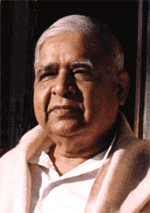
 An interview with S. N. Goenka
S. N. Goenka has been teaching Vipassana meditation for thirty-one years and is most widely known, perhaps, for his famous introductory ten-day intensive courses, which are held free of charge in centers all around the world, supported by student donations.
Born in Mandalay, Burma in 1924, he was trained by the renowned Vipassana teacher Sayagyi U Ba Khin (1899-1971). After fourteen years of training, he retired from his life as a successful businessman to devote himself to teaching meditation. Today he oversees an organization of more than eighty meditation centers worldwide and has had remarkable success in bringing meditation into prisons, first in India, and then in numerous other countries. The organization estimates that as many as 10,000 prisoners, as well as many members of the police and military, have attended the ten-day courses.
S. N. Goenka came to New York this fall for the Millennium World Peace Summit at the United Nations. He was interviewed there by Helen Tworkov.
According to some people, Vipassana is a particular meditation practice of the Theravada School; for others, it is a lineage of its own. How do you use the term?
This is a lineage, but it is a lineage that has nothing to do with any sect. To me, Buddha never established a sect. When I met my teacher, Sayagyi U Ba Khin, he simply asked me a few questions. He asked me if, as a Hindu leader, I had any objection towards sila, that is, morality. How can there be any objection? But how can you practice sila unless you have control of the mind? He said, I will teach you to practice sila with controlled mind. I will teach you samadhi, concentration. Any objection? What can be objected to in samadhi? Then he said, that alone will not help—that will purify your mind at the surface level. Deep inside there are complexes, there are habit patterns, which are not broken by samadhi. I will teach you prajna, wisdom, insight, which will take you to the depth of the mind. I will teach you to go to the depth of the mind, the source where the impurities start and they get multiplied and they get stored so that you can clear them out.
So when my teacher told me: I will teach you only these three—sila, samadhi and prajna—and nothing else, I was affected. I said, let me try.
How is sila generated by watching the mind?
When I began to learn Vipassana meditation, I became convinced that Buddha was a not a founder of religion, he was a super-scientist. A spiritual super-scientist. When he teaches morality, the point is, of course, there that we are human beings, living in human society, and we should not do anything which would harm the society. It’s quite true. But then—and it’s as a scientist he’s talking here—he says that when you harm anybody, when you perform any unwholesome action, you are the first victim. You first harm yourself and then you harm others. As soon as a defilement arises in the mind, your nature is such that you feel miserable. That is what Vipassana teaches me.
So if you can see that mental defilement is causing anxiety and pain for yourself, that is the beginning of sila and of compassion?
If you can change that to compassion, then another reality becomes so clear. If instead of generating anger or hatred or passion or fear or ego, I generate love, compassion, goodwill, then nature starts rewarding me. I feel so peaceful, so much harmony within me. It is such that when I defile my mind I get punishment then and there, and when I purify my mind I get a reward then and there.
What happens during a ten-day Vipassana course?
The whole process is one of total realization, the process of self-realization, truth pertaining to oneself, by oneself, within oneself. It is not an intellectual game. It is not an emotional or devotional game: “Oh, Buddha said such and such . . . so wonderful . . . I must accept.” It is pure science. I must understand what’s happening within me, what’s the truth within me. We start with breath. It looks like a physical concept, the breath moving in and moving out. It is true. But on the deeper level the breath is strongly connected to mind, to mental impurities. While we’re meditating, and we’re observing the breath, the mind starts wandering—some memory of the past, some thoughts of the future—immediately what we notice is that the breath has lost its normality: it might be slightly hard, slightly fast. And as soon as that impurity is gone away it is normal again. That means the breath is strongly connected to the mind, and not only mind but mental impurities. So we are here to experiment, to explore what is happening within us. At a deeper level, one finds that mind is affecting the body at the sensation level.
This causes another big discovery—that you are not reacting to an outside object. Say I hear a sound and I find that it is some kind of praise for me; or I find someone abusing me, I get angry. You are reacting to the words at the apparent level, yes, true. You are reacting. But Buddha says you are actually reacting to the sensations, body sensations. That when you feel body sensation and you are ignorant, then you keep on defiling your mind by craving or by aversion, by greed or by hatred or anger. Because you don’t know what’s happening.
When you hear praise or abuse, is the response filtered through the psychological mind to the bodily sensations, or is it simultaneous?
It is one after the other, but so quick that you can’t separate them. So quick! At some point automatically you can start realizing, “Look what’s happening! I have generated anger.” And the Vipassana meditator will immediately say, “Oh, a lot of hate! There is a lot of hate in the body, palpitation is increased, “Oh, miserable. I feel miserable.”
If you are not working with the body sensations, then you are working only at the intellectual level. You might say, “Anger is not good,” or “Lust is not good,” or “Fear is not—.” All of this is intellectual, moral teachings heard in childhood. Wonderful. They help.
But when you practice, you understand why they’re not good. Not only do I harm others by generating these defilements of anger or passion or fear or evil, I harm myself also, simultaneously.
Vipassana is observing the truth. With the breath I am observing the truth at the surface level, at the crust level. This takes me to the subtler, subtler, subtler levels. Within three days the mind becomes so sharp, because you are observing the truth. It’s not imagination. Not philosophy or thinking. Truth, breath, truth as breath, deep or shallow. The mind becomes so sharp that in the area around the nostrils, you start feeling some biochemical reaction that means some physical sensation. This is always there throughout the body, but the mind was so gross it was feeling only very gross sensations like pain or such. But otherwise there are so many sensations which the mind is not capable to feel.
Can you say something about the generation of wisdom? Is insight the same as wisdom?
Same same same! Insight is not trying to understand the reality within myself merely at the intellectual level, but I understand it now at the experiential level. For anybody who admires Buddha’s teaching—that everything is impermanent, changing—this is at the intellectual level. Yes, everything’s changing. Nothing is permanent. Quite true. But that doesn’t help. When I practice Vipassana, I start with sensation: Look, sensation arises, seems to stay for some time but passes, is not eternal.
And after four, five, six days, the sensations get dissolved. There is no more solidity in the entire body. Mere vibration, very subtle vibration. So this impermanence is now experience. What is the purpose of reacting to something when it is changing so quickly? What is the purpose of reacting with craving or clinging? It passes away. Or hatred: it passes away. People who are very angry, or are full of lust, full of fear or full of depression or full of ego—when they keep on observing their sensations, the whole habit pattern changes.
Does the object of awareness ever disappear so that there’s only awareness of awareness itself?
Exactly. But when I say I am aware of this object, and “I” is there, “I” am aware of this. This is a duality. Slowly as you proceed, “I” goes away. Things are just happening, and the knowing part knows. That’s all.
Is that the same as what some teachers call “bare attention”?
Yes, this is bare attention.
When there’s no object.
The object keeps on changing. What is the object this moment may not be the object the next moment. So whatever manifests itself from moment to moment, there is clarity. And there awareness means you are not reacting to it. Say the object, the sensation, is very pleasant. The old habit pattern was that when we feel this sensation we react with, “Ah, Wonderful! I must continue—this must be retained.” Then this is not bare awareness. But if you keep on, just awareness, let me see what happens, it changes. You are just observing the changing nature of the sensations. This sensation or that sensation, makes no difference.
Do you move to a place where there’s absolutely no self-consciousness of the awareness?
That is a very high stage, the nirvanic stage. As long as we are in the field of mind and matter, sensation is bound to be there. But sensations will become subtler and subtler.
Is it possible to transcend awareness itself?
Certainly. But that takes time. If you keep on thinking about this, it will be imagination. No imagination is allowed in the whole technique. Be with the present moment as it is. Otherwise you will be thinking: Nirvana, nirvana is like this, I must—You haven’t experienced nirvana. You’ve heard about nirvana, you’ve intellectualized about nirvana, you’ve emotionalized about nirvana. You don’t know what nirvana is. So let it come. Every moment is nirvana for you. Whatever is arising you are observing it—now it is passing away, now it arises. Bare awareness. That will take you to the stage where there is no more sensation, that is beyond mind and matter. Sensations come where there is mind and matter. And where there is no mind and matter there is no horizon, no passing, no sensation. But we can’t imagine it. The moment you start imagining, then it becomes a philosophy.
Do you understand this practice to be the essence of Buddha’s teaching?
Yes. If proper attention is not given to the sensations, then we are not going to the deepest levels of the mind. The deepest level of the mind, according to Buddha, is constantly in contact with body sensations. And you find this by experience.
What is your role as the teacher?
A teacher, out of compassion and love, seeing that somebody is suffering, gives a path. But each individual has to walk on the path. There is no magical miracle with the teacher. Totally out of the question. He only shows the path. That is the only role of the teacher, nothing else.
You’ve built this worldwide organization, and it seems that you don’t have a successor. So many are coming up, and to appoint somebody a successor will disturb the purity. Buddha never appointed anybody as a successor. Who am I to appoint? All these five hundred or six hundred teachers whom I have trained, they will carry on. If I am not there they will still carry on. Not because they have faith in the teacher—they have faith in the technique, which gives them results. That’s all that will remain. Otherwise they think so long as guru is there you get all of the benefits—guru is no more, it is gone: That is a personality cult. The technique is so great. It will survive. Don’t worry [laughs]. I am very confident. It will survive.
I wanted to ask you about criticisms in this country, specifically about your organization’s reported refusal to allow homosexuals to participate in advanced retreats.
I don’t know how somebody started this talk, which is, I can say very confidently, totally wrong. We have no discrimination of any kind with anybody. It is totally out of the question. But of course when you go for deeper courses - twenty-day course, thirty-day course, forty-day course - it is a really deep operation of the mind, surgical operation of the mind. Deep-rooted complexes start coming to the surface, so every student must have the facility of privacy, a place to be without getting attracted to the object of passion. If somebody has got passion, and the object of passion is all the time there, then it might create a few difficulties. It has created difficulties sometimes even in ten-day courses. You have to be very careful.
I don’t know how this wrong thing started. There are teachers who are lesbians and homosexuals in this country and in Europe. Where there are facilities I teach them. When they go to a center where there’s not much facility and they say, I was refused there, so they write letters and say something bad about the teaching. They can’t understand. What about the facilities we are giving them? Just because one or two started complaining because they were refused - and there are other reasons also for refusing. I have refused those who are not homosexuals, who are not lesbians. Because at present this person is not fit for such deep operation. Even multi-millionaires, even there is one billionaire who is pressing hard to take a long course. I don’t give it to him. I say, No, you are not fit yet.
There has been some concern that the idea of not allowing these people into long courses is that they would act inappropriately.
No, no, no! Anybody can act in a wrong way. If we separate people it is for their good, not for segregation, or denouncing them, saying: “Oh you’re not good, so I keep you separate.” It is for everyone!
Is it true that homosexuals have to renounce their sexual orientation in order to take the longer courses?
Totally wrong. Of course we examine every person whether lesbian or not-lesbian, homosexual or not. If you are still a bundle of lust and you can’t control yourself so you can’t do a deeper operation of the mind, wait a little, take a few more courses. That is what we tell everybody. Not because someone is a homosexual.
In this country now, traditional practices—like segregating men and women, or variations on that theme—are becoming part of a mix, a melting pot. Some teachers welcome this challenge, but others are quite concerned about maintaining the purity of the various traditions. You are somewhat renowned for taking a strict view of maintaining the integrity of each lineage.
Ultimately you have to take one decision. You want water, you dig ten feet, don’t get water, a different ten feet, you keep on digging in different places. Some day you must be sure I will get water here, then dig, come to that stage. I don’t say only remain with me. You try, and whichever path seems more compatible to your ideology, your thinking, go ahead. I don’t condemn.
In another example of traditions coming together, the peace summit that you’re attending at the U.N. this week is bringing world religious leaders together to make a declaration committing themselves to global peace. What’s your outlook? Any cause for optimism? When we look at Asia, we look at Burma, Sri Lanka, such violence and suffering in these Buddhist countries—how can we use our practice for peace? In centuries of Buddha’s teaching there is not a single incident where the followers of Buddha were involved in any kind of bloodshed in the name of propagating Buddha’s teachings. Wherever Buddha’s teaching went, it went with love and compassion. So that tradition says that here is a path which does not support violence or bloodshed.
Now you come to this millennium conference that is going on. Again, according to Buddha’s teaching and according to science, human science and the reality that we face, we want peace in human society. Certainly everybody, Buddhist or non-Buddhist, wants this. But how can there be peace in society unless there is peace in the individual? If the individual is boiling, agitated all the time, there is no peace. And you expect the entire society to be peaceful? To me it is unsound. Doesn’t sound logical.
Is it helpful to not use the word “Buddhism,” so it can become something for everyone? These are two words I have avoided in the last thirty-one years. In the thirty-one years since I started teaching I avoid using the word “Buddhism.” I never use the word “religion,” so far as Buddha’s teaching is concerned. For me Buddha never established a religion. Buddha never taught Buddhism. Buddha never made a single person a Buddhist.
Everybody will agree that every religion of the world has got these common factors, which I call the inner core of religion—morality, mastery of the mind, purification of mind. So I say this is the core, the wholesome core of every religion. And then there’s the outer shell. The outer shell differs from one to the other. Let everyone be happy with their rites, rituals—but they should not forget this inner core.
If they forget this and say, I am a religious person because I have done this rite, they are deluding themselves, they are deluding others.
In terms of this sense of interior peace: There’s a fear in this culture that if you are very peaceful that you’re a little dead. We want to be peaceful but cannot imagine how we can save the world, in terms of ecology, without being angry. We want to engage in life with those kinds of passions.
I recognize that. I am not against that. People have not understood the Buddha’s teaching properly. Say a person comes to harm me, and I say, “I am a Vipassana meditator, like a vegetable, come and cut me”—that is not Buddha’s teaching. We will take strongest action wherever necessary, strongest physical and vocal action.
But before doing that we must examine ourselves at the physical level, at the sensation level, and the mental level. If I find my mind is very equanimous, I’ve got no anger towards this person. I’ve got love towards this person. But because this person does not understand soft language, I’ve got to use hard language. He does not understand soft action, I will take hard action. In his interest, in her interest. Love is there. Compassion is there. If there is anger, then I’m miserable. How can a miserable person help another miserable person?
This question requires a lot of clarification, because this question keeps coming up. That if you are not angry, how will we be able to defend ourselves? If we are not angry, how will be able to be successful in this way or that way? That is because people have not lived a life where they are detached and yet very strong. People feel that only with attachment I can gain my goal. But when they understand and they practice, a detached person is more successful to reach their goal. Because the mind is so calm, so clear. And whatever problem comes you can make a quick decision, a right decision.
And the government is introducing Vipassana into the police academy. Even prisoners change. Hard criminals. And every government wants a prisoner to be reformed when he comes to the prison. Instead of that it is a house of crime, where you discuss what kind of crime, and how you did it. They learn much more, and come out as bigger criminals. Now with Vipassana there is a big change.
And that is not by giving discourses, giving praises of Buddha. It is by technique, when they start observing. Living in the prison, most of the students have anger: So-and-so gave witness against me, when I get out I’ll kill him. Revenge. When they start observing, “Oh, what am I doing? I’m burning myself,” it goes away. With the other way this person will create more and more violence. Now he can’t do that. He’s full of love, full of compassion.
And the person becomes so active. A number of hard criminals when they come out, they get jobs here and there and they don’t return.
Do you think in the Buddhist societies today, where violence is being carried out, are they functioning with this detachment or no?
If somebody says they are a Buddhist and that is all they do, then I say you are a devotee of Buddha, you are not a follower of Buddha. It’s a real difference. You have great devotion towards Buddha, you say, “Lord Buddha, Lord Buddha, how wonderful!” But you don’t practice. Whether we keep calling ourselves Christian or Hindu or Muslim, it makes no difference. A follower of the Buddha follows the teachings: sila, samadhi, prajna. Those people who simply call themselves Buddhists are not living the life of Buddha. That is why I don’t use the word “Buddhist” or “Buddhism.” Buddha never taught any isms. In all his words, and the commentaries, which number thousands of pages, the word “Buddhism” is not there. So this all started much later, when Buddha’s teaching began to settle. I don’t know when it started, how it started, calling it Buddhism, but the day it happened it devalued the teaching of Buddha. It was a universal teaching, and that made it sectarian, as if to say that Buddhism is only for Buddhists, like Hinduism is for Hindus, Islam is for Muslims. Dharma is for all..
Article source: www.tricycle.com
--------------------------------------
Technorati: Buddhism Buddha Buddhist Dharma Compassion Wisdom Religion Meditation S. N. Goenka Philosophy Spirituality Vipassana Peace Insight
Friday, August 13, 2010
Superscience

Wednesday, February 17, 2010
One Tool Among Many - The Place of Vipassana in Buddhist Practice

by Thanissaro Bhikkhu
© 1997–2010
What exactly is vipassana?
Almost any book on early Buddhist meditation will tell you that the Buddha taught two types of meditation: samatha and vipassana. Samatha, which means tranquillity, is said to be a method fostering strong states of mental absorption, called jhana. Vipassana — literally "clear-seeing," but more often translated as insight meditation — is said to be a method using a modicum of tranquillity to foster moment-to-moment mindfulness of the inconstancy of events as they are directly experienced in the present. This mindfulness creates a sense of dispassion toward all events, thus leading the mind to release from suffering. These two methods are quite separate, we're told, and of the two, vipassana is the distinctive Buddhist contribution to meditative science. Other systems of practice pre-dating the Buddha also taught samatha, but the Buddha was the first to discover and teach vipassana. Although some Buddhist meditators may practice samatha meditation before turning to vipassana, samatha practice is not really necessary for the pursuit of Awakening. As a meditative tool, the vipassana method is sufficient for attaining the goal. Or so we're told.
But if you look directly at the Pali discourses — the earliest extant sources for our knowledge of the Buddha's teachings — you'll find that although they do use the word samatha to mean tranquillity, and vipassana to mean clear-seeing, they otherwise confirm none of the received wisdom about these terms. Only rarely do they make use of the word vipassana — a sharp contrast to their frequent use of the word jhana. When they depict the Buddha telling his disciples to go meditate, they never quote him as saying "go do vipassana," but always "go do jhana." And they never equate the word vipassana with any mindfulness techniques. In the few instances where they do mention vipassana, they almost always pair it with samatha — not as two alternative methods, but as two qualities of mind that a person may "gain" or "be endowed with," and that should be developed together. One simile, for instance (SN 35.204), compares samatha and vipassana to a swift pair of messengers who enter the citadel of the body via the noble eightfold path and present their accurate report — Unbinding, or nibbana — to the consciousness acting as the citadel's commander. Another passage (AN 10.71) recommends that anyone who wishes to put an end to mental defilement should — in addition to perfecting the principles of moral behavior and cultivating seclusion — be committed to samatha and endowed with vipassana. This last statement is unremarkable in itself, but the same discourse also gives the same advice to anyone who wants to master the jhanas: be committed to samatha and endowed with vipassana. This suggests that, in the eyes of those who assembled the Pali discourses, samatha, jhana, and vipassana were all part of a single path. Samatha and vipassana were used together to master jhana and then — based on jhana — were developed even further to give rise to the end of mental defilement and to bring release from suffering. This is a reading that finds support in other discourses as well.
There's a passage, for instance, describing three ways in which samatha and vipassana can work together to lead to the knowledge of Awakening: either samatha precedes vipassana, vipassana precedes samatha, or they develop in tandem (AN 4.170). The wording suggests an image of two oxen pulling a cart: one is placed before the other or they are yoked side-by-side. Another passage (AN 4.94) indicates that if samatha precedes vipassana — or vipassana, samatha — one's practice is in a state of imbalance and needs to be rectified. A meditator who has attained a measure of samatha, but no "vipassana into events based on heightened discernment (adhipañña-dhamma-vipassana)," should question a fellow meditator who has attained vipassana: "How should fabrications (sankhara) be regarded? How should they be investigated? How should they be viewed with insight?" and then develop vipassana in line with that person's instructions. The verbs in these questions — "regarding," "investigating," "seeing" — indicate that there's more to the process of developing vipassana than a simple mindfulness technique. In fact, as we will see below, these verbs apply instead to a process of skillful questioning called "appropriate attention."
The opposite case — a meditator endowed with a measure of vipassana into events based on heightened discernment, but no samatha — should question someone who has attained samatha: "How should the mind be steadied? How should it be made to settle down? How should it be unified? How should it be concentrated?" and then follow that person's instructions so as to develop samatha. The verbs used here give the impression that "samatha" in this context means jhana, for they correspond to the verbal formula — "the mind becomes steady, settles down, grows unified and concentrated" — that the Pali discourses use repeatedly to describe the attainment of jhana. This impression is reinforced when we note that in every case where the discourses are explicit about the levels of concentration needed for insight to be liberating, those levels are the jhanas.
Once the meditator is endowed with both samatha and vipassana, he/she should "make an effort to establish those very same skillful qualities to a higher degree for the ending of the mental fermentations (asava — sensual passion, states of being, views, and ignorance)." This corresponds to the path of samatha and vipassana developing in tandem. A passage in MN 149 describes how this can happen. One knows and sees, as they actually are, the six sense media (the five senses plus the intellect), their objects, consciousness at each medium, contact at each medium, and whatever is experienced as pleasure, pain, or neither-pleasure-nor-pain based on that contact. One maintains this awareness in such a way as to stay uninfatuated by any of these things, unattached, unconfused, focused on their drawbacks, abandoning any craving for them: this would count as vipassana. At the same time — abandoning physical and mental disturbances, torments, and distresses — one experiences ease in body and mind: this would count as samatha. This practice not only develops samatha and vipassana in tandem, but also brings the 37 Wings to Awakening — which include the attainment of jhana — to the culmination of their development.
So the proper path is one in which vipassana and samatha are brought into balance, each supporting and acting as a check on the other. Vipassana helps keep tranquillity from becoming stagnant and dull. Samatha helps prevent the manifestations of aversion — such as nausea, dizziness, disorientation, and even total blanking out — that can occur when the mind is trapped against its will in the present moment.
From this description it's obvious that samatha and vipassana are not separate paths of practice, but instead are complementary ways of relating to the present moment: samatha provides a sense of ease in the present; vipassana, a clear-eyed view of events as they actually occur, in and of themselves. It's also obvious why the two qualities need to function together in mastering jhana. As the standard instructions on breath meditation indicate (MN 118), such a mastery involves three things: gladdening, concentrating, and liberating the mind. Gladdening means finding a sense of refreshment and satisfaction in the present. Concentrating means keeping the mind focused on its object, while liberating means freeing the mind from the grosser factors making up a lower stage of concentration so as to attain a higher stage. The first two activities are functions of samatha, while the last is a function of vipassana. All three must function together. If, for example, there is concentration and gladdening, with no letting go, the mind wouldn't be able to refine its concentration at all. The factors that have to be abandoned in raising the mind from stage x to stage y belong to the set of factors that got the mind to x in the first place (AN 9.34). Without the ability clearly to see mental events in the present, there would be no way skillfully to release the mind from precisely the right factors that tie it to a lower state of concentration and act as disturbances to a higher one. If, on the other hand, there is simply a letting go of those factors, without an appreciation of or steadiness in the stillness that remains, the mind would drop out of jhana altogether. Thus samatha and vipassana must work together to bring the mind to right concentration in a masterful way.
The question arises: if vipassana functions in the mastery of jhana, and jhana is not exclusive to Buddhists, then what is Buddhist about vipassana? The answer is that vipassana per se is not exclusively Buddhist. What is distinctly Buddhist is (1) the extent to which both samatha and vipassana are developed; and (2) the way they are developed — i.e., the line of questioning used to foster them; and (3) the way they are combined with an arsenal of meditative tools to bring the mind to total release.
In MN 73, the Buddha advises a monk who has mastered jhana to further develop samatha and vipassana so as to master six cognitive skills, the most important of them being that "through the ending of the mental fermentations, one remains in the fermentation-free awareness-release and discernment-release, having known and made them manifest for oneself right in the here and now." This is a description of the Buddhist goal. Some commentators have asserted that this release is totally a function of vipassana, but there are discourses that indicate otherwise.
Note that release is twofold: awareness-release and discernment-release. awareness-release occurs when a meditator becomes totally dispassionate toward passion: this is the ultimate function of samatha. Discernment-release occurs when there is dispassion for ignorance: this is the ultimate function of vipassana (AN 2.30). Thus both samatha and vipassana are involved in the twofold nature of this release.
The Sabbasava Sutta (MN 2) states that one's release can be "fermentation-free" only if one knows and sees in terms of "appropriate attention" (yoniso manasikara). As the discourse shows, appropriate attention means asking the proper questions about phenomena, regarding them not in terms of self/other or being/non-being, but in terms of the four noble truths. In other words, instead of asking "Do I exist? Don't I exist? What am I?" one asks about an experience, "Is this stress? The origination of stress? The cessation of stress? The path leading to the cessation of stress?" Because each of these categories entails a duty, the answer to these questions determines a course of action: stress should be comprehended, its origination abandoned, its cessation realized, and the path to its cessation developed.
Samatha and vipassana belong to the category of the path and so should be developed. To develop them, one must apply appropriate attention to the task of comprehending stress, which is comprised of the five clinging-aggregates — clinging to physical form, feeling, perception, mental fabrications, and consciousness. Applying appropriate attention to these aggregates means viewing them in terms of their drawbacks, as "inconstant, stressful, a disease, a cancer, an arrow, painful, an affliction, alien, a dissolution, an emptiness, not-self" (SN 22.122). A list of questions, distinctive to the Buddha, aids in this approach: "Is this aggregate constant or inconstant?" "And is anything inconstant easeful or stressful?" "And is it fitting to regard what is inconstant, stressful, subject to change as: 'This is mine. This is my self. This is what I am'?" (SN 22.59). These questions are applied to every instance of the five aggregates, whether "past, future, or present; internal or external; blatant or subtle, common or sublime, far or near." In other words, the meditator asks these questions of all experiences in the cosmos of the six sense media.
This line of questioning is part of a strategy leading to a level of knowledge called "knowing and seeing things as they actually are (yatha-bhuta-ñana-dassana)," where things are understood in terms of a fivefold perspective: their arising, their passing away, their drawbacks, their allure, and the escape from them — the escape, here, lying in dispassion.
Some commentators have suggested that, in practice, this fivefold perspective can be gained simply by focusing on the arising and passing away of these aggregates in the present moment; if one's focus is relentless enough, it will lead naturally to a knowledge of drawbacks, allure, and escape, sufficient for total release. The texts, however, don't support this reading, and practical experience would seem to back them up. As MN 101 points out, individual meditators will discover that, in some cases, they can develop dispassion for a particular cause of stress simply by watching it with equanimity; but in other cases, they will need to make a conscious exertion to develop the dispassion that will provide an escape. The discourse is vague — perhaps deliberately so — as to which approach will work where. This is something each meditator must test for him or herself in practice.
The Sabbasava Sutta expands on this point by listing seven approaches to take in developing dispassion. Vipassana, as a quality of mind, is related to all seven, but most directly with the first: "seeing," i.e., seeing events in terms of the four noble truths and the duties appropriate to them. The remaining six approaches cover ways of carrying out those duties: restraining the mind from focusing on sense data that would provoke unskillful states of mind; reflecting on the appropriate reasons for using the requisites of food, clothing, shelter, and medicine; tolerating painful sensations; avoiding obvious dangers and inappropriate companions; destroying thoughts of sensual desire, ill will, harmfulness, and other unskillful states; and developing the seven factors for Awakening: mindfulness, analysis of qualities, persistence, rapture, serenity, concentration, and equanimity.
Each of these approaches covers a wide subset of approaches. Under "destroying," for instance, one may eliminate an unskillful mental state by replacing it with a skillful one, focusing on its drawbacks, turning one's attention away from it, relaxing the process of thought-fabrication that formed it, or suppressing it with the brute power of one's will (MN 20). Many similar examples could be drawn from other discourses as well. The overall point is that the ways of the mind are varied and complex. Different fermentations can come bubbling up in different guises and respond to different approaches. One's skill as a meditator lies in mastering a variety of approaches and developing the sensitivity to know which approach will work best in which situation.
On a more basic level, however, one needs strong motivation to master these skills in the first place. Because appropriate attention requires abandoning dichotomies that are so basic to the thought patterns of all people — "being/not being" and "me/not me" — meditators need strong reasons for adopting it. This is why the Sabbasava Sutta insists that anyone developing appropriate attention must first must hold the noble ones (here meaning the Buddha and his awakened disciples) in high regard. In other words, one must see that those who have followed the path are truly exemplary. One must also be well-versed in their teaching and discipline. According to MN 117, "being well-versed in their teaching" begins with having conviction in their teachings about karma and rebirth, which provide intellectual and emotional context for adopting the four noble truths as the basic categories of experience. Being well-versed in the discipline of the noble ones would include, in addition to observing the precepts, having some skill in the seven approaches mentioned above for abandoning the fermentations.
Without this sort of background, meditators might bring the wrong attitudes and questions to the practice of watching arising and passing away in the present moment. For instance, they might be looking for a "true self" and end up identifying — consciously or unconsciously — with the vast, open sense of awareness that embraces all change, from which it all seems to come and to which it all seems to return. Or they might long for a sense of connectedness with the vast interplay of the universe, convinced that — as all things are changing — any desire for changelessness is neurotic and life-denying. For people with agendas like these, the simple experience of events arising and passing away in the present won't lead to fivefold knowledge of things as they are. They'll resist recognizing that the ideas they hold to are a fermentation of views, or that the experiences of calm that seem to verify those ideas are simply a fermentation in the form of a state of being. As a result, they won't be willing to apply the four noble truths to those ideas and experiences. Only a person willing to see those fermentations as such, and convinced of the need to transcend them, will be in a position to apply the principles of appropriate attention to them and thus get beyond them.
So, to answer the question with which we began: Vipassana is not a meditation technique. It's a quality of mind — the ability to see events clearly in the present moment. Although mindfulness is helpful in fostering vipassana, it's not enough for developing vipassana to the point of total release. Other techniques and approaches are needed as well. In particular, vipassana needs to be teamed with samatha — the ability to settle the mind comfortably in the present — so as to master the attainment of strong states of absorption, or jhana. Based on this mastery, samatha and vipassana are then applied to a skillful program of questioning, called appropriate attention, directed at all experience: exploring events not in terms of me/not me, or being/not being, but in terms of the four noble truths. The meditator pursues this program until it leads to a fivefold understanding of all events: in terms of their arising, their passing away, their drawbacks, their allure, and the escape from them. Only then can the mind taste release.
This program for developing vipassana and samatha, in turn, needs the support of many other attitudes, mental qualities, and techniques of practice. This was why the Buddha taught it as part of a still larger program, including respect for the noble ones, mastery of all seven approaches for abandoning the mental fermentations, and all eight factors of the noble path. To take a reductionist approach to the practice can produce only reduced results, for meditation is a skill like carpentry, requiring a mastery of many tools in response to many different needs. To limit oneself to only one approach in meditation would be like trying to build a house when one's motivation is uncertain and one's tool box contains nothing but hammers.
--------------------------------------
Technorati: Buddhism Buddha Buddhist Dharma Compassion Wisdom Religion Meditation Zen vipassana Spirituality Inspiration Peace Insight
Friday, October 23, 2009
Vipassana in India Prison
--------------------------------------
Technorati: Buddhism Buddha Buddhist Dharma Compassion Wisdom Religion Meditation Zen Philosophy Spirituality Inspiration Peace Insight
Friday, May 25, 2007
How to practise vipassana (or mindfulness) in daily life?
Here are some chatlogs between myself (CK) or my friend (AEN), and my friend 'Thusness' who is a good practitioner, on 'how to practise vipassana in daily life'. I hope it will benefit anyone in the Path.
Ck: Thusness, how to practise vipassana in daily life?
Thusness: just observe every sensation.
Thusness: until one day u are able to experience "emptiness as form".
Thusness: then it becomes effortless.
Thusness: CK u cannot imagine the bliss when one clearly experiences that.
Thusness: but there is no point to over stress anything.
Thusness: *Smile*
Ck: Thusness just observe every sensation... give me an eg?
Thusness: when u breath, u don't have to care what is the right way of breathing, whether u breath hard or soft, smooth or fine...just experience as much clarity as u can...just that experience...regardless of what it is like.
Thusness: same for all other experiences.
Ck: what abt sound? hows it?
Thusness: when u hear, just the sound...the totality of the sound. There is no how but just to do away with all arbitary thoughts. Hear the sound as clear as u can be.
Ck: then what abt thoughts?
Ck: thoughts r v sticky *Sad*
Thusness: thoughts seldom arise if the practice is correct. If it arises, then not to chase after its meaning. Not to answer urself what it means, not to dwell in 'what'...then u will resort to just the moment of awareness.
Ck: when i try to be just openly aware, i notice that i jump from sense to sense
Ck: like one moment hearing, then touch, etc
Thusness: that is okie.
Thusness: our nature is so.
Ck: whats the right way to do it
Thusness: don't think that u should concentrate.
Thusness: ur only duty is to sense with as much clarity as possible.
Ck: and for all the sensations, i dun dwell in the 'what'?
Thusness: ur mind is looking for a way, a method
Thusness: but what that is needed is only the clarity.
Thusness: however because our mind is so molded and affect by our habitual propensities, it becomes difficult what that is direct and simple.
Thusness: just stop asking 'how', 'what', 'why'.
Thusness: and submerge into the moment.
Thusness: and experience.
Thusness: i perfer u to describe.
Thusness: not to ask how, what, why, when, where and who.
Thusness: only this is necessary.
Ck: ok
Thusness: if u practice immediately, u will understand.
Thusness: if u entertain who, what, where, when and how, u create more propensities and dull ur own luminosity.
Ck: i shuffle between self inquiry, observing sensations n thoughts, being aware... its ok right
Thusness: yes
Ck: means start work i'll hv even more propensities...
Thusness: that is when u do not understand what's awareness, but it is true to certain extend. *Smile*
Another conversation 'Thusness' with my friend, 'AEN':
Thusness: tell me what u think is awareness?
Thusness: in ur own words
Thusness: just say
AEN: just the knowingness, the sensation or thoughts etc
Thusness: look at the skin of ur hands
AEN: ok
Thusness: looks real?
AEN: yea
Thusness: touch it...feel it as much as u can
Thusness: can u don't think of a background
AEN: yea
Thusness: and know that, that is awareness?
AEN: ya
Thusness: that is all.
1 and a half year ago:
Thusness: so far what do u understand about awareness?
AEN: hmm like u say lor... awareness is never lost
Thusness: what is awareness right now?
Thusness: when u say thought arises, is thought awareness?
AEN: thought is not awareness, but there is awareness of thought
AEN: lol
Thusness: so what is thought?
Thusness: and where is awareness?
Thusness: same like taste, is the taste awareness?
AEN: i think u cant define awareness to a 'thing' :P
Thusness: so is taste or thought a thing? *Smile*
Thusness: u practice meditation now right?
Thusness: *Smile*
AEN: never practise for quite some time :P
AEN: taste or thought is not a thing
AEN: lol
Thusness: so do u think awareness is a party behind thinking thought or experiencing taste?
Thusness: *Smile*
Thusness: lol
AEN: no
Thusness: taste is not a thing, then what is it?
AEN: just the awareness
Thusness: experience this awareness with totality. *Smile*
~End of post~
--------------------------------------
Technorati: Buddhism Buddha Buddhist Dharma Compassion Wisdom Religion Meditation Zen Philosophy Spirituality Inspiration Peace InsightVipassana
