

 Article Source: salon.com.
Ex-monk B. Alan Wallace explains what Buddhism can teach Western scientists, why reincarnation should be taken seriously and what it's like to study meditation with the Dalai Lama.
By Steve Paulson
Nov. 27, 2006 | The debate between science and religion typically gets stuck on the thorny question of God's existence. How do you reconcile an all-powerful God with the mechanistic slog of evolution? Can a rationalist do anything but sneer at the Bible's miracles? But what if another religion -- a nontheistic one -- offered a way out of this impasse? That's the promise that some people hold out for in Buddhism. The Dalai Lama himself is deeply invested in reconciling science and spirituality. He meets regularly with Western scientists, looking for links between Buddhism and the latest research in physics and neuroscience. In his book "The Universe in a Single Atom," he wrote, "If scientific analysis were conclusively to demonstrate certain claims in Buddhism to be false, then we must accept the findings of science and abandon those claims."
B. Alan Wallace may be the American Buddhist most committed to finding connections between Buddhism and science. An ex-Buddhist monk who went on to get a doctorate in religious studies at Stanford, he once studied under the Dalai Lama, and has acted as one of the Tibetan leader's translators. Wallace, now president of the Santa Barbara Institute for Consciousness Studies, has written and edited many books, often challenging the conventions of modern science. "The sacred object of its reverence, awe and devotion is not God or spiritual enlightenment but the material universe," he writes. He accuses prominent scientists like E.O. Wilson and Richard Dawkins of practicing "a modern kind of nature religion."
In his new book, "Contemplative Science: Where Buddhism and Neuroscience Converge," Wallace takes on the loaded subject of consciousness. He argues that the long tradition of Buddhist meditation, with its rigorous investigation of the mind, has in effect pioneered a science of consciousness, and that it has much to teach Western scientists. "Subjectivity is the central taboo of scientific materialism," he writes. He considers the Buddhist examination of interior mental states far preferable to what he calls the Western "idolatry of the brain." And he says the modern obsession with brain chemistry has created a false sense of well-being: "It is natural then to view psychopharmaceutical and psychotropic drugs as primary sources of happiness and relief from suffering." Wallace also chastises cognitive psychologists and neuroscientists for assuming the mind is merely the product of the physical mechanics of the brain. And he talks openly about ideas that most scientists would consider laughable, including reincarnation and a transcendent consciousness.
In conversation, Wallace is a fast talker who laughs easily and often gets carried away with his enthusiasm. I spoke with him by phone about the Buddhist theory of consciousness, his critique of both science and Christianity, and why he thinks reincarnation should be studied by scientists.
Why do you think Buddhism has an important perspective to add to the science and religion debate?
Buddhism has a lot to add for a number of reasons. Some are simply historical. Especially since the time of Galileo, there has been a sense of unease, if not outright hot war, between religion and science in the West. And Buddhism is coming in as a complete outsider. It's not theistic, as is Christianity. At the same time, it's not just science, as is physics or biology. And there's another reason why Buddhism may bring a fresh perspective. While there's no question that Buddhism has very religious elements to it -- with monks and temples, rituals and prayers -- it does have a broad range of empirical methods for investigating the nature of the mind, for raising hypotheses and putting them to the test.
There's a common assumption that science and religion are entirely separate domains. Science covers the empirical realm of facts and theories about the observable world, while religion deals with ultimate meaning and moral value. But you don't accept that dichotomy, do you?
Not at all. In fact, most religious people don't. This is a notion that's been brought up by Stephen Jay Gould with his whole notion of "non-overlapping magisteria." But it's never been true. All of the great pioneers of the scientific revolution -- Copernicus, Galileo, Kepler, Newton, and on into the 19th century with Gregor Mendel -- they were all Christians. And their whole approach to science was deeply influenced by Christianity. Religion, whether we like it or not, is making many truth claims about the natural world as well as the transcendent world. And now that science is honing in on the nature of the mind and questions of free will, it is definitely invading the turf that used to belong to religion and philosophy.
Many people would acknowledge that Buddhism has some profound insights into the human mind -- why we get depressed, what makes us happy and how we become slaves to our attachments. But what does this have to do with science?
In Buddhism, the very root of suffering and all our mental distress -- what Buddhists call mental afflictions -- is ignorance. The path to liberation, or enlightenment, is knowledge. It's knowing reality as it is. So despite many differences in methodology, both science and Buddhism are after knowledge of the natural world. But what defines the natural world? In modern science, the natural world is often equated with the physical world, and mental phenomena and subjective experiences are regarded as emergent phenomena or simply functions of the brain. But there are many other domains of reality that the physical instruments of science have not yet been able to detect.
But science is as much about method as anything. The scientific method posits hypotheses and theories that can be tested. Is that something Buddhism does as well?
Not in the same way. I wouldn't want to overplay the case that Buddhism has always been a science, with clear hypotheses and complete skepticism. It's too much of a religion, and so there's a lot of vested interest in the Buddhist community not to challenge the statements made by the Buddha and other great patriarchs in the Buddhist tradition. So there are some fundamental differences. At the same time, science is not just science. This very notion that the mind must simply be an emergent property of the brain -- consisting only of physical phenomena and nothing more -- is not a testable hypothesis. Science is based upon a very profound metaphysical foundation. Can you test the statement that there is nothing else going on apart from physical phenomena and their emergent properties? The answer is no.
You're saying we don't know for sure that the physical functions of the brain -- the neural circuits, the electrochemical surges -- are what produce our rich inner lives, what we call the mind?
Cognitive science has plenty of hypotheses that are testable. For instance, is Alzheimer's related to a particular malfunctioning of the brain? More and more, scientists are able to identify the parts and functions of the brain that are necessary to generate specific mental states. So these are scientific issues. But now let's tap into what the philosopher David Chalmers has called "the hard problem" -- the relationship between the physical brain and consciousness. What is it about the brain -- this mass of chemicals and electromagnetic fields -- that enables it to generate any state of subjective experience? If your sole access to the mind is by way of physical phenomena, then you have no way of testing whether all dimensions of the mind are necessarily contingent upon the brain.
But that is certainly the paradigm of the vast majority of neuroscientists and psychologists. The mind is nothing more than the brain, and what happens in the mind is strictly because of the physical mechanics of the brain. I'm sure most of these scientists would say it's absurd to talk about the mind functioning independently of the brain.
Well, when you have no possible means of investigating the mind as it might operate independently of the brain, then to even raise it as an issue is indeed absurd. But there is one avenue of inquiry that's been largely left out or simply repudiated. Right now, you and I have an ability to monitor our own mental states. Can we generate a mental image of an apple? Can we remember our mother's face? Can we recite the opening lines of the Gettysburg Address or some favorite poem? Are these mental images that you generate nothing other than brain states or parts of the brain? At this point, those are not even scientific questions because nobody knows how to tackle them.
You have called for a new field of study, what you call "contemplative science." What would that involve?
Contemplative science must live up to the rigorous standards that neuroscience, cognitive psychology, chemistry and physics have set for us. They've set the bar very high. So I'm a great admirer of the rigor and skepticism of science at its best. But William James, who's one of my intellectual heroes, suggested we have a triadic approach. We should study the mind by way of behavior and brain studies, but, first and foremost, he said, we should study the mind by observing mental phenomena directly. But what he didn't have, and neither did any of his contemporaries, was a rigorous methodology.
Is that what Buddhism offers -- a rigorous methodology?
Yes. I'm not saying we should fuse religion with science. Rather, we should select very specific methodologies from Buddhism and other contemplative traditions where the ability to monitor the mind has been honed over thousands of years -- beginning with the training of attention and then using sophisticated methods for investigating the nature of the mind, feelings and the very nature of consciousness itself during the waking state, the dream state, even during deep sleep. Now, because of the great advances in transportation and communications, we have easy access to the Taoist tradition of China, the Sufi tradition of the Near East, the Buddhist tradition of Tibet and Southeast Asia. I'm convinced this would add much greater depth and breadth to the types of questions that are raised in modern cognitive science.
In science, you have a hypothesis that's tested, and it can be disproved. Does that happen in Buddhism?
On its home turf, frequently not. But I'm also waiting for a neuroscientist to tell me how the hypothesis that mental states are nothing more than neural states will be repudiated. I don't see that as a testable hypothesis. So there's a fair amount of dogma, not in science per se but in the minds of scientists. Likewise, there's plenty of dogma in the minds of Buddhists. But Buddhism at its best -- and we go right back to the teachings of the Buddha himself -- encourages a spirit of skepticism. He said, "Do not take my statements to be true simply out of reverence for me. But rather, put them to the test." Well, if you do that, you should be able to repudiate them as well as confirm them.
Well, let me ask you about that. I know there is a tradition, particularly among advanced contemplatives, that you have your meditative experience, and then you talk about it, you analyze it, and your peers critique it. Does that really happen? When someone comes out of meditation, would someone else say, "Sorry. You didn't do it right"?
Absolutely. You know, Buddhism, like any other tradition, is subject to degeneration. So if you and I headed off to India or Nepal or Tibet, we'd find plenty of Buddhist meditators who are simply going through rote ritual, who are just trying to come up with the right answers at the end of the book. But when Buddhism is really thriving, it's exactly what you described. You go into a three-year retreat, where you are meditating eight to 12 hours a day. You're training the mind. You're investigating the nature of the mind. But you're probably not doing that in entire isolation. You're in consultation with a mentor who's going to review your experience and help you deepen your experience. You'll be questioning your insights. So [your] relationship with your mentor is analogous to working on your Ph.D. with a mentor. If at any point your research becomes flaky or not up to snuff, the mentor is there to say, "No, that's a dead end. This is not good research." This happens frequently in the Buddhist contemplative tradition when it's really robust and healthy.
Has that happened to you? You've meditated for decades. And you were a Buddhist monk for 14 years. Did you have your meditative practice analyzed and critiqued?
Definitely.
I can imagine that might be kind of humiliating.
[Laughs] No. Take the first long retreat I did in 1980. I was a monk at the time. I'd just spent the last 10 years in very rigorous theoretical and practical training in India and in a monastery in Switzerland. And then all I wanted to do was go to the lab -- basically, go into a meditation hut and spend eight, 10, 12 hours a day meditating. Well, I had the tremendously good fortune to have the Dalai Lama as my personal mentor. So he guided me in the meditation. I would meet with him every few weeks. I would discuss the practice and he'd give me feedback. I was living in a little hut in the mountains above Dharamsala, India. I went into a five-month solitary retreat. Somebody brought me food once a week. I was meditating 10 hours a day. I was honing my attention skills. And I would consult with the Dalai Lama. I would consult with other yogis up there on the hill about technique and problems that were arising. They would draw from their decades of experience to help me. And I started to adapt some of these methods for myself as a Westerner who grew up in America and Europe, rather than as a nomad at 14,000 [feet] up on the Tibetan plateau.
Did you have profound mystical experiences? Did you have moments of what might be called enlightenment?
Well, the word "enlightenment" has been used in so many different ways, I won't tread on that mine field. Eighteenth century Europe itself went through an Enlightenment, but I'm not sure that would be an enlightenment in my category. So for me to make any claims about enlightenment would be counterproductive. Did I find any transformation of consciousness? Did I find attention skills honed? Did I experience states of consciousness that I'd never experienced before such sustained meditative training? The answer is yes, yes, yes. But what a mature meditator is even more concerned with than those epiphanies -- those moments of revelation or breakthrough -- is the overall impact on the quality of your life, your way of engaging with other people and dealing with adversity. Is it helpful? Does it give you a clearer sense of reality? If it doesn't, then I say meditation is merely a hobby. If it does, then meditation can be something very central to developing greater mental health and clear engagement with reality itself.
I've heard that your father was a Protestant theologian. It does raise the question of why you became a Buddhist. Why has Buddhism resonated with you in a way that Christianity has not?
Well, it's a personal issue. You're quite right. My father was -- and is -- a Christian theologian. We have a loving and very trusting relationship. The fact that he is a Christian theologian definitely had a profound impact on the course my life has taken. As I was growing up, from the age of 13, I had a very clear sense that I wanted to dedicate my life to science. And so I immersed myself in chemistry, biology, physics and calculus. At the same time, my religious background had made a very deep impact on my life. But what really struck me very painfully -- I would say existentially -- was the profound incompatibility between science and the whole worldview of Christianity, with God being the creator, responding to prayer, and human identity being that of an immortal soul. Basically, everything was God saturated in this Judeo-Christian view. On the other hand, in the scientific worldview I was simply a body, an animal. There was no creator. There was no ethics in nature. It was just Darwin. It was a great big machine. And I looked at these two worldviews and said, "Wow, these are incompatible."
So I basically went AWOL from Western civilization for 14 years. I picked up one book on Buddhism when I was 20. It was like a starving man picking up some fragrance of hot baked bread. So I spent a year studying the Tibetan language in Germany, where I was spending a year abroad. And then I bought myself, literally and metaphorically, a one-way ticket to India. I wanted to go live with Tibetans and explore as deeply as I could this Buddhist worldview. It's not just a religion. It's not theistic. It doesn't posit the existence of God as standing outside of creation, governing it, ruling it, punishing the wicked and rewarding the virtuous. It doesn't have any of that. Nor is it materialistic, flattening my very existence to being an epiphenomenon of my brain.
You've suggested that there might be certain functions of the mind, certain aspects of consciousness, that don't have a material foundation.
Yes.
Advanced contemplatives in the Buddhist tradition have talked about tapping into something called the "substrate consciousness." What is that?
Just for a clarification of terms, I've demarcated three whole dimensions of consciousness. There's the psyche. It's the human mind -- the functioning of memory, attention, emotions and so forth. The psyche is contingent upon the brain, the nervous system, and our various sensory faculties. It starts sometime at or following conception, certainly during gestation, and it ends at death. So the psyche has pretty clear bookends. This is what cognitive neuroscientists and psychologists study. They don't study anything more. And they quite reasonably assume that that's all there is to it. But as long as you study the mind only by way of brain states and behavior, you're never going to know whether there's any other dimension because of the limitations of your own methodologies. So here's a hypothesis: The psyche does not emerge from the brain. Mental phenomena do not actually emerge from neuronal configurations. Nobody's ever seen that they do.
So your hypothesis is just the reverse from what all the neuroscientists think.
Precisely. The psyche is not emerging from the brain, conditioned by the environment. The human psyche is in fact emerging from an individual continuum of consciousness that is conjoined with the brain during the development of the fetus. It can be very hampered if the brain malfunctions or becomes damaged.
But you're saying there are also two other aspects of consciousness?
Yeah. All I'm presenting here is the Buddhist hypothesis. There's another dimension of consciousness, which is called the substrate consciousness. This is not mystical. It's not transcendent in the sense of being divine. The human psyche is emerging from an ongoing continuum of consciousness -- the substrate consciousness -- which kind of looks like a soul. But in the Buddhist view, it is more like an ongoing vacuum state of consciousness. Or here's a good metaphor: Just as we speak of a stem cell, which is not differentiated until it comes into the liver and becomes a liver cell, or into bone marrow and becomes a bone marrow cell, the substrate consciousness is stem consciousness. And at death, the human psyche dissolves back into this continuum.
So this consciousness is not made of any stuff. It's not matter. Is it just unattached and floating through the universe?
Well, this raises such interesting questions about the nature of matter. In the 19th century, you could think of matter as something good and chunky out there. You could count on it as having location and specific momentum and mass and all of that. Frankly, I think the backdrop of this whole conversation has to be 21st century physics, not 19th century physics. And virtually all of neuroscience and all of psychology is based on 19th century physics, which is about as up-to-date as the horse and buggy.
So not everything in the universe can be reducible to matter, to particles?
According to quantum field theory, string theory and quantum cosmology -- cutting-edge fields of 21st century physics -- matter itself is not reducible to matter. And Richard Feynman, the great Nobel laureate in physics, commented very emphatically, "We don't know what energy is." He said it's not stuff out there that has a specific location. It's more like a mathematical abstraction. So matter has been reduced to formations of space. Energy is configurations of space. Space itself is rather mysterious. And so when I introduce this theme of a substrate consciousness, it's not something ethereal that's opposed to matter. Matter is about as ethereal as anything gets. But could there be this continuum of substrate consciousness that's not contingent upon molecules? From the Buddhist perspective, yes. But again, this frankly sounds like one more system of belief.
I have to say, you could put a religious spin on all of this. What you're describing as substrate consciousness sounds a lot like how people talk about God. There is some kind of divine presence that's outside the material world but somehow intervenes in our material lives.
I think we're jumping the gun there. In the Buddhist perspective, the substrate consciousness is individual. It's not some great collective unconscious like Jung talked about. In the Buddhist view, it's an individual continuum of consciousness that carries on from lifetime to lifetime. That's not God. Beyond that is this whole third dimension, the deepest dimension, called "primordial consciousness." This has certain commonalities with Christian mystical notions of God beyond the trinity. It has a thoroughly and deeply transcendent quality to it. And that's way beyond the pale of scientific inquiry. But when I speak of substrate consciousness, I think it would simply be a mistake to say that's God. If you want to relate this to something in Western religions, you might say it's the immortal soul. Christianity really has nothing to say about the existence of your continuum of consciousness prior to your conception. There's nothing in the Bible that says, where was Steve Paulson 70 years ago? Where did your stream of consciousness, your identity, your soul, come from? But Buddhism has a lot to say about this.
Here in the West, we have on the table three large hypotheses about the nature of human consciousness. One of these looks really good from a scientific perspective. Your consciousness is a product of the brain. Damage the brain and your consciousness evaporates into nothing. Now what's the experiment by which you repudiate that hypothesis? Well, all the mental states you're studying are by way of the brain, so the answer is nada. So it's not scientific and it's not testable, at least not yet. We have another major hypothesis. You die and your soul carries on to heaven or hell in the Protestant tradition. You go there and it's forever. Or in the Roman Catholic tradition, you have another couple of options -- limbo and purgatory. But these are all one-way tickets. You can't say, I didn't like it in purgatory and then come back. My point here is the Christian hypothesis is not testable scientifically. It may be true, but it's not a scientific hypothesis.
Of course, the Tibetan Buddhist tradition has reincarnation. Is that testable scientifically?
Well, here's the hypothesis. Your psyche emerged some time while you were in your mother's womb. It's continuing to evolve, and eventually it's going to implode back into the substrate, carry on as a disembodied continuum of consciousness and then reincarnate. There's the theory in a nutshell. Is that one testable? My short answer is yes, I think this is a testable hypothesis, and in principle it really should be able to be repudiated. But we're also looking for positive evidence.
There are two types of studies being done at the University of Virginia. One is by Bruce Greyson. He's got a very good track record of doing rigorous, objective scientific studies of alleged -- I'm choosing my words carefully here -- alleged out-of-body experiences and near-death experiences of patients undergoing surgery. Does it ever happen that a person, while being under general anesthetic, has an out-of-body experience and can actually perceive something, as they hover above, that only the surgeons see? That's an empirically testable question. And Greyson is studying this scientifically.
So basically, the premise here is that consciousness can exist outside the body. I've heard that Greyson has started these tests but so far hasn't come up with any results.
Quite so. As you can imagine, the National Science Foundation is not exactly jumping over itself to fund this type of research. Nor is the NIH [National Institutes of Health]. This is outside the paradigm. They're not interested in providing funding for things that challenge the foundations of materialism. So basically, it's like asking the Catholic Church to pay for research to show that Jesus never lived.
OK, that's one test for out-of-body experiences. What about reincarnation?
Well, lo and behold, at the same university -- they have some chutzpah over there -- the University of Virginia, Ian Stevenson is now retired from the psych department. He's not a Buddhist, he wasn't a Hindu, and he didn't believe in reincarnation. Forty years ago he heard anecdotes of children maintaining that this wasn't their first life and giving detailed accounts of their alleged memories of past life experiences. So he started studying it. On a shoestring budget, he and a team of researchers did this for about 40 years. And about halfway through, he wrote a book called "Twenty Cases Suggestive of Reincarnation." He scanned thousands of accounts of children, throwing out most of them because they were either false or the child could have heard about it from parents, relatives, television and so forth. He then selected 20 cases where the accounts given by the child wound up being true when they were subjected to objective corroboration. He couldn't see any way the child could have known this information. But he also said in that book, "I don't believe in reincarnation. But I don't know what else to do with these twenty cases because I can't see any other way to explain them."
And then he did another 20 years of research and wrote another book, "Where Biology and Reincarnation Intersect." It showed the empirical findings of more cases of children giving these very detailed accounts of past life experiences. And usually they were not glorified, like I was Cleopatra or Einstein or somebody spectacular. No, [it was like,] I was a philanderer, and one of the husbands of the wives I had sex with shot me dead because I cuckolded him. So that's not very glamorous, but that was the recollection of one of these children. This is empirical evidence. It should be scrutinized rigorously, but not thrown out dogmatically.
This raises some interesting questions about Buddhism. Is Buddhism a religion or is it something else? Because there are some people in the West who say we should strip Buddhism of any vestiges of the religious or the transcendental. For instance, Stephen Batchelor, in his book "Buddhism Without Beliefs," writes, "The Buddha was not a mystic. His awakening was not a shattering insight into a transcendental truth that revealed to him the mysteries of God. He did not claim to have had an experience that granted him privileged, esoteric knowledge of how the universe ticks." Is Stephen Batchelor right?
[Laughs] I've known Stephen Batchelor for almost 35 years. We were monks together for years, both in India and in Switzerland. To come up with this picture of the Buddha, you have to bring out a carving knife and chop off great sections of the most authentic accounts we have of the Buddha's own teachings. You simply have to ignore and pretend he never said an enormous number of things he did say. I think Stephen, my dear friend, has recast the Buddha in his own image as an English skeptic who was raised in an agnostic background, who really doesn't believe in anything nonphysical.
So we should forget trying to strip Buddhism of its transcendentalism. You haven't quite come out and said it, but you're suggesting we should stop saying Buddhism is not a religion.
Well, we have to be very cautious when we take these Western categories -- religion, science, philosophy -- which are deeply and inextricably embedded in our Judeo-Christian and Greco-Roman heritage. But I have to add a footnote to our conversation about reincarnation research. The Buddhists have been looking at this critically and empirically for 2,500 years. They're not waiting with bated breath to see what the people at the University of Virginia come up with. They, unlike psychologists and neuroscientists, have been exploring mental phenomena directly. And they have specific strategies for going into a deep meditative state, directing your attention backward beyond the scope of this lifetime, directing it back to past lifetimes and coming up with memories. So you have a template here.
This could be studied, together with skeptics. Train very advanced contemplatives to tap into this substrate consciousness -- this storehouse of memories from past lives, if it in fact exists -- and do this in conjunction with neuroscientists and psychologists. If I had unlimited funds, I'd say this is one of the most important questions we can ask. Make this a 20-year research project, well funded, with all the skepticism of science. Make sure you have some hardcore atheists involved, but ones who are open-minded and not just knee-jerk dogmatists. And then put it to the test. In 20 years, I think you could come up with something that could repudiate or validate a startling, truly astonishing hypothesis that there is such a substrate consciousness.
-- By Steve Paulson
Read the many comments and letters written in response to the above article.
More on Buddhism & Science:
Interesting Old News - Phenomenon of reincarnation still mystifies modern scientists
Buddhism and Science - Ajahn Brahmavamso
--------------------------------------
This is a nice contribution, I want to share my reflections and experiences too!
++++++++++++++++++
Technorati: Buddhism Buddha Buddhist Dharma Compassion Wisdom Religion Meditation Zen Philosophy Spirituality Inspiration Peace Insight buddhism and science
Monday, November 27, 2006
News Article - Buddha on the Brain

Researchers: Meditation may increase alertness
 Just here for cuteness sake, this pic has nothing to do with the subject. ^^ (Picture source: http://www.flickr.com/)
Meditation may increase alertness
(Article source: The Daily Targum
Kevin Gengler/Contributing Writer 11/7/06
A study conducted by University of Kentucky researchers found that meditation might be as effective as sleep in raising a person's level of alertness, and members of the University say they agree with the finding.
According to a report of the study published in The New York Times, meditation might improve alertness and even serve as an equivalent of sleep.
The researchers, led by Prashant Kaul of the University of Kentucky, found that one area in which meditation is more effective than other methods is improving one's reaction time.
The study tested students before and after 40 minutes of meditation, napping or exercising or consuming caffeine.
Patricia Whelan, who teaches a non-credit meditation course at the College Avenue Gym, said she agreed with the study's results.
"Absolutely, I've noticed there's a correlation between meditating and one's level of alertness," she said.
"Meditation allows one to have more control over their thoughts," Whelan said, which leads to increased focus and alertness. "It also helps keep outside stimulants to a minimum, which also helps you stay more focused."
The study also reported that subjects who skipped a night of sleep and then took the test after meditation performed even better than their counterparts who had slept. This suggests meditation could be used as an alternative to sleep.
Rutgers College first-year student Brian Shlosberg said while he hasn't been sleeping any less since he began meditation, he has found it effective in curing mild insomnia. "I fall asleep so much more easily since I began," he said.
Shlosberg also said he experienced a higher level of alertness. "Ever since I began meditating, I have become more alert to otherwise forgettable things," he said.
Shlosberg said he views meditation as a type of medicine, and he believes it will be extremely helpful in his future.
"I feel meditation will cure any and all psychological or social problems I will face in the future," he said.
In addition to increased alertness and focus, Whelan said other benefits of meditation include reduced stress, a lower and more stable blood pressure and a decrease in brain wave patterns.
According to other studies, experienced meditators may be able to intervene before a fight or flight response takes over, and may even be able to redirect anxiety into more constructive or positive feelings. Studies also link meditation to increased activity in the left prefrontal cortex of the brain, which is associated with concentration, planning and positive feelings.
--------------------------------------
This is a nice contribution, I want to share my reflections and experiences too!
++++++++++++++++++
Technorati: Buddhism Buddha Buddhist Dharma Compassion Wisdom Religion Meditation Zen Philosophy Spirituality Inspiration Peace Insight
Interesting Old News - Phenomenon of reincarnation still mystifies modern scientists
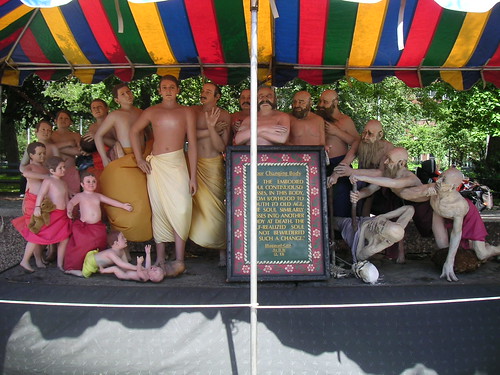 (Photo source: http://www.flickr.com/photos/mattyu_/165379358/)
Phenomenon of reincarnation still mystifies modern scientists
22.03.2005
Clinical death is one of the biggest mysteries that modern science still cannot solve
Some people say they remember their previous lives and can describe what they saw and did when they were having other bodies hundreds or thousands of years ago.
Vladimir Zatovka, head of the reanimation department in the Kaliningrad regional hospital revealed many astonishing facts about life and death when journalists interviewed him several years ago. The experienced doctor believes that clinical death is one of the biggest mysteries that modern science still cannot solve. Indeed, patients who revive after clinical death say they get some mysterious information and learn new things. Journalists were slightly shocked to hear the doctor saying the soul actually exists and lives its individual life.
One of the doctor's patients, Irina Lakoba was in coma for about a month after she seriously suffered in a traffic accident. She recovered from coma and turned out to be quite a different person. Before the accident, the woman worked as an engineer at a large fish company for twenty years. But when she regained consciousness after the coma, the woman said she saw herself being a little girl standing on the bank of some south river and even began speaking some strange language. Experts from the philology department of the Kaliningrad University stated that was one of Swahili dialects. Later, the woman began composing verses in this dialect and even translated them into Russian, English and French, the languages that she had never learnt before the accident.
Shortly before Irina recovered from coma, the doctor talked to her husband. They met in a room two floors above the ward where the patient stayed. But when the woman recovered, she told precisely what both men were talking about during that meeting. What is more, she described things which she could not see and hear when she was in coma. She said she had seen and heard everything because she could walk about the hospital. At that, she said she was watching her body staying in bed and was shocked to see it was old and ugly. She said she was a little healthy girl while walking about the hospital.
This is real reincarnation, the doctor says. Followers of esoteric doctrines, Hinduists and Buddhists never hesitate that there is no death at all; they believe the soul reincarnates endlessly. But people brought up according to the Orthodox traditions and scientific atheism can hardly believe it is so. It was a couple of decades ago that reincarnation was considered a myth, but now it is forming a scientific conception that is winning an increasing number of supporters.
It took American reanimatologist Raymond Moody thirty years within which he wrote several books about the after-life phenomenon before he managed to convince majority of his readers that cardiac arrest and cessation of brain activity do not mean the end. Those patients who revived from the dead told the doctor similar stories about the light they saw at the end of a long tunnel, about dead relatives who came to tell about new life coming and about a better world. Moody and his followers collected thousands of evidence of this sort; all stories told by patients coincide in every particular detail, which means these stories cannot be a forgery.
The conclusions made by Moody give people some hope for immortality; but at the same time they have already won lots of opponents. Famous psychiatrist Stanislav Grof is the most competent critic of Moody's conclusions. He conducted experiments with those patients who revived after clinical death. During the experiment, Stanislav Grof arrived at a conclusion that the tunnel many people see during their clinical death is in fact an impression of a baby going through the long and narrow birth canal. Thus, the bright light they see at the end of the tunnel is in fact an obstetrics ward where babies are delivered. As it turned out, even people who never went through clinical death see the same tunnel when put under hypnosis.
Other opponents to Moody, physician Paul Kurtz, physiologist Jack Kowan and neurobiologist Elizabeth Clark state that the vision of a tunnel is produced with those parts of the dying cerebral cortex that controls vision. This happens because of oxygen deficit in dying cells; as a result, stimulation waves form concentric circles. We can see such circles after we dive and stay under water too long or hang with the head down. The dying consciousness sees the circles as forming a tunnel. Materialist researchers are sure that all the rest are fancies and dreams that people have in an unconscious state.
However, even these experts cannot explain why even patients whose brain no longer functions still see the tunnel, the bright light and dead relatives. Russian neurophysiologist Natalya Bekhtereva wrote about the thought and its origin in her works. She said that human brain is the greatest mystery, and it will take incredibly much time before scientists study it.
The lack of oxygen in tissues and organs is not the reason why people experiencing clinical death see their bodies lifeless on an operating table or in a reanimation ward and hear what doctors or other patients say.
Researcher from Holland Van Lommel studied the phenomenon while working with patients and arrived at a conclusion that dying people see visions at the moment when their central nervous system cuts off. This in its turn proves that consciousness is not a brain function. Doctors verified clinical death of one of Lommel's patients. A tube for mechanical ventilation of lungs was inserted into the patient's larynx. For that, the patient's denture was taken out. In an hour and a half, the man's heart started beating; in a week the patient came to his senses and asked to give him his denture. But doctors could not remember where they put the denture. Then, the patient said he saw where doctors had put the denture, as he was soaring above the body when the doctors were saving his life.
French woman Annel Besier living in Moscow says she can recollect her previous lives. She wrote a book about her previous reincarnations. Annel is sure that it is not necessary to die to experience reincarnation. The author does not remember the exact number of her reincarnations. According to the karma doctrine, each of us has had thousands of reincarnations, and our soul does not always reincarnate into the human body, it may also belong to an animal.
There are many people who remember their previous lives. Muscovite Olga Kuleshova, 37, knows perfectly well that before her birth 37 years ago she was a violinist living in England (she has partially retained the skills although she never learnt to play the violin). Before that, she served in the house of a rich magnate in India. Olga says that 200 years ago she was a concubine of a Turkish sultan and also that in Medieval Italy Michelangelo was her tutor in painting. Indeed, Olga can draw resembling the Michelangelo style and speaks the old Italian language (she says she never learnt the language). May this be true? There is no opportunity to verify this.
Academician with the Russian Academy of Sciences Vlail Kaznacheyev says the reincarnation phenomenon is undoubted, as it has been given much confirmation. However, none of the hypotheses currently existing as concerning the issue can actually explain the phenomenon. Unfortunately, there is no scientific theory of reincarnation.
But is not it better to be unaware of what is going to happen after we die? Nothing, immortality or endless reincarnation? Each of us hopes there is no end to life, but we never think that this eternity may be even worse than death. Academician Kaznacheyev is sure that life we are having now and here is the only undoubted wonder.
Natalia Leskova
(Article source: http://english.pravda.ru/science/19/94/377/15151_reincarnation.html)
--------------------------------------
This is a nice contribution, I want to share my reflections and experiences too!
++++++++++++++++++
Technorati: Buddhism Buddha Buddhist Dharma Compassion Wisdom Religion afterlife Zen Philosophy Spirituality Inspiration Peace rebirth reincarnation
Saturday, November 25, 2006
Buddhism and Science - Ajahn Brahmavamso
 (Picture source: http://www.flickr.com/photos/93996572@N00/63719196/)
BUDDHISM AND SCIENCE
Meditation Timer
 I found this very interesting and maybe useful tool for meditation. I normally use my mobile phone as a timer, but at times I receive sms or phone calls and I get distracted. So maybe this is more helpful.
Meditation Timer (Taken from www.audiodharma.org. Please give donation support to this splendid Dharma website if you can. It hosts a huge collection of audio Dharma talks all for free.)
These audio files consist of various lengths of silence as an aid to meditation practice. A bell is rung once at the start and three times at the end.
You may download these files or listen to them in streaming audio.
- 15 minutes [Download] [Play]
- 20 minutes [Download] [Play]
- 30 minutes [Download] [Play]
- 40 minutes [Download] [Play]
- 45 minutes [Download] [Play]
- 60 minutes [Download] [Play]
~End of post~
--------------------------------------
This is a nice contribution, I want to share my reflections and experiences too!
++++++++++++++++++
Technorati: Buddhism Buddha Buddhist Dharma Compassion Wisdom Religion Meditation Zen Philosophy Spirituality Inspiration Peace Insight
Friday, November 24, 2006
Buddha's Words on Metta (Loving-kindness) Meditation and its Benefits

There are plenty of instructions by meditation teachers about how to practise Metta (loving-kindness) meditation. But what are the actual words of Buddha on it?
I have posted here two scriptures on Metta meditation and its benefits spoken by the Buddha. The two suttas are Karaniya Metta Sutta (Good Will) & Metta (Mettanisamsa) Sutta (Discourse on Advantages of Loving-kindness).
In addition, you can find the chant of the Karaniya Metta Sutta in the ancient Pali language in which Buddha's words was recorded. I personally find that softly playing the chant continuously gives me a calm, nice feeling. There is also an audio instruction mp3 which you can listen and follow to practise on your own.
~UnawakenOne~
Karaniya Metta Sutta
Good Will
Translated from the Pali by
Thanissaro Bhikkhu
This is to be done by one skilled in aims
who wants to break through to the state of peace:
Be capable, upright, & straightforward,
easy to instruct, gentle, & not conceited,
content & easy to support,
with few duties, living lightly,
with peaceful faculties, masterful,
modest, & no greed for supporters.
Do not do the slightest thing
that the wise would later censure.
Think: Happy, at rest,
may all beings be happy at heart.
Whatever beings there may be,
weak or strong, without exception,
long, large,
middling, short,
subtle, blatant,
seen & unseen,
near & far,
born & seeking birth:
May all beings be happy at heart.
Let no one deceive another
or despise anyone anywhere,
or through anger or irritation
wish for another to suffer.
As a mother would risk her life
to protect her child, her only child,
even so should one cultivate a limitless heart
with regard to all beings.
With good will for the entire cosmos,
cultivate a limitless heart:
Above, below, & all around,
unobstructed, without enmity or hate.
Whether standing, walking,
sitting, or lying down,
as long as one is alert,
one should be resolved on this mindfulness.
This is called a sublime abiding
here & now.
Not taken with views,
but virtuous & consummate in vision,
having subdued desire for sensual pleasures,
one never again
will lie in the womb.
(Text source: http://www.accesstoinsight.org/tipitaka/kn/snp/snp.1.08.than.html)
Metta (Mettanisamsa) Sutta
Discourse on Advantages of Loving-kindness
Translated from the Pali by
Piyadassi Thera
Thus have I heard:
On one occasion the Blessed One was living near Savatthi at Jetavana at Anathapindika's monastery. Then he addressed the monks saying, "Monks." — "Venerable Sir," said the monks, by way of reply. The Blessed One then spoke as follows:
"Monks, eleven advantages are to be expected from the release (deliverance) of heart by familiarizing oneself with thoughts of loving-kindness (metta), by the cultivation of loving-kindness, by constantly increasing these thoughts, by regarding loving-kindness as a vehicle (of expression), and also as something to be treasured, by living in conformity with these thoughts, by putting these ideas into practice, and by establishing them. What are the eleven?
1. "He sleeps in comfort. 2. He awakes in comfort. 3. He sees no evil dreams. 4. He is dear to human beings. 5. He is dear to non-human beings. 6. Devas (gods) protect him. 7. Fire, poison, and sword cannot touch him. 8. His mind can concentrate quickly. 9. His countenance is serene. 10. He dies without being confused in mind. 11. If he fails to attain arahantship (the highest sanctity) here and now, he will be reborn in the brahma-world.
"These eleven advantages, monks, are to be expected from the release of heart by familiarizing oneself with thoughts of loving-kindness, by cultivation of loving-kindness, by constantly increasing these thoughts, by regarding loving-kindness as a vehicle (of expression), and also as something to be treasured, by living in conformity with these thoughts, by putting these ideas into practice and by establishing them."
So said the Blessed One. Those monks rejoiced at the words of the Blessed One.
(Text source: http://www.accesstoinsight.org/tipitaka/an/an11/an11.016.piya.html)
Metta Goodies
Taken from www.audiodharma.org/
--------------------------------------
This is a nice contribution, I want to share my reflections and experiences too!
++++++++++++++++++
Technorati: Buddhism Buddha Buddhist Dharma Compassion Wisdom Religion Meditation Zen Philosophy Spirituality Inspiration Peace Insight metta
Loving-Kindness Meditation for Chronic Low Back Pain - Results From a Pilot Study

 Loving-Kindness Meditation for Chronic Low Back Pain
Results From a Pilot Trial
Purpose: Loving-kindness meditation has been used for centuries in the Buddhist tradition to develop love and transform anger into compassion.
This pilot study tested an 8-week loving-kindness program for chronic low back pain patients.
Method: Patients (N = 43) were randomly assigned to the intervention or standard care. Standardized measures assessed patients’ pain, anger, and psychological distress.
Findings: Post and follow-up analyses showed significant improvements in pain and psychological distress in the loving-kindness group, but no changes in the usual care group. Multilevel analyses of daily data showed that more loving-kindness practice on a given day was related to lower pain that day and lower anger the next day.
Conclusions: Preliminary results suggest that the loving-kindness program can be beneficial in reducing pain, anger, and psychological distress in patients with persistent low back pain.
Implications: Clinicians may find loving-kindness meditation helpful in the treatment of patients with persistent pain.
Keywords: meditation; chronic low back pain; pain; anger; psychological distress
JOURNAL OF HOLISTIC NURSING, Vol. 23 No. 3, September 2005 287-304
DOI: 10.1177/0898010105277651
© 2005 American Holistic Nurses’ Association
Download the full study text in PDF
~End of post~
--------------------------------------
This is a nice contribution, I want to share my reflections and experiences too!
++++++++++++++++++
Technorati: Buddhism Buddha Buddhist Dharma Compassion Wisdom Religion Meditation Zen Philosophy Spirituality Inspiration Peace Insight metta loving kindness backache
Mind your own business
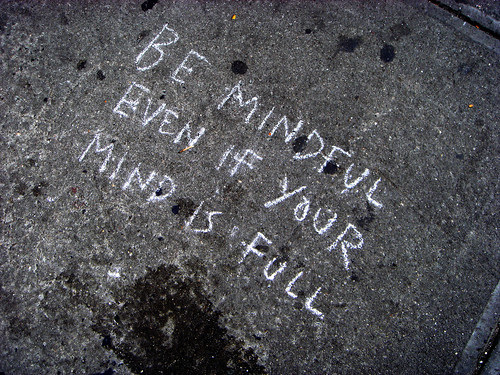 Mind your own business
(Article source: www.theage.com.au)
Megan Gressor
November 24, 2006
Concentrate on every little action to reduce racing thoughts and stress.
It is said to boost performance and wellbeing, decrease anxiety, depression and chronic fatigue, and have beneficial effects on conditions ranging from chronic pain and fibromyalgia to psoriasis, multiple sclerosis and even cancer. But it's not a futuristic wonder drug - it's an ancient Buddhist discipline gaining increased acceptance in mainstream medicine.
It is mindfulness meditation, also known as "insight meditation". Its foremost proponent is Jon Kabat-Zinn, who is visiting Australia this month. Professor Emeritus at the University of Massachusetts Medical School, where he founded the Centre for Mindfulness in Medicine, Health Care and Society, Kabat-Zinn has researched mind-body interactions for more than 25 years, focusing on the applications of meditation in the treatment of stress-related disorders.
He developed the Mindfulness-Based Stress Reduction program now used in settings as varied as schools, corporations and prisons in the US and hospitals worldwide.
Meditation may sound like an alternative practice to some, but there is hard science to back up its effects. It is the subject of increasing studies by other researchers, including Dr Belinda Khong, a practising psychologist with a special interest in the integration of Buddhist psychology and western psychotherapy. With her colleague Dr Andrew Baillie, Khong has launched a research interest group at Macquarie University's Department of Psychology.
"Our idea is to provide a resource and dialogue for everyone working in this area, not just at Macquarie," she says. "I'm interested in how people use mindfulness in their daily lives [not just in the treatment of disease]. We have enough research to know that it helps performance and wellbeing. I want to know how it helps. Is it just stress reduction or something else?"
Meditation mainly affects stress responses. The theory goes that by mediating the stress response you can affect the course of stress-related diseases.
People react to stress differently, depending on their frame of mind. Some continually ruminate or stew over issues, as is common in depression and anxiety. This adds to stress levels. If that cycle can be broken, stress will be reduced.
With mindfulness, instead of reacting to thoughts, emotions and sensations such as pain, the aim is to observe them objectively as they come and go, aware that they are continually changing and will pass.
"Say, for example, you experience anger. You see it come up so you label it: you say, 'There is anger; if I make space for it, if I don't get attached to it, the feeling of anger will dissipate,' " Khong says.
She uses mindfulness as one of a range of approaches in her practice. "If, however, you ruminate over it - thinking, 'Why am I angry, I don't want to be angry, I must be a worthless person' - you get more stressed." There is a difference between mindfulness and relaxation meditation, which involves concentrating on one thing - a mantra, for example, or one's own breathing. Mindfulness doesn't attempt to still the mind but to observe it, continuously monitoring one's mental processes and physical sensations.
Contrary to the stereotypes of meditation requiring sitting in the lotus position for hours, it can be performed any way at any time. "If you want to stand up or walk around and meditate, it's fine, because it's more about tuning into everyday experience," says clinical psychologist Dolores Foley. "It could be as simple as noticing the feelings of your feet on the floor when you jump in a lift, or the sounds around you, so the details of life become more acute."
The effects can be akin to an epiphany, according to Foley, who has meditated daily for more than a decade. "As a student I did an intensive retreat, meditating for 11 hours a day for 10 days. By the end, my mind was quite still, instead of the usual constant stream of background mental chatter," she says. "The big thing I noticed was the intensity of my emotions had decreased, so that if I got upset about something, I wouldn't stay annoyed for so long."
Foley describes the process as being more engaged but less reactive. "You realise there is a different way of looking at things, you can disengage and not get lost in your emotions," she says. "The reduction in reactivity is the key - allowing space to see your experience more accurately and respond more thoughtfully." Foley, a research fellow at Royal Prince Alfred's Sydney Cancer Centre, is studying the effects of mindfulness training on cancer patients. She has also used it in treating drug and alcohol problems. "Cravings for drugs and alcohol come in waves, so it's helping individuals to notice those waves and ride them rather than using [drugs], and step outside those unhelpful patterns."
Meditation practice can take various forms, such as a body scan (moving the attention around the body from head to toes), aiming to bring the awareness into the present moment. This is important, according to its proponents, because many of us function on automatic pilot, our thoughts flitting between the past and the future. That makes it hard to pay attention to what we are doing now.
Another mindfulness exercise involves taking a single raisin, studying it, smelling it, feeling it, rolling it around the mouth and finally eating it. The process should take minutes to complete.
It sounds simple, but it can have profound effects. Binge eaters, for example, often bolt down huge amounts of food without noticing the taste. In a study of binge eaters given mindfulness meditation training, Dr Jean Kristeller, professor of Psychology at Indiana State University, found they lost weight and reduced diabetic symptoms by learning to savour the moment.
Meditation is also used in treatment for borderline personality disorder - a condition marked by extreme emotional instability - and has been found to halve the risk of recurrence of depression, according to a study by Professor Mark Williams when he was at the University of North Wales. As a treatment for depression, it works with cognitive behavioural therapy, a structured therapy that involves learning to challenge habitual negative thoughts and reframe them in more positive terms. Both techniques require monitoring one's thinking, albeit in different ways. Beyondblue, the national depression initiative, is trialling a combination of the two approaches.
All this without prescriptions or side-effects. It costs nothing; all that's needed is commitment, perseverance and regular practice. As Khong says: "Mindfulness isn't magic, it's just giving yourself a quiet place to reflect on your thoughts and behaviour."
An anchor in your awareness
Youth worker David Harvey, 44, undertook mindfulness meditation training earlier this year to improve his professional and personal performance.
"I wanted to be able to take on more in my work, parenting, family relationships - my performance overall - and be able to enjoy it in a sustainable way," he says.
"Now I meditate for about 30 to 45 minutes every morning and enjoy it. At one level it's about noticing your thoughts. By monitoring that awareness you start to have more control over your feelings. It's like an anchor in your awareness; it brings you back to your experience of what's going on rather than reacting to it. "I'm a lot more energetic - now I'm getting up between 5.30am and 6.30am and I'm really awake - and have more satisfaction with what I'm doing. I'd recommend it for people interested not just in getting through life, but in getting more out of those little moments that make up life."
Calling cancer patients
Clinical psychologist Dolores Foley is seeking 80 participants for a NSW Cancer Institute-funded study of the effects of mindfulness on cancer patients and carers.
"At this time of great stress, many find themselves lost in concerns about the past or worries about the future so the here-and-now orientation of mindfulness is particularly useful," Foley says. "Mindfulness training has been shown to reduce tension, depression and anger in cancer patients, while improving concentration, sleep and quality of life."
The study involves a combination of mindfulness meditation and cognitive therapy training for 45 minutes daily over eight weeks. Training is free. Contact Foley on 9515 7937 or email dolores.foley@email.cs.nsw.gov.au
--------------------------------------
This is a nice contribution, I want to share my reflections and experiences too!
++++++++++++++++++
Technorati: Buddhism Buddha Buddhist Dharma Compassion Wisdom Religion Meditation Zen Philosophy Spirituality Inspiration Peace Insight mindfulness cancer
